
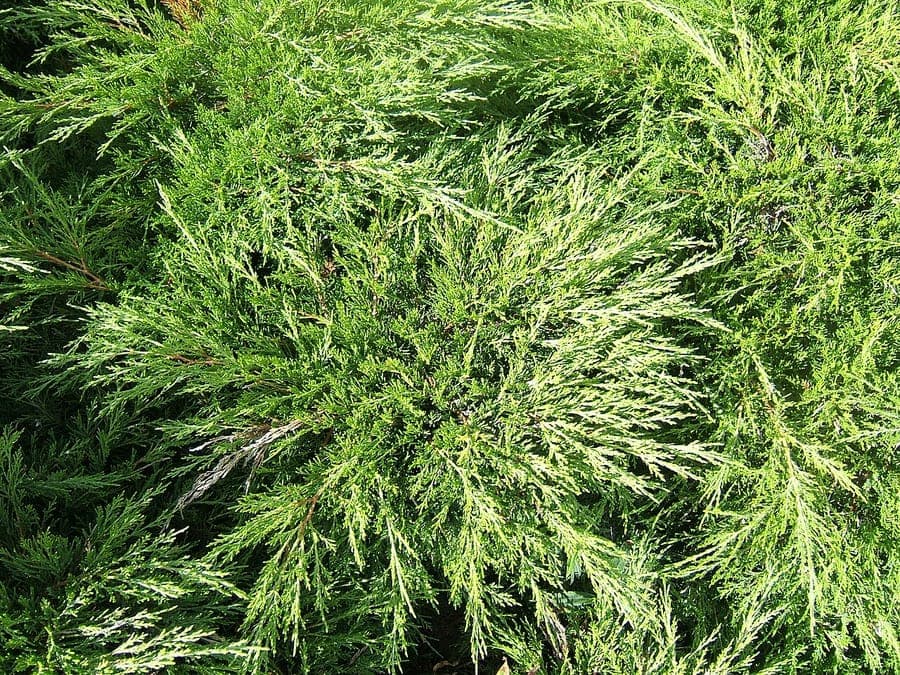
MPF / CC BY 2.5, via Wikimedia Commons
Savin: complete guide
Juniperus sabina
¿Quieres ver Savin: complete guide en tu jardín?
1 minuto, sin tarjeta de crédito
Overview
Savin (Juniperus sabina) is a low, spreading conifer native to European mountain ranges from Central Europe to South Europe (500-2500m elevation). The plant also grows wild from Korea to the Caucasus. In temperate gardens, savin is a rarity, yet highly prized among alpine enthusiasts.
The name "savin" comes from the French "savorin." Its distinctive scent - warm, spicy, slightly penetrating - earns it respect among knowledgeable gardeners who recognize this as a plant of character.
Appearance & growth habit
Savin grows horizontal and spreading, rarely exceeding 100-150 cm in height. Many cultivars remain low (30-60 cm). Foliage is small and scale-like, blue-green to green.
The plant is dioecious - male and female plants are separate. Female plants bear "berries" that are deep blue with a waxy bloom. These "berries" are actually scaled cones 10-15 mm across, resembling those of juniper.
Growth is extremely slow (5-8 cm annually) but remains exceptionally compact. After 20 years, a well-established plant reaches 1-1.5 m wide but only 30-50 cm tall.
Ideal location
Savin flourishes on sunny, warm, exceptionally well-drained sites. Ideal conditions are:
- Full sun (minimum 6 hours direct sun daily)
- Dry, well-drained locations
- Alpine troughs and raised beds
- South-facing aspects
- Windy sites are acceptable (less snow-smothering risk)
Shade is unsuitable - foliage becomes sparse and the plant loses character.
Soil requirements
Savin is extraordinarily tolerant. It thrives even on poor, very well-drained soils. Sand, gravel, and silt-rich soils are all suitable. Strongly acidic soil (pH < 5.5) is not optimal but still acceptable.
Key requirement: drainage. Waterlogging is fatal. Add sand and gravel to heavy clay. In containers, use Alpine Grit Mix.
Watering
Once established, savin has very modest moisture needs. In rainy climates, plants may suffer waterlogging - improve drainage with gravel channels in very wet seasons.
During the first year after planting, water more regularly (every two weeks). Thereafter, water only during dry, hot spells.
Diseño gratis
¿Quieres ver Savin: complete guide en tu jardín? Crea un diseño gratis ahora.
Pruning
Pruning is unnecessary. Savin grows compact and naturally assumes attractive forms. If shaping is desired, prune only in May/June after new growth emerges, and very conservatively.
Remove only dead branches.
Maintenance calendar
- April-May: Plant container stock
- June-August: Minimal special attention required
- September-October: Enjoy blue fruits (on female plants)
- November-March: Winter dormancy; no maintenance needed
Winter hardiness & form
Savin is bulletproof: hardy to -20°C and below. In temperate regions, no winter protection is necessary.
In areas with heavy snowfall (50+ cm annually), snow load may damage branches. In such regions, protect the plant gently with burlap wrapping in December-January.
Companion plants
Savin harmonizes beautifully with:
- Other alpine conifers: Juniperus communis 'Compressa', Chamaecyparis obtusa 'Nana Gracilis'
- Alpine ground covers: Saxifraga, Sempervivum, Delosperma
- Rock garden plants: Dianthus alpinus, Armeria maritima, Silene
- Dark stone chippings between plantings (for contrast)
The blue-grey tone of savin contrasts beautifully with buff-colored stone in alpine gardens.
Closing thoughts
Savin is for patient gardeners with sunny, dry sites. This is not a plant for quick gratification but for 20-30 years of very low-maintenance beauty. Many Dutch retailers don't stock savin, but quality alpine nurseries in Germany and Belgium do carry it.
The distinctive scent matters: many gardeners choose savin precisely because of this warm, spicy-deep character. It's a plant for minimalists who understand that small, slow-growing plants teach patience and observation. Explore gardenworld.app to see how alpine planting schemes develop with minimum water - savin is the starring actor.
¿Quieres ver Savin: complete guide en tu jardín? Crea un diseño gratis ahora.
Sube una foto, elige un estilo y obtén un diseño fotorrealista con lista de plantas en menos de un minuto.
Más de 10.000 jardines diseñados
Sin tarjeta de crédito


Plantas similares
Cupressus macnabiana: complete guide
Cupressus macnabiana
The Fragrant Cypress offers elegant growth with fine, aromatic foliage. Perfect for temperate climates and as specimen trees in contemporary gardens.
Cupressus guadalupensis: complete guide
Cupressus guadalupensis
The Guadalupe cypress: an elegant conifer for gardens. Complete cultivation guide for this Mexican cypress. Information about care, location, form and maintenance.
Austrocedrus chilensis: complete guide
Austrocedrus chilensis
Discover Austrocedrus chilensis, the Chilean Cedar ornamental conifer. Elegant specimen with fine foliage and columnar form for permanent structure.