
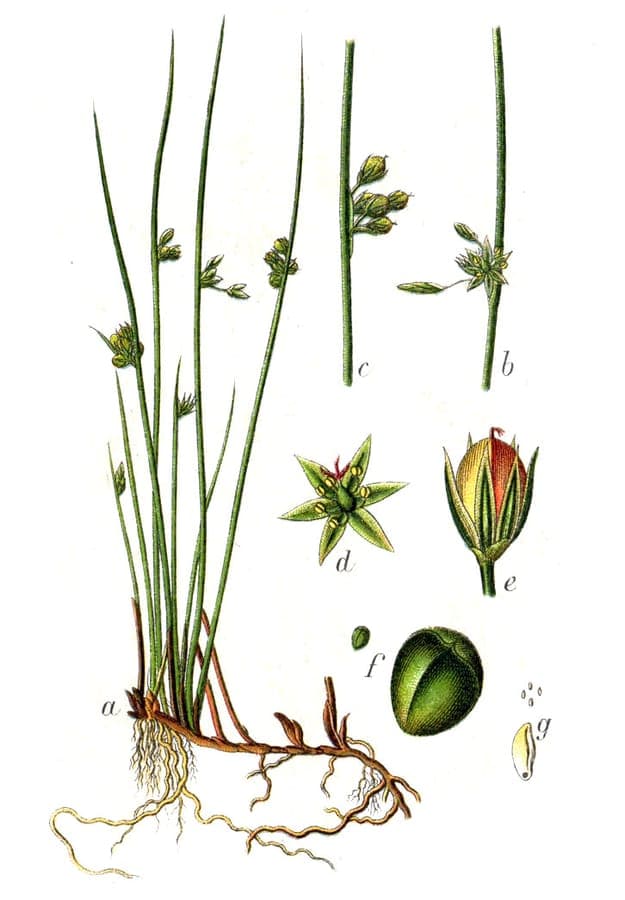
Johann Georg Sturm (Painter: Jacob Sturm) / Public domain, via Wikimedia Commons
Thread rush: complete guide
Juncus filiformis
¿Quieres ver Thread rush: complete guide en tu jardín?
1 minuto, sin tarjeta de crédito
Overview
Juncus filiformis, commonly known as thread rush, is an elegant, fine-leaved plant from the Juncaceae family, native to temperate regions of the northern hemisphere. Its range extends from Europe to North America, where it naturally inhabits marshes, wet grasslands, and boggy areas. The name refers to its characteristically thread-like, extremely fine stems - a distinctive visual feature.
For British gardeners, thread rush is a subtle yet fascinating choice for wet corners, ponds, and waterside projects. With its light, silky texture, it brings refinement where heavier rushes offer robustness. On gardenworld.app, you can visualise how this plant provides visual lightness and sophistication in water garden designs.
Appearance & bloom cycle
Thread rush forms densely-clustered, extremely fine leafy stems reaching 20–60 centimetres long, with an almost hair-fine texture. Stems are glossy green, becoming slightly yellow-green in full sun. They grow upright yet gently curved, creating an elegant, billowing appearance.
Flowering occurs May to July. Flowers are tiny and inconspicuous, appearing in small, brownish clusters at stem tips. The flowering stage is subtle but valuable for insects. After blooming, minute seeds develop in capsules - bird food in waiting.
Ideal location: wet soil, waterside, marsh
Thread rush grows best in full sun to half-shade - 4–6 hours of direct daily light is ideal. In deep shade, plants become sparse and thin.
Moisture-loving terrain is essential. Place it along pond edges, in marshes, on wet grassland, or in wet borders. This isn't a drought-tolerant species. A permanently moist environment is its preference. In design terms, this is a plant that stabilises and beautifies wet ecosystems.
Soil requirements
Thread rush thrives in wet to very wet soil, preferably sandy loam or peaty substrates. pH can range from acidic to neutral (5.5–7.0). Standing water and periodic flooding aren't problems - quite the opposite.
Ideal soil characteristics: moderate to high organic matter, consistent moisture availability, and adequate oxygen in open water. Adding peat substitute or compost helps.
Diseño gratis
¿Quieres ver Thread rush: complete guide en tu jardín? Crea un diseño gratis ahora.
Watering
This is a moisture-loving plant that ideally should grow in water or very wet soil. Plant it preferably in or very close to water surfaces. Young plants away from water need daily irrigation during their growing season - roughly 2 litres daily.
For optimal placement: directly in shallow ponds, in marshy areas, or in richly moistured soil. Standing water poses no problem as long as oxygen circulation exists.
Pruning
Pruning is rarely needed. Thread rush maintains a natural form without becoming unwieldy. In spring, remove dead or yellowed stems, or in autumn cut back old growth to about 5–10 centimetres above ground.
Use sharp, sterilised secateurs. Otherwise, leave the plant largely untended - its natural form is its charm.
Maintenance calendar
- January: check soil moisture
- February: light cleanup of dead material
- March: water young plants if dry
- April: increase watering as growth resumes
- May: first flowering observed
- June: flowering period continues
- July: end of bloom, watch for seed set
- August: leave seed heads for wildlife
- September: remove seed heads if desired
- October: cut back old stems
- November: verify soil moisture before winter
- December: let natural snow cover protect
Winter hardiness
Thread rush is hardy to USDA zone 3 - perfectly suited to UK gardens and beyond. Temperatures down to -30°C cause no problems. In severe winters, above-ground growth may die back, but roots survive and produce fresh shoots in spring.
Ensure soil is well-moistured in November. Snow provides natural insulation.
Companion plants
Combine with other delicate moisture-loving plants: water mint (Mentha aquatica), hemp agrimony (Eupatorium), marsh marigold (Caltha palustris), and other delicate aquatic species.
Also beautiful with lower-growing plants like foamflowers (Tiarella) and ferns.
Closing
Thread rush is a refined plant for gardeners who value subtlety and nature. It brings fine texture to marshy areas and ecologically stabilises wetland zones. A plant for sophisticated water garden designs.
Find it at specialist nurseries and larger garden centres, particularly in aquatic plant sections. Choose healthy, well-rooted specimens. On gardenworld.app, design water gardens where thread rush provides visual refinement and natural beauty.
¿Quieres ver Thread rush: complete guide en tu jardín? Crea un diseño gratis ahora.
Sube una foto, elige un estilo y obtén un diseño fotorrealista con lista de plantas en menos de un minuto.
Más de 10.000 jardines diseñados
Sin tarjeta de crédito


Plantas similares
Short-fruited Rush (Juncus brachycarpus): complete guide
Juncus brachycarpus
Complete guide to Juncus brachycarpus: wet soil, pond margins, bloom season, division and winter care for this North American rush in garden ponds.
Smallhead rush: complete guide
Juncus brachycephalus
Smallhead rush (Juncus brachycephalus) - a slender North American wetland plant for pond margins and boggy garden zones. Full care guide.
Mertens' rush: complete guide
Juncus mertensianus
Mertens' rush (Juncus mertensianus) - a compact alpine wetland plant with purple-brown flower heads for cool pond margins. Full growing guide.