
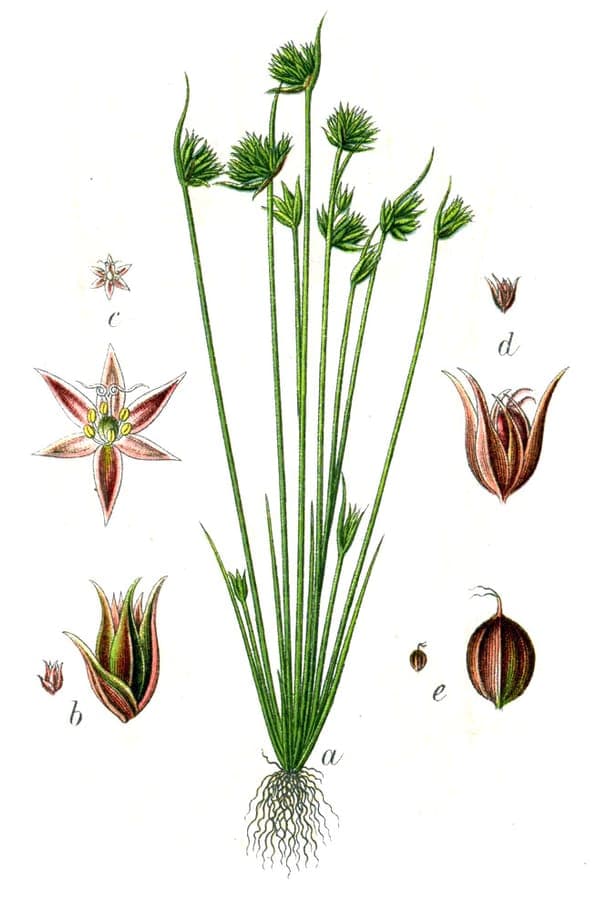
Johann Georg Sturm (Painter: Jacob Sturm) / Public domain, via Wikimedia Commons
Leafybract dwarf rush: complete guide
Juncus capitatus
¿Quieres ver Leafybract dwarf rush: complete guide en tu jardín?
1 minuto, sin tarjeta de crédito
Overview
Leafybract dwarf rush, Juncus capitatus, is a charming miniature that reaches just 5–10 cm tall. This tiny member of the Juncaceae family is naturally distributed across Europe to Kazakhstan, the Mediterranean, and parts of Africa. Named for its distinctive head-shaped flower clusters, it's utterly unique among rushes. This is a plant for specialists and collectors - not for broad landscape applications, but for specific niches where moisture control and space constraint converge.
On gardenworld.app, you can create detail designs where this diminutive rush truly shines.
Appearance & bloom cycle
The plant rarely exceeds 10 cm in height. Fine, dark green stems are extremely narrow, forming a compact, almost moss-like carpet. Flowering is the highlight - tiny, head-shaped inflorescences on very short stalks, blooming July through September. The bracts are subtle but characteristic of the genus.
Its dwarf stature and compact form make it a plant for collectors and microlandscape enthusiasts.
Ideal location
This miniature loves open, sunny spots in moisture-rich environments. Site it along damp patches in lowlands, at seasonal water margins, and in constructed wet zones. Full sun to half-shade, though full sun is optimal.
Avoid dry spots - this is a genuine moisture-lover.
Diseño gratis
¿Quieres ver Leafybract dwarf rush: complete guide en tu jardín? Crea un diseño gratis ahora.
Soil
Slightly acidic to neutral, moist soil is essential. Soil type matters far less than moisture consistency - as long as it stays regularly wet, it thrives. No need for rich fertility; simple natural soil suffices.
Watering
Maintain constant moisture without standing water. In wet climates like the UK, seasonal wetness usually suffices. During dry spells, monitor closely and spray if necessary.
Pruning
No pruning needed. Remove dead matter in spring.
Maintenance calendar
- Jan-Apr: Preparation; minimal growth
- May-Jun: Growth begins
- Jul-Sep: Full growth and flowering; water levels critical
- Oct-Dec: Senescence and dormancy
Winter hardiness
Completely hardy, USDA zones 5–9.
Companion plants
Pair with other miniature moisture-loving plants. On gardenworld.app, design specialised microhabitats.
Closing
Leafybract dwarf rush is for plant collectors and gardeners who delight in minute details. Not for broad application, but a strong voice in microlandscape design. Source it from specialist water-plant nurseries. This is pure plant-collecting passion.
¿Quieres ver Leafybract dwarf rush: complete guide en tu jardín? Crea un diseño gratis ahora.
Sube una foto, elige un estilo y obtén un diseño fotorrealista con lista de plantas en menos de un minuto.
Más de 10.000 jardines diseñados
Sin tarjeta de crédito


Plantas similares
Short-fruited Rush (Juncus brachycarpus): complete guide
Juncus brachycarpus
Complete guide to Juncus brachycarpus: wet soil, pond margins, bloom season, division and winter care for this North American rush in garden ponds.
Smallhead rush: complete guide
Juncus brachycephalus
Smallhead rush (Juncus brachycephalus) - a slender North American wetland plant for pond margins and boggy garden zones. Full care guide.
Mertens' rush: complete guide
Juncus mertensianus
Mertens' rush (Juncus mertensianus) - a compact alpine wetland plant with purple-brown flower heads for cool pond margins. Full growing guide.