
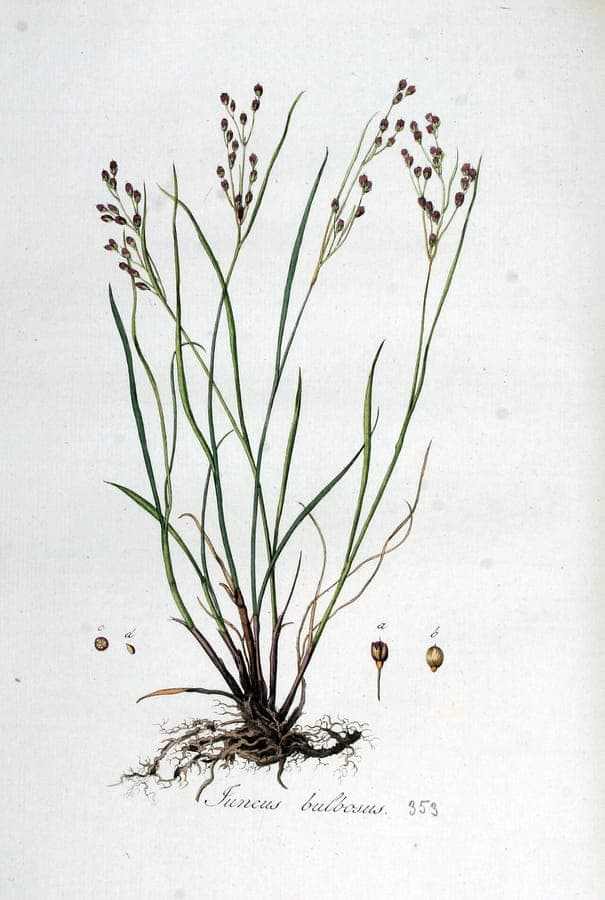
Jan Kops / Public domain, via Wikimedia Commons
Bulbous rush: complete guide
Juncus bulbosus
¿Quieres ver Bulbous rush: complete guide en tu jardín?
1 minuto, sin tarjeta de crédito
Overview
Bulbous rush, or Juncus bulbosus, is a remarkable plant naturally at home in wet, moisture-rich environments. This member of the Juncaceae family (rushes and sedges) is native to marshy grasslands, wetlands, and waterside habitats across Europe, North Africa, and Macaronesia. Its defining feature is the thick, bulbous tuber-like structure at the base of the rhizome - hence the name. It's exceptionally well-suited to water gardens, seasonal seep areas, and any landscape where moisture management is central.
On gardenworld.app, you can design water gardens around this robust plant, using its dark green colour and compact habit as a visual anchor along water edges.
Appearance & bloom cycle
Bulbous rush typically grows 15 to 35 cm tall. The stems are rigid, dark green, and cylindrical - lacking true leaves, which is typical of all Juncus species. Tiny brownish flower heads appear at stem tips from May to August. The most distinctive feature, however, is the underground bulbous swelling - the 'bulbosus' characteristic that gives the plant its common name.
These bulbous tubers function as storage organs, allowing the plant to survive seasonal drying. The plant is evergreen, retaining its green colour year-round.
Ideal location
Choose sites with full water or permanently moist ground. This rush belongs in wetlands, around pond margins, and in water gardens where depth ranges from 0 to 30 cm. It tolerates full sun to half-shade, though it performs best in full sun. In shadier spots, growth slows and compactness decreases.
Avoid dry summer sites - whilst its tubers grant some drought tolerance, the plant thrives in permanently moist to wet soil.
Soil requirements
This plant is remarkably indifferent to soil type as long as it remains moist to wet. Heavy clay, sand, loam mixed with water - all work. Waterlogged, slightly acidic to neutral soils (pH 5.0–7.5) support robust growth. In artificial water features, plant it directly in shallow water or place it in submerged baskets.
The tubers provide flexibility in moisture tolerance, but this is genuinely a plant for wet situations.
Diseño gratis
¿Quieres ver Bulbous rush: complete guide en tu jardín? Crea un diseño gratis ahora.
Watering
Watering is straightforward: plant in water or very moist soil and keep it that way. No supplemental watering needed in normal years. In constructed water features, monitor water levels regularly for stability. In rainy climates like the UK or Belgium, it thrives in damp spots with zero intervention.
Never intentionally dry it out - this significantly weakens the plant.
Pruning
Pruning is minimal. In spring (March), remove brown, dead stems from the previous year - this encourages fresh green growth and maintains neatness. More than that isn't needed; let the plant build its natural form. At the end of the growing season (October), cut back all dead above-ground parts to tidy up for winter.
Maintenance calendar
- Jan: Underground dormancy; no action required
- Feb: Growth resumes; check water levels
- Mar: Remove dead stems; monitor for growth
- Apr: Growth accelerates; inspect regularly
- May: Flowering begins; watch for insects
- Jun: Full growth; extremely vigorous
- Jul: Peak growth; water levels critical
- Aug: Flowering ends; monitor water
- Sep: Growth slows toward winter dormancy
- Oct: Cut back dead material
- Nov: Plant prepares for rest
- Dec: Winter rest; tubers conserve energy
Winter hardiness
Juncus bulbosus is fully hardy throughout the UK and temperate zones, USDA zones 5–9. Underground tubers survive even extreme winters. In severe freezes, above-ground growth may be damaged, but the plant regrows from tubers without issue.
No winter protection required - plant and forget about it.
Companion plants
Pair with other moisture-lovers: reed canary grass, kingcup, cowslip, and water mint. These combinations create natural water-garden ecology. Also excellent alongside water plants with contrasting forms, such as water lilies or ferns. On gardenworld.app, you can design a complete water-garden ecosystem.
Closing
Bulbous rush is an unassuming but powerful workhorse in water garden design. No fuss, no problems - pure functionality. Perfect for gardeners who want wetland plants without complication. Source it from specialist water-plant nurseries or garden centres with aquatic sections. Bulbous rush is your solution for perpetually wet spots.
¿Quieres ver Bulbous rush: complete guide en tu jardín? Crea un diseño gratis ahora.
Sube una foto, elige un estilo y obtén un diseño fotorrealista con lista de plantas en menos de un minuto.
Más de 10.000 jardines diseñados
Sin tarjeta de crédito


Plantas similares
Short-fruited Rush (Juncus brachycarpus): complete guide
Juncus brachycarpus
Complete guide to Juncus brachycarpus: wet soil, pond margins, bloom season, division and winter care for this North American rush in garden ponds.
Smallhead rush: complete guide
Juncus brachycephalus
Smallhead rush (Juncus brachycephalus) - a slender North American wetland plant for pond margins and boggy garden zones. Full care guide.
Mertens' rush: complete guide
Juncus mertensianus
Mertens' rush (Juncus mertensianus) - a compact alpine wetland plant with purple-brown flower heads for cool pond margins. Full growing guide.