
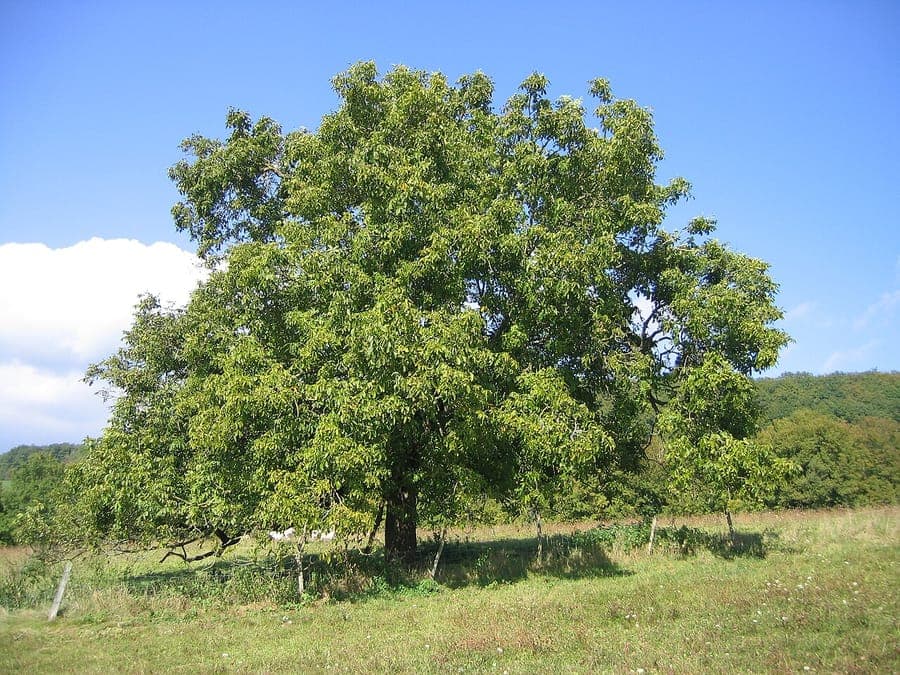
Thesupermat / CC BY-SA 3.0, via Wikimedia Commons
Common Walnut (Juglans regia): complete guide
Juglans regia
¿Quieres ver Common Walnut (Juglans regia): complete guide en tu jardín?
1 minuto, sin tarjeta de crédito
Overview
The Common Walnut, scientifically Juglans regia (also known as Persian Walnut), is a majestic tree native to regions from eastern Turkey through Lebanon to the western Himalayas. This fruit tree belongs to the Juglandaceae family and is renowned for its large, compound leaves, impressive canopy, and nutritious, delicious nuts it produces. Reaching heights of up to 25 meters and spreads of up to 20 meters, the Common Walnut forms a beautiful, majestic tree in the landscape. Unlike its American cousin (the Black Walnut), this tree produces no harmful juglone and is therefore better suited to mixed gardens. This makes Common Walnut an ideal choice for landscape planting throughout Europe. With gardenworld.app, you can create garden designs that perfectly integrate this fruit tree.
Appearance & Growth
Common Walnut grows as a powerful, wide-spreading tree with a broad, robust canopy. The trunk is upright and thick, with gray bark that darkens somewhat with age. The leaves are large and compound (30-60 cm long), with 5-9 small leaflets that are smooth and elongated. In spring, small, inconspicuous flowers appear; female flowers stand in upright clusters. Fruits appear in August and September: green, round to oval fruits 3-4 cm in diameter with a thin green shell. The nuts inside are smooth, nutritious, and delicious in flavor.
Ideal Location
Common Walnut thrives best in a sunny location receiving at least 6-8 hours of direct sunlight daily. The tree is very adaptive and grows on various soil types, but prefers well-drained, deep soil. Plant the tree in a large, open space far from houses and sewers, as its massive canopy requires considerable room. Protection from strong winds promotes better growth, though the tree is reasonably wind-resistant.
Soil & Drainage
Common Walnut performs best in deep, well-drained soil with a pH between 6.0 and 8.0 (slight preference for somewhat alkaline soil). The tree also grows in acidic soils but somewhat more slowly. Heavy clay soils should be improved with compost and sand. Ensure good drainage; waterlogging is harmful. Young trees benefit from mulching to retain soil moisture.
Diseño gratis
¿Quieres ver Common Walnut (Juglans regia): complete guide en tu jardín? Crea un diseño gratis ahora.
Watering
Once established (after 2-3 years), Common Walnut is highly drought-tolerant and requires minimal supplemental water. Young trees need more water, especially in the first year. Water regularly when the top soil layer feels dry. Mature trees are self-sufficient and thrive with natural rainfall alone in most years.
Pruning & Shaping
Common Walnut requires minimal pruning if allowed to grow naturally. During youth, you can remove dead branches and promote a single leader. Heavy pruning should not be done, as this tree recovers slowly from major wounds. Light pruning in autumn is possible.
Maintenance Calendar
January-March: Check for tree damage; light pruning of young specimens. April-May: Begin watering young trees. June-September: Water young trees during dry periods; provide support. October-December: Harvest nuts in October-November; leaf fall.
Winter Hardiness
Common Walnut is winter-hardy to USDA zone 6 (-23°C) and thrives in temperate climates throughout the Netherlands, Belgium, France, Germany, and southern regions. In very severe winters, light branch dieback may occur, but the tree recovers well.
Nut Harvesting
Nuts mature in October and November. Collect them when they fall to the ground, or gently shake branches. Remove the green outer husk (it stains; wear gloves). Then dry the nuts in a warm, dry place for 4-8 weeks. Crack the shell open with a nutcracker or carefully with a hammer. The white meat inside is nutritious, delicious, and rich in proteins and oils.
Advantages over Black Walnut
Common Walnut (Juglans regia) differs significantly from Black Walnut (Juglans nigra):
- No juglone toxicity (more suitable for gardens)
- Thinner nut shell (easier to crack)
- Better-tasting nuts
- Somewhat smaller size (better for temperate gardens)
- European origin (better adapted to European climate)
Companion Plants
Without the juglone toxicity of Black Walnut, you can pair Common Walnut with many garden plants. Fruit trees (apple, pear), flowers, herbs, and shade-loving plants under the canopy all work well. Ensure adequate space around the tree.
Final Thoughts
Common Walnut is a beautiful, practical choice for sustainable landscape planting. With its majestic growth, nutritious nuts, and absence of juglone toxicity, this tree offers the best of both worlds. With gardenworld.app, you can create garden designs using this valuable fruit tree as your centerpiece. A tree for generations.
¿Quieres ver Common Walnut (Juglans regia): complete guide en tu jardín? Crea un diseño gratis ahora.
Sube una foto, elige un estilo y obtén un diseño fotorrealista con lista de plantas en menos de un minuto.
Más de 10.000 jardines diseñados
Sin tarjeta de crédito


Plantas similares
Texas walnut: complete guide
Juglans microcarpa
Complete guide to Texas walnut (Juglans microcarpa): a small, drought-tolerant walnut tree for gardens. Location, soil, watering, and care advice.
Mockernut hickory: complete guide
Carya alba
Mockernut hickory is a majestic North American tree with ornamental and nut value. Learn everything about care, cultivation and ideal location.
Pecan Tree: complete guide
Carya illinoinensis
Majestic pecan tree producing delicious nuts. Explore this American native for shade-free growth and abundant harvests worldwide.