
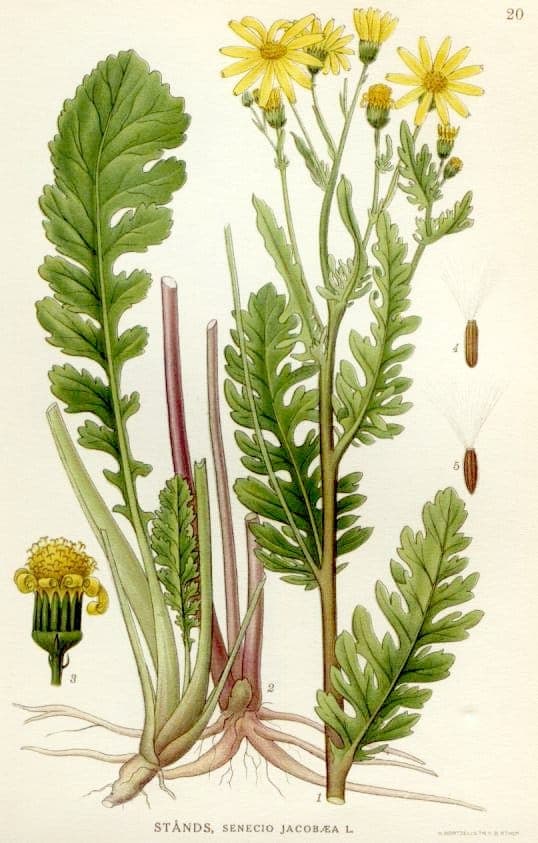
Carl Axel Magnus Lindman / Public domain, via Wikimedia Commons
Tansy Ragwort (Jacobaea vulgaris): complete guide
Jacobaea vulgaris
¿Quieres ver Tansy Ragwort (Jacobaea vulgaris): complete guide en tu jardín?
1 minuto, sin tarjeta de crédito
Overview
Tansy Ragwort, scientifically Jacobaea vulgaris (formerly Senecio jacobaea), is a biennial to perennial plant native to regions from Europe through Mongolia to the Caucasus. This plant is primarily recognized for its striking red and yellow flower clusters, but equally important is understanding its toxic properties and invasive tendencies in certain areas. It is crucial to comprehend this plant thoroughly before considering it for your garden. For safe, responsible garden planning with gardenworld.app, non-toxic alternatives are strongly recommended.
Appearance & Flowering
Tansy Ragwort forms a rosette of dark green, deeply lobed leaves in its first year, remaining basal at the plant's base. These leaves feature a distinctly wrinkled texture and can reach 20 cm in length. In the second year or beyond, the plant sends up flower stems reaching 50-150 cm tall. Flowers form in impressive, flat clusters (umbels) with hundreds of tiny red or yellow florets, blooming from June through September. The plant grows relatively compactly but can spread under favorable conditions.
Warning: Toxicity & Health Hazards
The primary reason for extreme caution with Tansy Ragwort is the presence of toxic alkaloids (especially senecionine) throughout all plant parts. These toxins can cause serious liver disease in animals and humans who consume the plant or have prolonged contact with large quantities. Horses and cattle are particularly susceptible. Seeding and propagation of this species is restricted or prohibited in many countries. Always consult local regulations before growing this plant.
Ideal Location
Tansy Ragwort grows in full sun to partial shade, preferring open sites receiving at least 4 hours of direct sunlight daily. The plant is highly adaptable, thriving even in adverse locations like marginal lands, grasslands, and disturbed areas. This survival ability makes it potentially invasive in natural habitats.
Soil & Drainage
The plant grows in virtually any soil - from heavy clay to sand - provided drainage is reasonable. Soil pH preference ranges from 5.5 to 7.5. It is extremely tolerant of nutrient-poor, degraded soils and even thrives in contaminated sites. This exceptional adaptability contributes to its invasive spreading potential.
Diseño gratis
¿Quieres ver Tansy Ragwort (Jacobaea vulgaris): complete guide en tu jardín? Crea un diseño gratis ahora.
Watering
Once established, Tansy Ragwort is drought-tolerant and requires minimal supplemental water. Young plants or seedlings need more moisture during their first months; thereafter, natural rainfall suffices in most seasons. During dry summers, occasional watering helps, though the plant survives without additional irrigation.
Pruning & Shaping
Pruning isn't essential, but remove diseased and damaged sections regularly. After flowering, you can remove spent flower clusters, though this isn't necessary. Preventing seed set is critical for containment - remove fading flower clusters before seed ripens.
Maintenance Calendar
January-March: Monitor for disease. April-May: Plant seeds or collect wild seed. June-September: Enjoy flowering; prevent seed set. October-December: Collect or destroy seeds (cautiously).
Winter Hardiness
Tansy Ragwort is winter-hardy to USDA zone 5 (-29°C) and thrives throughout the Netherlands, Belgium, and France. The plant easily survives mild winters and self-seeds readily under favorable conditions.
Legal & Ecological Warning
In many countries, actively cultivating Tansy Ragwort is restricted or prohibited due to its invasive tendency and toxic nature. The Netherlands and Belgium have strict regulations governing this species' propagation. Check local regulations; in many cases, existing populations must be removed. This species appears on unwanted species lists in nature conservation.
Safe Alternatives
For red flowers with similar visual appeal, choose safe alternatives such as red Lychnis, red Silene, red Phlox, or red Bee Balm. Gardenworld.app helps you design perfect, safe plant combinations without any risks.
Final Thoughts
While Tansy Ragwort is visually attractive with its red and yellow flowers, most modern horticultural practice advises against its cultivation due to health, environmental, and legal concerns. For a responsible, safe garden, choose non-toxic, non-invasive alternatives. Create your garden plan with gardenworld.app that is clean, safe, and legal - no compromises.
¿Quieres ver Tansy Ragwort (Jacobaea vulgaris): complete guide en tu jardín? Crea un diseño gratis ahora.
Sube una foto, elige un estilo y obtén un diseño fotorrealista con lista de plantas en menos de un minuto.
Más de 10.000 jardines diseñados
Sin tarjeta de crédito


Plantas similares
Calendula stellata: complete guide
Calendula stellata
Complete guide to Calendula stellata, the star-flowered marigold from Sicily: location, soil, watering and companion planting tips.
Korean chrysanthemum: complete guide
Chrysanthemum x rubellum
Chrysanthemum x rubellum is a hardy autumn perennial with single pink to copper flowers from August to November. Care and combinations.
Helianthus divaricatus: complete guide
Helianthus divaricatus
Helianthus divaricatus is a North American woodland sunflower with yellow summer blooms, ideal for naturalistic borders and shady edges.