
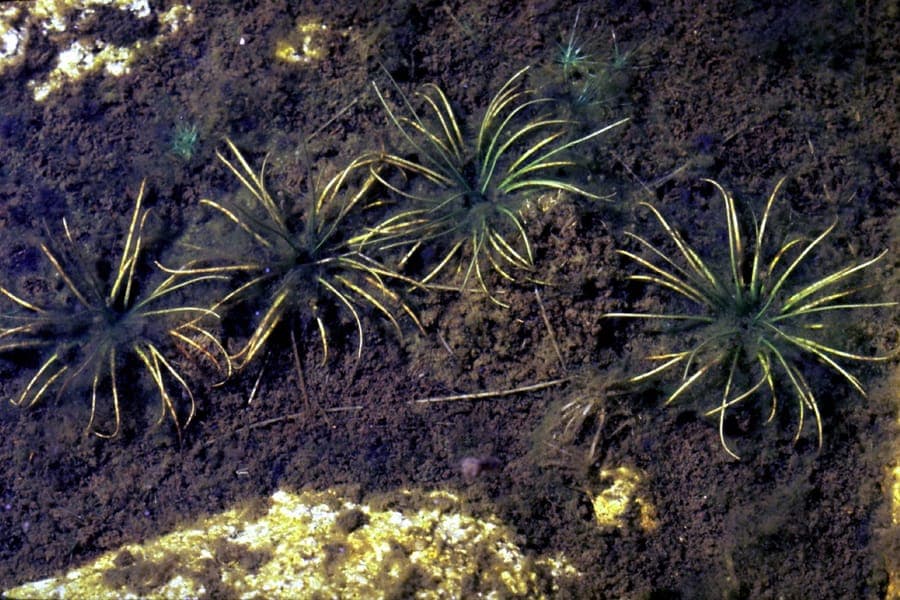
W. Carl Taylor. USDA NRCS. 1992. Western wetland flora: Field office guide to plant species. West Region, Sacramento. Courtesy of USDA NRCS Wetland Science Institute. / Public domain, via Wikimedia Commons
Spring quillwort: complete guide
Isoetes echinospora
¿Quieres ver Spring quillwort: complete guide en tu jardín?
1 minuto, sin tarjeta de crédito
Overview
The spring quillwort (Isoetes echinospora) is a remarkable submerged plant from the Isoetaceae family, representing an ancient lineage dating back 350+ million years to the Devonian period. This species thrives in nutrient-poor, acidic waters across temperate Europe and Siberia, typically found in deep oligotrophic lakes at depths up to 15 meters.
Appearance & Bloom
Spring quillwort grows as a diminutive rosette of needle-like leaves (3-10 cm long) radiating from a small base. Unlike flowering plants, this ancient species reproduces via sporangia (spore-producing organs) located at the leaf bases. These sporangia contain distinctive spiny spores, giving the plant its scientific name (echinospora means "spiny-spored"). Underwater, it appears as a delicate tuft of fine, grass-like fronds.
Ideal Location
This aquatic plant demands pristine, nutrient-poor water with a pH range of 5.5-6.5. It is extremely sensitive to pollution and eutrophication. Home aquaria and garden ponds are unsuitable habitats; however, it plays a crucial role in alpine and boreal lake ecosystems from Iceland to Siberia.
Soil & Substrate
In its natural habitat, spring quillwort anchors to sandy or silty sediment in ultra-oligotrophic lakes. For scientific study, sterile substrates (fine sand) combined with deionized or naturally soft water (pH 5.5-6.5) are essential.
Diseño gratis
¿Quieres ver Spring quillwort: complete guide en tu jardín? Crea un diseño gratis ahora.
Watering & Moisture
As a permanently submerged aquatic plant, continuous water exchange is vital. In the wild, it persists between 2-15 meters depth in well-oxygenated water. Stagnation leads to rapid decline.
Pruning & Maintenance
No intervention required. The plant grows slowly and maintains stable colony forms across decades without disturbance.
Maintenance Calendar
Spring: Dormancy phase. Summer: Potential spore maturation. Fall: Monitoring growth onset. Winter: Hibernation beneath ice.
Winter Hardiness
Extremely cold-hardy. It survives complete lake-freezing and is native to subarctic regions including Iceland, Scandinavia, and Russia.
Companion Plants
In alpine lakes, spring quillwort coexists with its congeners (I. lacustris, I. setacea in southern Europe), aquatic mosses (Sphagnum), and rare flowering aquatics like Lobelia dortmanna and sedges (Carex limosa).
Closing Remarks
Spring quillwort stands as a living fossil, an evolutionary relic from primordial aquatic ecosystems. Its survival depends entirely on pristine water quality and freedom from nutrient loading. While cultivation outside research labs is impractical, conservation of quillwort populations in European alpine lakes remains an ecological imperative. Visit gardenworld.app to learn how responsible garden water management supports broader freshwater conservation goals.
¿Quieres ver Spring quillwort: complete guide en tu jardín? Crea un diseño gratis ahora.
Sube una foto, elige un estilo y obtén un diseño fotorrealista con lista de plantas en menos de un minuto.
Más de 10.000 jardines diseñados
Sin tarjeta de crédito


Plantas similares
Lake quillwort: complete guide
Isoetes lacustris
Discover Isoetes lacustris, the deep-water quillwort of northern European and North American lakes. Cultivation and ecology.
Bristle-leaved quillwort: complete guide
Isoetes setacea
Explore Isoetes setacea, the Mediterranean quillwort found in southern European oligotrophic lakes from Spain to Morocco.