
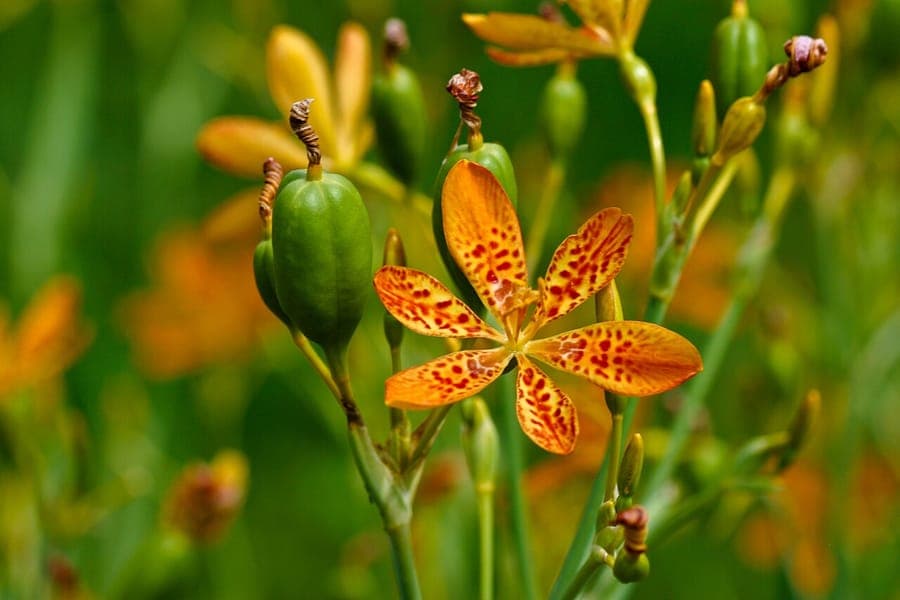
Tom Murphy VII / CC BY 2.5, via Wikimedia Commons
Iris domestica: complete guide to leopard flower
Iris domestica
¿Quieres ver Iris domestica: complete guide to leopard flower en tu jardín?
1 minuto, sin tarjeta de crédito
Overview
Iris domestica, also known as Leopard Flower, Belamcanda, and Blackberry Lily, is a fascinating flowering plant native from the Himalayas to Japan and the Philippines. This exotic iris was formally described in 2005 (though known for centuries) and embodies the beauty of Asian flowers. The plant is popular in perennial borders and natural gardens.
This is an easy-to-grow plant with spectacular speckled flowers and remarkable black seeds in autumn months. Iris domestica adds exotic color and structure to gardens.
Appearance and Bloom
Iris domestica distinguishes itself through its long, grass-like foliage and unique speckled flowers. The leaves are linear to lanceolate, green, and form a compact clump. The flowers are small to medium, about 4-5 cm wide, with an orange-red base color densely peppered with red or dark orange spots.
The flowers bloom sequentially for multiple weeks during summer. After the flowers fade, striking, greenish-brown seed pods form, splitting to reveal glossy black seeds. These black seed clusters provide dramatic autumn and winter interest.
Ideal Location
Iris domestica thrives best in locations with full sun to partial shade. In very warm regions, light afternoon shade can be beneficial. The plant is flexible and grows in diverse light conditions, though full sun encourages maximum flowering.
Use this iris in perennial borders, for structure in rock gardens, or in naturalistic plantings. The compact growth and interesting seed pods make it perfect for seasonal interest.
Soil
Iris domestica grows in diverse soils, as long as drainage is good. The plant prefers sandy-loam soils with good drainage. Avoid very heavy clay soils, which can cause waterlogging.
Ensure some organic matter in the soil when planting. Once established, the plant is very undemanding.
Diseño gratis
¿Quieres ver Iris domestica: complete guide to leopard flower en tu jardín? Crea un diseño gratis ahora.
Watering
Once established, Iris domestica is fairly drought-tolerant. Young plants should be regularly watered during their first growing period. Once deep roots have developed, you can significantly reduce watering.
Ensure the plant is not over-watered, which can cause rot. In very dry summers, water can be provided.
Pruning
Iris domestica requires minimal pruning. The plant grows naturally tidy. Remove spent flowers to encourage neat growth, though leaving some flowers allows seed production.
At the end of winter, remove dead foliage. Young plants can be divided in early spring.
Maintenance Calendar
March-April: Remove dead foliage from previous years; divide large clumps. May-June: Monitor watering needs; no special maintenance needed. July-August: Flowers reach peak; remove spent flowers if desired. September-October: Seed pods split and reveal dramatic black seeds. November-December: Enjoy seed structure; minimal maintenance needed.
Winter Hardiness
Iris domestica is moderately winter-hardy with tolerance for temperatures to about -10 to -15degC. In the Netherlands and Belgium, the plant can overwinter outdoors in most regions, though in very cold winters some leaf drop may occur.
The plant regrows quickly from rhizomes in spring. In very cold regions, winter mulch can provide protection.
Companion Plants
Iris domestica combines beautifully with:
- Helenium autumnale for yellow and red flowers
- Rudbeckia fulgida for yellow flowers
- Sedum spectabile for pink flowers
- Echinacea purpurea for purple flowers
- Coreopsis for yellow flowers and fine texture
This mixture creates long seasonal interest in borders.
Closing Thoughts
Iris domestica is an excellent choice for gardeners seeking exotic, low-maintenance flowering plants. The speckled flowers and dramatic black seeds provide unique garden interest. Plant in groupings for maximum effect. You can purchase from garden centers specializing in perennials. Discover on gardenworld.app how to use Iris domestica in borders and naturalistic plantings for exotic garden ambiance.
¿Quieres ver Iris domestica: complete guide to leopard flower en tu jardín? Crea un diseño gratis ahora.
Sube una foto, elige un estilo y obtén un diseño fotorrealista con lista de plantas en menos de un minuto.
Más de 10.000 jardines diseñados
Sin tarjeta de crédito

