
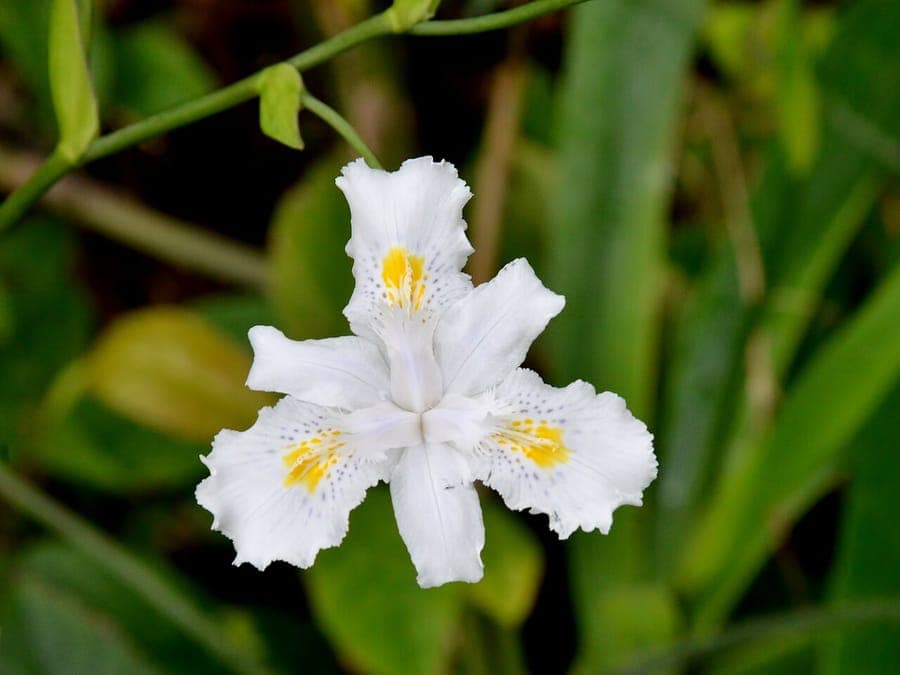
Hans Hillewaert / CC BY-SA 4.0, via Wikimedia Commons
Iris confusa: complete guide
Iris confusa
¿Quieres ver Iris confusa: complete guide en tu jardín?
1 minuto, sin tarjeta de crédito
Overview
Iris confusa, also known as the flat bamboo-orchid iris, is a fascinating iris from southern China. This hardy iris belongs to the Iridaceae family and is known for its elegant white flowers and remarkable leaf structure. For gardeners seeking something different from standard irises, this is an excellent choice.
This iris grows as a herbaceous plant with a unique growth habit, where vertical and horizontal leaves expand vigorously. The plant forms attractive, neat clusters. It is a plant for gardeners seeking something distinctive.
Appearance and Bloom
Iris confusa produces elegant, semi-open flowers in snow-white to cream tones. Flowers appear in May and have a refined appearance. The flowers are not enormous, but very decorative and abundance makes them noticeable.
The leaves are the most striking feature - long, flat and green, with a bamboo-like appearance. The leaves grow both upright and spreading, creating a unique three-dimensional structure. This sets the plant apart from regular irises.
Ideal Location
This iris thrives best in partial shade to dappled sun. Two to four hours of direct sunlight daily is ideal. In warmer regions, afternoon partial shade is welcome. This plant can even grow in deeper shade, though fewer flowers appear.
Do not place the plant in full sun in warm climates - leaves can scorch. A location under trees or on the north side of structures is ideal. Protection from strong winds helps keep delicate foliage intact.
Soil
Iris confusa is moisture-loving and grows best in well-draining, fertile soil that is nonetheless moisture-retentive. Unlike many other irises, this one loves consistently moist conditions.
Improve soil with plenty of organic matter - compost, leaf mold, rotted leaves. A pH around neutral is ideal. This iris thrives in well-amended garden soil. Never allow it to dry out completely.
Watering
Water regularly - keep soil moist but not waterlogged. This plant loves moist conditions more than most irises. Regular watering is essential, especially during the growing season.
During dry periods, water to depth. Container plants need more frequent watering. In winter months, watering can be slightly reduced, but keep soil never completely dry. This iris is a water user.
Diseño gratis
¿Quieres ver Iris confusa: complete guide en tu jardín? Crea un diseño gratis ahora.
Pruning
Minimal pruning needed. Remove dead leaves and flower stems after blooming. The plant maintains a neat form by itself.
Old leaf clusters can be carefully separated if they become too dense or tangled. The plant naturally forms attractive shapes, so heavy pruning is not needed. Let growing energy go toward bloom and foliage.
Maintenance Calendar
Early Spring (March-April): Check soil moisture. Begin regular watering as growth starts. Remove dead leaves from previous season.
Spring-Summer (May-July): Full growth and blooming period. Water regularly. Flowers appear and are beautiful. Apply fertilizer for support.
Summer (July-August): Continue watering. Plant grows vigorously. Provide support if needed.
Autumn (September-October): Gradually reduce watering as growth slows. Prepare for winter.
Winter (November-February): Plant is dormant/semi-evergreen. Minimal water, but do not dry out. Protect from extreme cold.
Winter Hardiness
Iris confusa is winter hardy in temperate climates. Temperatures to about -10 degrees Celsius are tolerable. In very cold regions (below -15 degrees), protection may be needed.
Mulch around the base provides protection in cold winters. The plant is semi-evergreen, so leaves remain partly standing. In extreme cold, leaves may die, but the plant will recover in spring.
Companion Plants
Iris confusa combines beautifully with:
Hosta: Complementary foliage texture, partial shade partner.
Astilbe: Similar moisture preference, complementary bloom time.
Fern: Grassy foliage texture underplanting.
Carex: Grass-like partner, neat finish.
Primula: Early blooming, nice contrast.
Closing Thoughts
Iris confusa offers something unique - an iris that tolerates partial shade and prefers moist conditions. This sets it apart from most irises that require full sun and drainage. For gardeners with moist, partly shaded gardens, this is an excellent choice.
The plant is reliable, winter hardy and adds architectural interest with its unique leaf structure. Combine with other shade-lovers for coherent planting schemes. Available through gardenworld.app for specialized garden design in partial shade conditions.
¿Quieres ver Iris confusa: complete guide en tu jardín? Crea un diseño gratis ahora.
Sube una foto, elige un estilo y obtén un diseño fotorrealista con lista de plantas en menos de un minuto.
Más de 10.000 jardines diseñados
Sin tarjeta de crédito


Plantas similares
Iris tingitana: complete guide
Iris tingitana
Iris tingitana, the Morocco iris, is the bulb species behind the Dutch iris: early blue-violet blooms that need a sunny, well-drained position.
Iris hookeri: complete guide
Iris hookeri
Hooker's Iris is a compact North American native plant with blue flowers. Low-growing and moisture-loving water plant.
Siskiyou iris: complete guide
Iris bracteata
Complete guide to Iris bracteata, the Siskiyou iris: location, soil, bloom cycle, watering, pruning and companion plants for this rare Pacific Coast iris.