
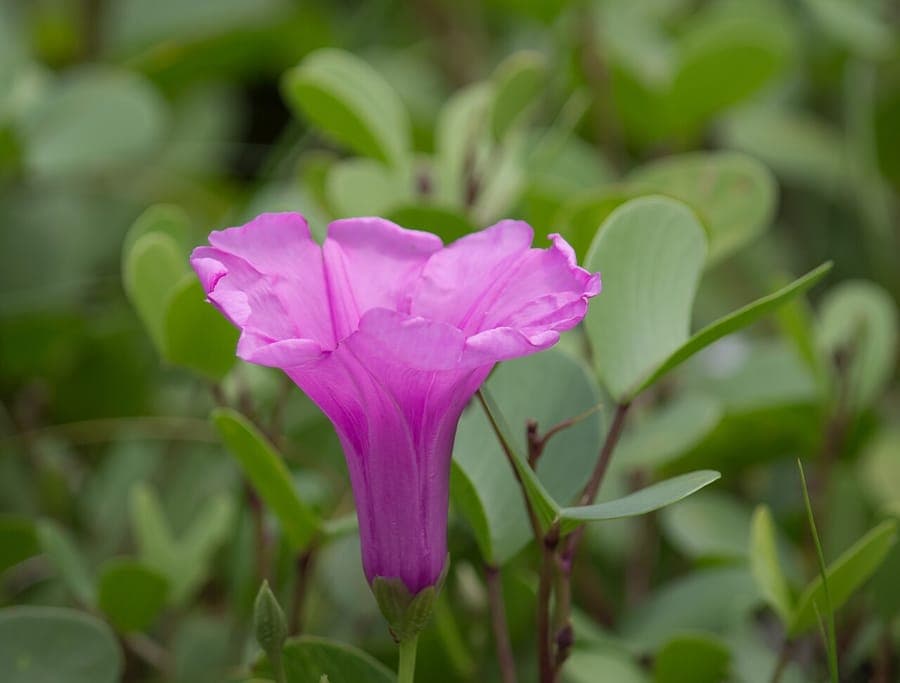
Drajay1976 / CC BY-SA 3.0, via Wikimedia Commons
Ipomoea pes-caprae: complete guide
Ipomoea pes-caprae
¿Quieres ver Ipomoea pes-caprae: complete guide en tu jardín?
1 minuto, sin tarjeta de crédito
Overview
Ipomoea pes-caprae, also known as railroadvine, goat's foot morning-glory, or beach morning-glory, is a salt-tolerant climbing plant native to tropical and subtropical coastal regions worldwide. This frost-sensitive climber is renowned for its ability to grow in sandy, saline soils and for its deep purple flowers.
The plant distinguishes itself through its divided leaves (resembling a goat's hoof, hence the name) and its remarkable salt tolerance. It is ideal for coastal gardens, sandy beach landscapes, and erosion control.
Appearance and Bloom
Railroadvine forms heavy, succulent stems that spread horizontally to 2-3 meters per season. The leaves are deeply divided into two round or kidney-shaped lobes (almost like hooves), approximately 5-8 centimeters wide, with thick and fleshy structure resembling succulent plants.
The flowers are funnel-shaped, 2-3 centimeters in diameter, deep purple to mauve with white center, rarely red or pink. They open in the morning and close by late afternoon. Flower production is continuous during warm season (May-October).
The seed pods are small, round, and papery, ripening October-November. Seeds are gray-brown and smooth, with very high germination rates.
Ideal Location
Railroadvine grows best in full sun (6-8 hours direct light). Partial shade (4-5 hours sun) tolerated, but flowering diminishes. The plant is heat-loving and does not grow below 12C.
This plant is unique: it tolerates sea wind, salt spray, sandy soils, and even periodic salt water inundation. Ideal for coastal areas, sandy river banks, and protected beach zones. The plant is suitable for zones 9-12; in zones 7-8 can be grown in large pots against south-facing wall during summer.
Always place on sandy or rocky soils. Avoid heavy clay and waterlogging.
Soil
Railroadvine tolerates poor soil better than all other Ipomoea species. Sand, sand-gravel mixes, or even pure sand with some compost worked in work well. pH can vary from acidic (pH 5.5) to neutral (pH 7.5); the plant is less pure-acid-sensitive than most plants.
Drainage must be perfect: waterlogging immediately leads to root rot. For container cultivation: heavy sand-compost mix (50% coarse sand, 30% compost, 20% garden soil) is ideal.
Salt tolerance: this plant tolerates seawater spray and even direct salty soil. Unique among ornamentals!
Diseño gratis
¿Quieres ver Ipomoea pes-caprae: complete guide en tu jardín? Crea un diseño gratis ahora.
Watering
Once established, railroadvine tolerates drought exceptionally well. In coastal areas with regular rainfall: water only during extremely dry periods (no rain 3-4 weeks). Inland or in containers: water 1-2 times weekly during growing period.
In peak summer containers: check daily whether top 2-3 centimeters of soil remain moist. In autumn, reduce water significantly. Overwintering: give almost no water.
Seawater infiltration is no problem; beach water or water with salt residue is perfectly acceptable.
Pruning
Regular pruning promotes dense growth and richer flower production. Begin pruning once plant reaches 25-30 centimeters tall: pinch the growing tip. This causes side branching and bushier form.
After blooming (October-November), apply heavy pruning: cut plant back to 50-75 centimeters, depending on available space. This stimulates stronger growth next season.
During peak summer, light monthly pruning suffices. Remove tangled runners and dead wood.
Maintenance Calendar
May: sow seed in warmth (20-25C) or take cuttings from mature plants. Lightly scarify seed for better germination. June-September: feed once every 4-5 weeks with balanced fertilizer (10-10-10 NPK). Salt water spray causes no harm. September-October: reduce feeding to once every 6 weeks. Heavy pruning after blooming. November-April: outside warm zones, plant dormant. Minimal water and no feeding.
Winter Hardiness
Railroadvine is not winter-hardy in temperate Europe. Plant dies back at frost temperature. In zones 9-11, plant can overwinter in protected coastal locations. In zones 7-8, reseed annually or apply heavy winter protection.
Most practical: container cultivation that moves to greenhouse or protected terrace in September. Plant can survive very long without feeding.
Save seed for next season: harvest in October, store in dry, cool place.
Companion Plants
Railroadvine pairs well with other salt-tolerant coastal plants:
- With beach poppy (Papaver rhoeas)
- With dune plants
- With other sand-tolerant climbers
From nutrition perspective: nitrogen-fixing Rhizobium nodosities help plant in poorer soils.
Conclusion
Ipomoea pes-caprae is for gardeners living in coastal areas seeking salt-tolerant green plantings. This is one of the rare ornamental plants that truly tolerates sea wind and salt residues. Perfect for beach erosion control, sandy coastal landscapes, and seaside garden decoration.
Start from seed in May, plant out in June, and enjoy purple blooms through October. Seed available from specialized seed merchants. GardenWorld.app can create coastal garden designs with salt-tolerant elements where railroadvine fits perfectly.
The plant itself is not edible, but its beauty in sandy coastal regions makes that irrelevant. A true heritage plant for coasts.
¿Quieres ver Ipomoea pes-caprae: complete guide en tu jardín? Crea un diseño gratis ahora.
Sube una foto, elige un estilo y obtén un diseño fotorrealista con lista de plantas en menos de un minuto.
Más de 10.000 jardines diseñados
Sin tarjeta de crédito


Plantas similares
Spreading alkaliweed: complete guide
Cressa truxillensis
Full growing guide for Cressa truxillensis, the salt-tolerant groundcover of alkaline flats: location, soil, watering, pruning and winter care.
Betony-leaved bindweed: complete guide
Convolvulus betonicifolius
Full guide to betony-leaved bindweed (Convolvulus betonicifolius): origin, appearance, ideal site, soil, watering and garden uses.
Ivyleaf morning glory: complete guide
Ipomoea hederacea
Everything about Ipomoea hederacea: location, soil and climbing care. A fast-growing annual vine with blue funnel flowers for sunny walls and pergolas.