
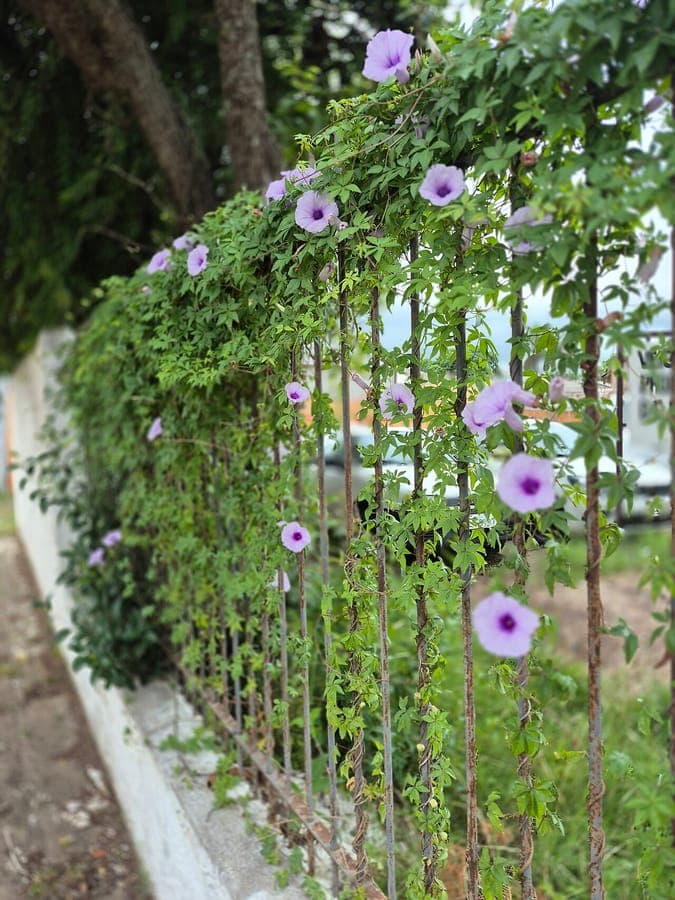
Gabriel Collares / CC BY 4.0, via Wikimedia Commons
Ipomoea cairica: complete guide
Ipomoea cairica
¿Quieres ver Ipomoea cairica: complete guide en tu jardín?
1 minuto, sin tarjeta de crédito
Overview
Ipomoea cairica, also known as railroad creeper, Egyptian morning-glory, or Cairo morning-glory, is a frost-sensitive climbing plant from tropical and subtropical Africa, the western Indian Ocean, and the Arabian Peninsula to temperate East Asia. This fast-growing climber is primarily used in Europe for pergolas, screens, and vertical landscape design.
The plant distinguishes itself from other Ipomoea species through deeply divided, almost feathery leaves that create an airy, graceful texture. The flowers are soft lilac to deep purple and appear abundantly in summer and early autumn. Railroad creeper is aggressively and productively growing: ideal for rapid coverage.
Appearance and Bloom
Railroad creeper forms slender, twining stems that can extend 3-4 meters per season. The most characteristic feature is the leaves: instead of simple heart-shaped or arrow-shaped, these are deeply cut into 5-7 narrow, linear lobes, giving the plant a very elegant, fern-like appearance.
The flowers are funnel-shaped, 3-4 centimeters in diameter, usually lilac-purple to deep violet, sometimes with white centers. They open in the morning and close by late afternoon. Flower production is exceptional: thousands of blooms can develop during the flowering period (May-October).
The seed pods are small, round, and brown, ripening late in autumn. Seeds are smooth, brownish-black, and remain viable for up to two years.
Ideal Location
Railroad creeper grows better in full sun (6-8 hours direct light) to partial shade (4-6 hours sun). In very hot regions, the plant tolerates 50% shade during the hottest hours. The plant is heat-, light-, and wind-loving.
A strong support structure is essential: pergola, trellis, garden wall, or robust screen construction. The plant becomes heavy when fully mature. Prefer locations where morning to afternoon sun is optimal.
The plant is suitable for zones 9-11 outdoors; in zones 7-8 as an annual (in warm summers). In zones 5-6, experiment with containers in full sun against a south-facing wall during summer.
Soil
Railroad creeper places moderate demands on soil: it grows in poor, drought-tolerant soil but blooms more richly with moderate feeding. Well-draining soil is crucial; avoid persistently moist, compacted clay.
Acidic (pH 5.5) to neutral (pH 7.0) is all acceptable. For optimal bloom: mix 50% garden soil, 30% compost, 20% sand, with decayed leaf mold. This plant tolerates poor soil better than water-spinach.
Container cultivation: well-draining potting mix with 40% agricultural soil, 40% compost, 20% sand. Ensure good drainage.
Watering
Once established (after three weeks growing), railroad creeper tolerates drought well. Water regularly during the growing period (May-September) so soil remains moist but not waterlogged. During intense heat (25-30C), water at least 2-3 times weekly.
In full growth in full sun, plants can consume considerable water; check daily whether the top 2-3 centimeters of soil remain moist. Once good root system develops (after two months), reduce water application.
In autumn and winter, reduce watering significantly or nearly stop, especially in cooler regions.
Diseño gratis
¿Quieres ver Ipomoea cairica: complete guide en tu jardín? Crea un diseño gratis ahora.
Pruning
Regular pruning promotes denser, bushier growth and richer flower production. Begin pruning once the plant reaches 30 centimeters tall: pinch the growing tip. This causes branching.
After blooming (October-November), apply heavy pruning: cut plant back to 1-2 meters height, depending on available space. This stimulates explosive growth and better blooming next season.
During peak growth (summer), light pruning once monthly suffices. Remove crossing and tangled runners. Always cut just above leaf nodes.
Maintenance Calendar
May: sow seed in warmth (18-22C) or take cuttings from mature plant. Soak seeds in water 24 hours before sowing. June-September: feed once every 3 weeks with balanced fertilizer (10-10-10 NPK) or bloom fertilizer higher in phosphorus (10-52-10). Regular watering. September-October: reduce feeding to once every 4-5 weeks. Heavy pruning after blooming. November-April: outside warm zones, virtually no maintenance. Plant dormant or frost-sensitive.
Winter Hardiness
Railroad creeper is not winter-hardy in temperate Europe. Plants die back at freezing temperatures. In zones 9-10, the plant can remain overwinter in protected locations against a south-facing wall. In zones 7-8, reseed the plant annually or provide good winter protection (multiple frost cloth layers).
Most practical: cultivation in large pots that can be moved to a greenhouse or conservatory in autumn. On a warm windowsill, plants can survive winter (15-18C minimum).
Saving seed for next season is economical. Seeds ripen in October-November.
Companion Plants
Railroad creeper combines well with other climbing plants in vertical design. Pairing possibilities:
- With Clematis jackmanii: white-flowering clematis against purple ipomoea
- With Jasminum sambac: fragrant jasmine at the base, ipomoea blooms above
- With Passiflora edulis: passion fruit climber provides fruiting weight low
From nutrition and health perspective: aphid browsing can be prevented by association with angelica (insect-repelling).
Conclusion
Ipomoea cairica is for impatient gardeners who want dense, full climbing growth NOW. No other annual achieves its speed and flowering abundance. For pergola, fence, or wall decoration from summer through October, railroad creeper cannot be beaten.
Set cuttings in May, enjoy full coverage by July, pick brilliant purple blooms until October. Go to Intratuin or Gamma for seed or young plants. GardenWorld.app can design pergolas and vertical spaces where this fast climber reaches full potential.
The plant itself is not edible, but its beauty makes that irrelevant.
¿Quieres ver Ipomoea cairica: complete guide en tu jardín? Crea un diseño gratis ahora.
Sube una foto, elige un estilo y obtén un diseño fotorrealista con lista de plantas en menos de un minuto.
Más de 10.000 jardines diseñados
Sin tarjeta de crédito


Plantas similares
Spreading alkaliweed: complete guide
Cressa truxillensis
Full growing guide for Cressa truxillensis, the salt-tolerant groundcover of alkaline flats: location, soil, watering, pruning and winter care.
Betony-leaved bindweed: complete guide
Convolvulus betonicifolius
Full guide to betony-leaved bindweed (Convolvulus betonicifolius): origin, appearance, ideal site, soil, watering and garden uses.
Ivyleaf morning glory: complete guide
Ipomoea hederacea
Everything about Ipomoea hederacea: location, soil and climbing care. A fast-growing annual vine with blue funnel flowers for sunny walls and pergolas.