
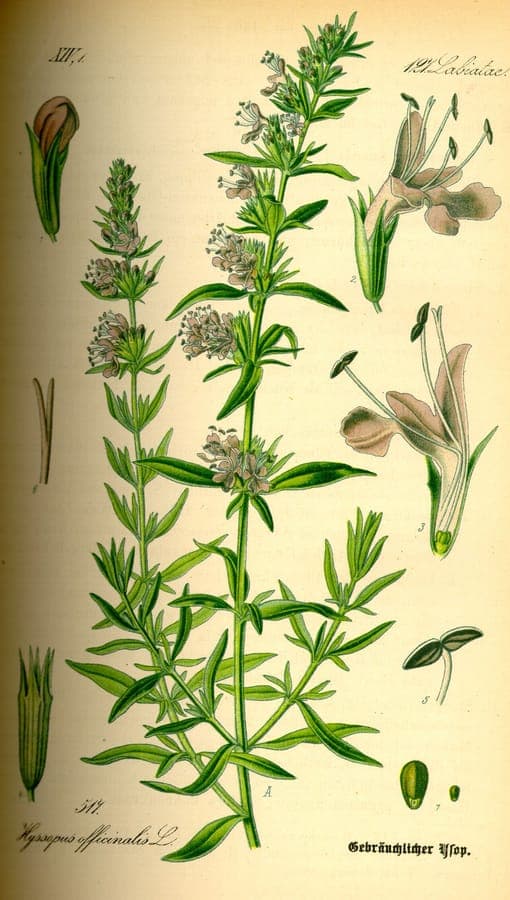
User:Topjabot / Public domain, via Wikimedia Commons
Hyssop: complete guide
Hyssopus officinalis
¿Quieres ver Hyssop: complete guide en tu jardín?
1 minuto, sin tarjeta de crédito
Overview
Hyssop, scientifically known as Hyssopus officinalis, is a valued herb that has maintained its place in European gardens for over one thousand years. This member of the Lamiaceae family (mint family) originates from Mediterranean and Asian regions where it grows on dry slopes and stony places. Hyssop transcends mere ornamental status; it offers medicinal properties, culinary applications, and spectacular appeal to pollinators. With its densely-packed blue, pink, or white flowers, hyssop creates impressive displays from July through September, precisely when many gardens begin fading into dormancy.
In contemporary gardens, hyssop receives renewed appreciation as an essential component of herb-focused and pollinator-friendly planting schemes. With gardenworld.app, you can design complete herb gardens where hyssop functions as both structural element and pollinator station. The plant typically reaches 30 to 60 centimeters in height with a compact, upright habit. The fragrance is powerfully aromatic, immediately noticeable when walking past the plant or touching foliage. Most modern cultivars remain smaller, reaching 40 to 50 centimeters, making them suitable for borders and containers.
Appearance & bloom cycle
Hyssop grows as a semi-woody shrub with upright stems densely clothed in narrow, linear leaves. Foliage measures approximately 1 to 2 centimeters long, dark green, glossy, and powerfully aromatic. When touched or brushed, leaves release an intense herbal fragrance that is mildly peppery and somewhat camphoraceous. Flowers appear in compact, densely-packed flower spikes at stem tips, beginning in July and continuing through October, especially in warm years. The standard form is blue, though red and white cultivars are equally available.
Each flower is small, approximately 8 millimeters in length, with characteristic two lips typical of Lamiaceae members. Flowers open gradually from base to apex along flower spikes, extending individual spike bloom period over 3 to 4 weeks. Hyssop attracts pollinators massively; healthy plants regularly host dozens of bees simultaneously. Following bloom, the plant produces small, nutlet seeds that readily self-sow in favorable conditions.
Ideal location
Hyssop performs optimally in sunny locations receiving minimum 6 to 8 hours direct daily sunlight. Full sun exposure generates optimal flowering and herb fragrance. In warm regions, light afternoon shade may prove beneficial, especially during intense heat periods, but overall full sun remains ideal. The plant tolerates wind exposure excellently, thriving even in windy coastal gardens. Ensure locations receive good air circulation to prevent fungal diseases.
Hyssop excels in dry borders, Mediterranean gardens, herb gardens, and roof plantings. Its compact, upright habit suits container cultivation, raised beds, and small spaces perfectly. Within larger borders, it functions as a front-of-border plant or mid-border edging. You can also employ it as informal hedging or border planting, providing fragrance and flowers throughout much of the season.
Soil requirements
Hyssop grows on well-draining soils ranging from very sandy through moderately heavy clay. The plant accepts acidic to alkaline soils (pH 4.5 to 8.5), though neutral to lightly alkaline (pH 6.5 to 7.5) proves optimal. Critical is excellent drainage; hyssop cannot tolerate waterlogging or wet feet. In clay soils, incorporate 30 to 40 percent sand and gravel for improved drainage. Organic matter should be minimal, as excess nutrition can reduce flowering and herb fragrance. Hyssop actually performs better on relatively poor soils, supporting traditional medicinal hyssop cultivation practices.
Fertilization is unnecessary and should be avoided to promote superior flower production. On very poor substrates (such as sterile sand with no organic matter), add only 2 to 3 centimeters of compost at planting time.
Diseño gratis
¿Quieres ver Hyssop: complete guide en tu jardín? Crea un diseño gratis ahora.
Watering
Hyssop is drought-tolerant once established, a characteristic making it valuable for water-conscious gardeners. Young plants and recently transplanted specimens require consistent moisture during the first 4 to 6 weeks after planting to establish robust root systems. Thereafter, watering can be substantially reduced. For mature plants, supplemental watering is typically unnecessary except during extreme drought or in very warm regions during July-August.
Even in continental climates or dry years, hyssop thrives without supplemental watering once established. Water in morning hours rather than evening to prevent fungal leaf diseases. Over-watering can cause root rot and plant death, especially during colder seasons. The plant tolerates extended drought periods better than most garden plants.
Pruning
Hyssop responds favorably to spring pruning in April or May, producing a more compact, fuller plant with increased flowers. Cut back approximately one-third to one-half of the previous season's growth. This stimulates multiple new flowering stems. Spent flower spikes can be removed to stimulate continued blooming, a practice called deadheading that you can employ throughout the growing season to extend flowering until October.
Following frost damage in autumn or winter, wait until all frost danger passes before pruning, typically April. Remove all dead wood then, even if the woody base shows green growth. For informal hedges, prune after flowering (October) to maintain shape. Many gardeners retain seed heads for winter bird food.
Maintenance calendar
March-April: Perform spring pruning based on winter damage assessment. Cut back approximately one-third. Growth commences as temperatures rise. No fertilization needed.
May-June: Active growth. Young flower spikes appear. Provide regular watering for young plants. Ensure location receives good air circulation.
July-September: Peak flowering period. Hyssop attracts bees and butterflies massively. Deadhead spent flower spikes to promote continued blooming. Water only if extreme drought occurs.
October: Flowering gradually concludes. Retain seed heads for bird food. Plant begins entering dormancy.
November-February: Dormancy. No watering required. Plant may retain green foliage in mild winters. Frost causes no damage.
Winter hardiness
Hyssop demonstrates exceptional cold hardiness, tolerating temperatures to -25 degrees Celsius, making it suitable for all Dutch and Belgian regions without protection. The plant rates USDA hardiness zones 3 through 9. In severely cold years, above-ground growth may freeze back to ground level, yet the plant reliably regenerates in spring. For extra protection in severe regions, mulch around the base with 5 to 10 centimeters of dry leaf material.
Companion plants
Hyssop combines beautifully with other Mediterranean herbs such as lavender (Lavandula), rosemary (Rosmarinus officinalis), and thyme (Thymus). For flower contrast, add white or pink hyssop cultivars alongside blue selections. In mixed borders, position hyssop in front of purple-flowering plants like woodland sage (Salvia nemorosa) or alliums (Allium). For pollinator-friendly design, add other insect-attracting plantings like Scabiosa, Echinacea, and Rudbeckia. Hyssop's compact height makes it suitable as front-of-border edging for taller plants.
In herb gardens, hyssop combines excellently with oregano, sage, and marjoram sharing similar growing requirements. On gardenworld.app, design complete herb gardens where hyssop serves as both structural and functional element.
Closing
Hyssop represents a valuable addition to any Dutch or Belgian garden, particularly for those appreciating pollinators, herbs, and low-maintenance plantings. With its extended flowering period, compact growth habit, drought tolerance, and medicinal properties, hyssop delivers numerous benefits with minimal effort. The plant demands virtually no maintenance once established: no fertilization, minimal watering, minimal pruning. Provide full sun, well-draining soil, and careful spring pruning in April, and you'll enjoy decades of this versatile plant. Whether you employ it for tea, medicinal applications, herb arrangements, or simply for pollinators, hyssop is a reliable, multi-purpose choice. Visit gardenworld.app for complete guidance on designing pollinator-friendly and herb-oriented gardens.
¿Quieres ver Hyssop: complete guide en tu jardín? Crea un diseño gratis ahora.
Sube una foto, elige un estilo y obtén un diseño fotorrealista con lista de plantas en menos de un minuto.
Sin tarjeta de crédito


Plantas similares
Apple mint (Mentha x villosa): complete guide
Mentha x villosa
Meet apple mint (Mentha x villosa): a fruity-scented kitchen herb with woolly leaves, perfect for tea and mojitos.
Salvia peyronii: complete guide
Salvia peyronii
Discover Salvia peyronii, a rare Lebanese mountain sage. Growing tips, hardiness, and companion planting for a Mediterranean gravel garden.
Bigleaf mint (Mentha x rotundifolia): complete guide
Mentha x rotundifolia
Discover bigleaf mint: cultivation, care tips, and garden uses. Learn how to grow this aromatic herb with soft, hairy leaves.