
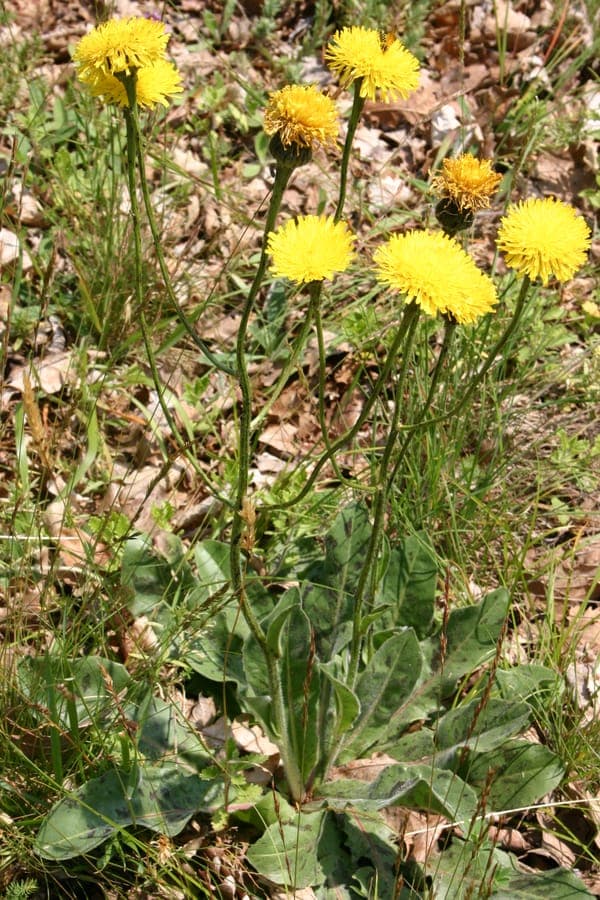
HermannSchachner / CC0, via Wikimedia Commons
Spotted cat's-ear: complete guide
Hypochaeris maculata
¿Quieres ver Spotted cat's-ear: complete guide en tu jardín?
1 minuto, sin tarjeta de crédito
Overview
Spotted cat's-ear, scientifically known as Hypochaeris maculata, is a remarkable wildflower belonging to the Asteraceae family that distinguishes itself from other Hypochaeris species through characteristic reddish-spotted foliage. This elegant plant occurs naturally throughout Europe, from eastern France through Russia and from Scandinavia to the Balkan states, where it inhabits typical mountain meadows and dry grasslands. Spotted cat's-ear appeals to discerning gardeners seeking more refined, uncommon plants for naturalistic garden compositions. The foliage spotting becomes most pronounced when plants are young or growing under stressed conditions.
In contemporary garden design, spotted cat's-ear receives increasing appreciation due to its distinctive leaf pattern and straightforward cultural requirements. With gardenworld.app, you can create unique garden compositions where this elegant wildflower functions as an interesting detail within mixed planting schemes. The plant typically reaches 20 to 45 centimeters in height with an open, airy structure. Particularly valuable for pollinating insects, it provides essential nutrition for beetles and other beneficial organisms.
Appearance & bloom cycle
Spotted cat's-ear forms a loose rosette group of leaves from the base, with multiple upright flowering stems. The most distinctive characteristic is the dark-reddish spotted foliage, particularly visible in basal rosette placement. Leaves are linear to lance-shaped, approximately 10 to 15 centimeters long, with distinct red spots distributed across the leaf surface. Spot intensity varies depending on growing conditions, appearing less prominent in shade while full sun intensifies their coloration.
Flowers appear from June through August, later than many other Hypochaeris species, making it valuable for extending wildflower seasons. Each flower measures approximately 20 to 25 millimeters in diameter with pure yellow petals, significantly larger than smooth cat's-ear. The flower stems are thin and elegant, creating an airy appearance even when multiple stems grow together. Following bloom, characteristic seed heads form, dispersed by wind through their feathery seed structures. A mature plant produces numerous seeds that naturalize readily.
Ideal location
Spotted cat's-ear performs optimally in sunny locations receiving minimum 6 to 8 hours direct daily sunlight. Full sun optimizes flowering and intensifies leaf spotting. Although the plant grows under light part-shade conditions, sunny locations provide superior performance. The plant tolerates wind well and manages fairly dry conditions. Avoid waterlogged soils and locations experiencing water accumulation, as this promotes bulb rot.
The plant integrates into wildflower mixtures, along pathways, in dry rock gardens, or within extensive living roofs. The distinctive leaf pattern makes it particularly suitable for positioning near border fronts where foliage detail receives admiring attention.
Diseño gratis
¿Quieres ver Spotted cat's-ear: complete guide en tu jardín? Crea un diseño gratis ahora.
Soil requirements
Spotted cat's-ear grows on well-draining soils ranging from sand through moderate clay. The plant accepts acidic to alkaline soils (pH 4.5 to 8.0), though neutral to lightly acidic soils (pH 6.0 to 7.0) prove optimal. Like other Hypochaeris species, spotted cat's-ear thrives better on nutrient-poor soils. Heavy fertilization promotes leaf growth at flowering expense and also lessens red spotting intensity.
For wildflower mixtures, add no more than 2 to 3 centimeters of well-rotted compost. The plant accepts dry soils better than many garden plants and even performs better on drought-stressed sandy or gravelly substrates.
Watering
Spotted cat's-ear is drought-tolerant once established. Young seedlings and recently transplanted plants require consistent moisture during the first 3 to 4 weeks. Thereafter, watering can be substantially reduced. For mature plants, supplemental watering is typically unnecessary except during extreme drought or in very warm regions during July and August.
Even light watering when plants show wilting signs may extend blooming, but the plant is sufficiently robust that this isn't necessary in average years. Ensure morning watering rather than evening to minimize foliar diseases.
Pruning
Spotted cat's-ear requires no routine pruning. Spent flowers may be removed for tidier appearance, but retain some for seed production if you wish plants to self-propagate. Seed heads remain ornamental until complete ripening, so you may leave them through October. For the most naturalistic appearance, allow seed heads to mature and disperse independently.
Maintenance calendar
April-May: Sow seeds directly into prepared ground in full sun. Seeds may be pre-chilled in refrigerator for two weeks before sowing. Keep seeded area moderately moist until germination occurs (10 to 20 days).
June: Young seedlings emerge and grow rapidly. Foliage markings become visible. Provide regular watering if drought occurs.
July-August: Flowering begins. Yellow flowers contrast beautifully against red-spotted foliage. Maintain regular watering during extreme heat.
August-September: Seed development and ripening. Seed heads fully mature by September. Allow seed heads to remain for naturalization.
October-November: Plants naturally decline. Seeds disperse. Leave leaf litter as protective cover.
Winter hardiness
Spotted cat's-ear is hardy as annual or biennial plant throughout Dutch and Belgian regions. Temperatures to -15 degrees Celsius present no difficulty. Seeds overwinter in soil, germinating next spring.
Companion plants
Spotted cat's-ear combines beautifully with other late-blooming wildflowers such as Centaurea scabiosa (field scabious), Knautia arvensis (devil's bit scabious), and Salvia pratensis (meadow sage). For formal arrangements, add purple tones like Sanguisorba minor (salad burnet) or blue Agapanthus (lily of the Nile). The red leaf spotting provides particular contrast when combined with silver-foliaged plants such as Artemisia campestris or evergreen shrubs. On gardenworld.app, design complete wildflower compositions.
Closing
Spotted cat's-ear offers the best of both worlds: wildflower simplicity with added refinement through its distinctive red-spotted foliage. Perfect for gardeners seeking something more interesting than straightforward yellow wildflowers. Sow seeds in full sun on well-draining soil and enjoy this attractive plant for many years. Visit gardenworld.app for comprehensive guidance on designing refined wildflower gardens.
¿Quieres ver Spotted cat's-ear: complete guide en tu jardín? Crea un diseño gratis ahora.
Sube una foto, elige un estilo y obtén un diseño fotorrealista con lista de plantas en menos de un minuto.
Más de 10.000 jardines diseñados
Sin tarjeta de crédito


Plantas similares
Calendula stellata: complete guide
Calendula stellata
Complete guide to Calendula stellata, the star-flowered marigold from Sicily: location, soil, watering and companion planting tips.
Korean chrysanthemum: complete guide
Chrysanthemum x rubellum
Chrysanthemum x rubellum is a hardy autumn perennial with single pink to copper flowers from August to November. Care and combinations.
Helianthus divaricatus: complete guide
Helianthus divaricatus
Helianthus divaricatus is a North American woodland sunflower with yellow summer blooms, ideal for naturalistic borders and shady edges.