
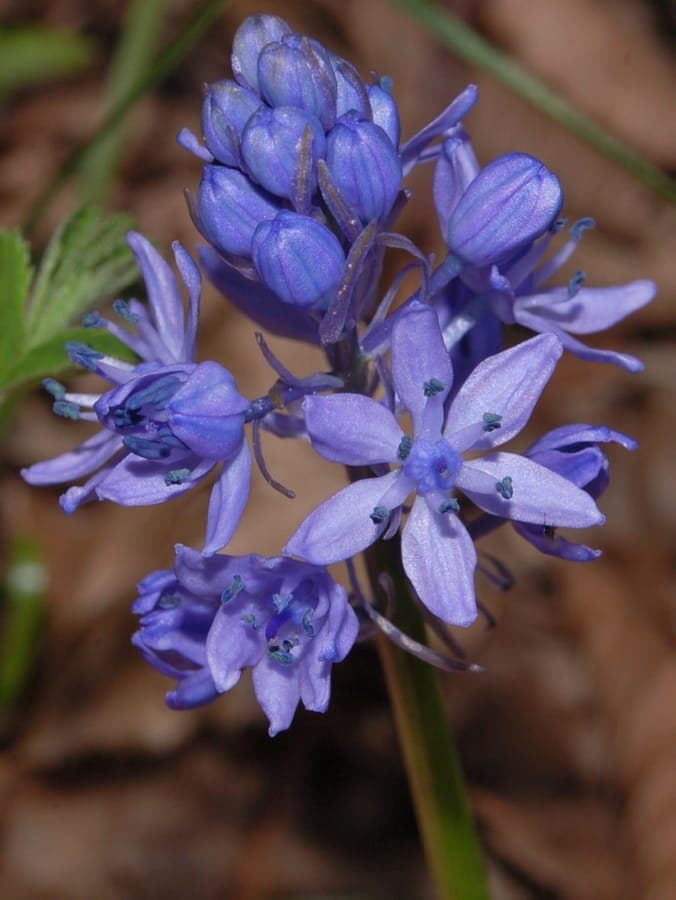
Hectonichus / CC BY-SA 3.0, via Wikimedia Commons
Italian bluebell: complete guide
Hyacinthoides italica
¿Quieres ver Italian bluebell: complete guide en tu jardín?
1 minuto, sin tarjeta de crédito
Overview
Italian bluebell (Hyacinthoides italica), also known as Scille d'Italie, is a charming early-flowering bulb plant from the Asparagaceae family. Native to southeastern France and northwestern Italy, this plant is renowned for its stunning blue flowers that appear in spring. Reaching heights of 15 to 25 centimetres, the scilla forms dense groups of delicate flowers highly attractive to bees and insects.
Appearance & bloom
Hyacinthoides italica has narrow, linear leaves that emerge from the ground in early spring. The flower heads consist of rows of small blue, violet or pink flowers appearing in April to May. Each flower has six petals and hangs elegantly downward in a bell-like shape. The plant reaches its maximum height of 20-25 cm when in full bloom. After flowering, the leaves gradually fade, freeing up space for summer-growing plants.
Ideal location
Italian bluebell grows best in locations receiving at least 3-4 hours of sunlight daily. The plant is very flexible and can grow under shrubs and trees where it receives winter sun and summer shade. This makes it ideal for wooded garden areas. Plant in large groups for maximum visual effect. The plant is perfect beneath trees, in borders and as groundcover in shaded garden areas.
Soil
Hyacinthoides italica is not fussy about soil conditions and grows in almost any well-draining soil. Add organic material such as peat or compost to improve water retention. The plant tolerates slightly acidic to neutral soils best. Ensure adequate drainage to prevent bulb rot. Mulching helps keep soil moisture consistent during the growing season.
Watering
During the growing season (spring) water regularly, especially if the weather is dry. After blooming, watering can be reduced. When leaves fade, watering can be limited. Generally, scillas have moderate water needs. Ensure soil does not dry out completely during the growing season but avoid waterlogging.
Diseño gratis
¿Quieres ver Italian bluebell: complete guide en tu jardín? Crea un diseño gratis ahora.
Pruning
Pruning is barely necessary for Hyacinthoides italica. Let the leaves fade naturally then remove them. Remove only wilted flowers if desired for neat appearance. Once leaves are dry, they can be completely removed. No further pruning needed.
Maintenance calendar
Autumn (September-October): plant bulbs at 8-10 cm depth. Winter: minimal maintenance; bulbs rest underground. March-April: enjoy the bloom. May-June: let leaves fade naturally. July-August: bulbs develop at rest. Check regularly for pests and diseases.
Winter hardiness
Italian bluebell is extremely winter hardy and tolerates temperatures down to -15 degrees Celsius without any problem. The plant grows well in many European regions and withstands heavy frost periods. Snow cover actually protects against extreme cold. Bulbs can overwinter in the ground in virtually all climates with slight protection.
Companion plants
Hyacinthoides italica pairs perfectly with other spring bloomers. Combine with snowdrops, grape hyacinths and other scillas for a sea of spring colour. Group beneath deciduous trees for beautiful underplanting effect. The plant pairs well with ferns and hostas. Plant in large dense groups for maximum effect.
Closing
Italian bluebell is a reliable, low-maintenance spring bloomer bringing early blue-violet flowers. Perfect for shaded garden areas and beneath trees where little other flowering success is possible. Available at major garden centres in the UK. Visit gardenworld.app/en for more plant information and garden design inspiration. Discover how to integrate these flower bulbs into your front garden with our free design tool at gardenworld.app/en.
¿Quieres ver Italian bluebell: complete guide en tu jardín? Crea un diseño gratis ahora.
Sube una foto, elige un estilo y obtén un diseño fotorrealista con lista de plantas en menos de un minuto.
Más de 10.000 jardines diseñados
Sin tarjeta de crédito


Plantas similares
Narrow-leaved dracaena: complete guide
Dracaena angustifolia
Everything about Dracaena angustifolia - the narrow-leaved dracaena: location, care, overwintering and use as a houseplant or patio plant.
Chaparral yucca: complete guide to Hesperoyucca whipplei
Hesperoyucca whipplei
Hesperoyucca whipplei (Our Lord's candle) is a dramatic rosette-forming plant from California that produces a towering flower spike, ideal for dry and gravel gardens.
False lily-of-the-valley: complete guide
Maianthemum dilatatum
Everything about Maianthemum dilatatum, the false lily-of-the-valley. Care, shade location, propagation and garden combinations for this popular shade ground cover.