
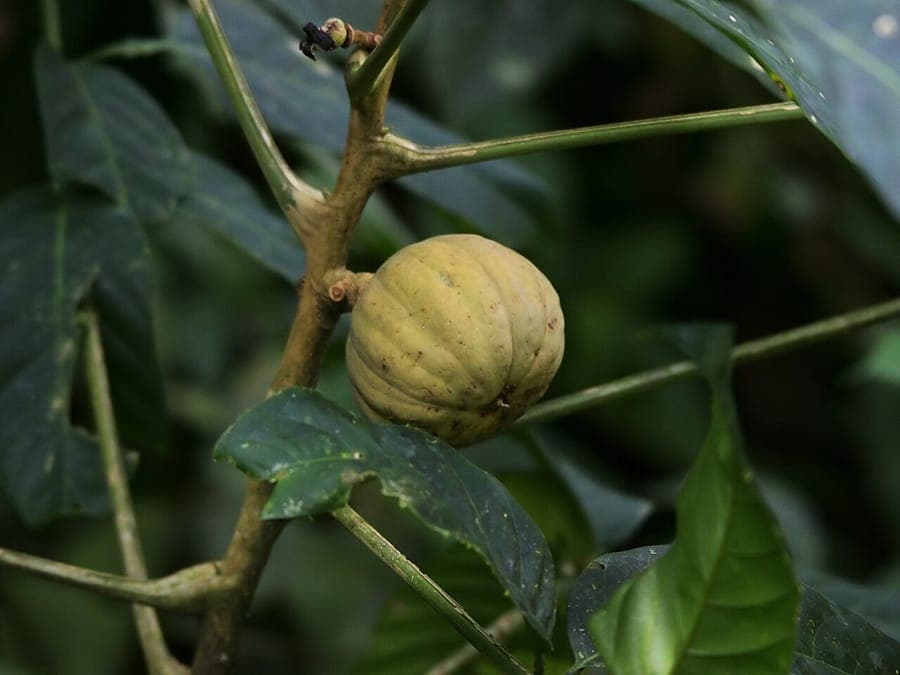
Hans Hillewaert / CC BY-SA 3.0, via Wikimedia Commons
Hura crepitans: complete guide
Hura crepitans
¿Quieres ver Hura crepitans: complete guide en tu jardín?
1 minuto, sin tarjeta de crédito
Overview
Hura crepitans, commonly known as the Sandbox Tree, Monkey's Dinner Bell, or Dynamite Tree, is a fascinating tropical specimen native to Central and South America. This tree is celebrated for two remarkable features: its spectacularly explosive fruit pods that disperse seeds with an audible crack, and its rapid growth rate under warm conditions. The tree can reach heights of 50 meters and develops a dense, compact canopy with substantial foliage.
In warmer climates or greenhouses, this is an impressive cultivar that commands attention from every visitor. The explosive fruit bursting is not merely biologically fascinating but also a genuine spectacle to witness. In its native habitat, the tree is highly valued for its durable hardwood.
Appearance and Bloom
The Sandbox Tree features a striking foliage crown with large, dark green leaves displaying a coarse texture. Leaves are alternately arranged and can reach 25 cm in length. During the growing season, distinctive red flowers appear prominently against the green background.
The fruits are spherical to slightly flattened, approximately 5-7 cm in diameter, starting green before ripening to brown or black. The most spectacular characteristic is the sudden expansion of the ripened fruit, which produces an audible shot dispersing seeds several meters away. This mechanism represents a highly efficient natural seed dispersal strategy.
Bloom timing occurs primarily during warm seasons, depending on specific growing conditions. The tree grows rapidly and can reach considerable size within a few years.
Ideal Location
The Sandbox Tree requires a sunny location with direct sunlight for at least 6-8 hours daily. This is essential for rapid growth and abundant flowering. The tree is sensitive to shade and will be less vigorous in partially shaded areas.
In regions with temperatures below 15 degrees Celsius, the tree struggles and may perish during frost. This makes it particularly suitable for warmer regions, southern Europe, or greenhouse cultivation in temperate climates. Protection from strong winds is advisable, especially for young specimens, as the substantial leaf mass is wind-sensitive.
Soil Requirements
The tree grows best in well-drained, fertile soil with a pH between 6 and 8. Heavy clay soils without good drainage can lead to root rot. Add generous amounts of organic material, especially compost or leaf mold, to improve structure and water-holding capacity.
In container culture, a mixture of garden soil, perlite, and organic matter works ideally. Ensure drainage holes are adequately sized. Annual top-dressing with compost helps maintain soil fertility.
Diseño gratis
¿Quieres ver Hura crepitans: complete guide en tu jardín? Crea un diseño gratis ahora.
Watering
Provide regular, consistent moisture during the growing season, especially in warm periods. Don't allow the soil to completely dry out, but avoid waterlogging. Young trees require more consistent moisture than mature specimens, which tolerate drought better.
During winter when growth slows, gradually reduce watering. Monitor soil moisture regularly with your finger. In rainfall-rich regions, you can water less frequently; in drier climates, more regular watering is essential.
Pruning
The Sandbox Tree requires minimal pruning when growing naturally, especially if you want to preserve its characteristic crown shape. Remove only dead, diseased, or damaged branches. Young trees can be pruned to develop a strong central stem.
If growing in containers and wanting to control size, pruning after flowering is optimal. Make clean cuts with sharp instruments to prevent infection. The tree heals quickly and easily produces new growth.
Maintenance Calendar
- March-April: Growth period begins, increase watering
- April-June: Peak growing season, feed regularly with tropical plant fertilizer
- July-August: Flowering and fruiting period, maintain adequate watering
- September: Growth stabilizes, gradually reduce watering
- October-November: Prepare for dormancy, minimal watering
- December-February: Rest period, sparse watering, no fertilizing
Winter Hardiness
The Sandbox Tree is completely frost-tender in European conditions. It is entirely dependent on warmth and cannot survive outdoors in temperate climates. The minimum temperature for survival is approximately 10-15 degrees Celsius; sustained temperatures below 5 degrees Celsius will cause serious damage or death.
In warming European regions, especially southern Portugal, Spain, and Greece, overwintered specimens may succeed outdoors, though frost protection is needed during unexpected cold snaps. In other regions, greenhouse culture or moving to heated shelter is essential.
Companion Plants
The Sandbox Tree naturally grows in tropical rainforests alongside other large trees and understory plants. In garden cultivation, combine this tree with other heat-loving specimens:
- Papayas, bananas, and other tropical fruit trees
- Large-leaved plants such as Anthurium or Monstera
- Shade-tolerant grasses and understory plants
- Epiphytes and climbers growing against the trunk
This creates a tropical atmosphere and simulates natural growing conditions.
Conclusion
The Sandbox Tree is a spectacular choice for those wanting to cultivate a true tropical tree in warm conditions. Its rapid growth, striking flowers, and unique seed dispersal mechanism make it biologically fascinating. With proper warmth, sunshine, and nutrition, you'll cultivate an impressive specimen providing years of enjoyment.
Find quality specimens at major garden centers. For more gardening inspiration and plant advice, visit gardenworld.app. Your next garden project begins on gardenworld.app, where you can create personalized designs!
¿Quieres ver Hura crepitans: complete guide en tu jardín? Crea un diseño gratis ahora.
Sube una foto, elige un estilo y obtén un diseño fotorrealista con lista de plantas en menos de un minuto.
Más de 10.000 jardines diseñados
Sin tarjeta de crédito


Plantas similares
Woolly mercury: complete guide
Mercurialis tomentosa
All about Mercurialis tomentosa, the woolly mercury from southwestern Europe: site, soil, watering, care and garden design tips.
Shurur: complete guide
Euphorbia fruticosa
Everything about Shurur: cultivation in dry climates, xeriscaping, care and tips for drought-resistant gardens in warm climates
Glary spurge: complete guide
Euphorbia glareosa
Everything about glary spurge: cultivation, maintenance, frost hardiness and use in Mediterranean and mountain-inspired gardens