
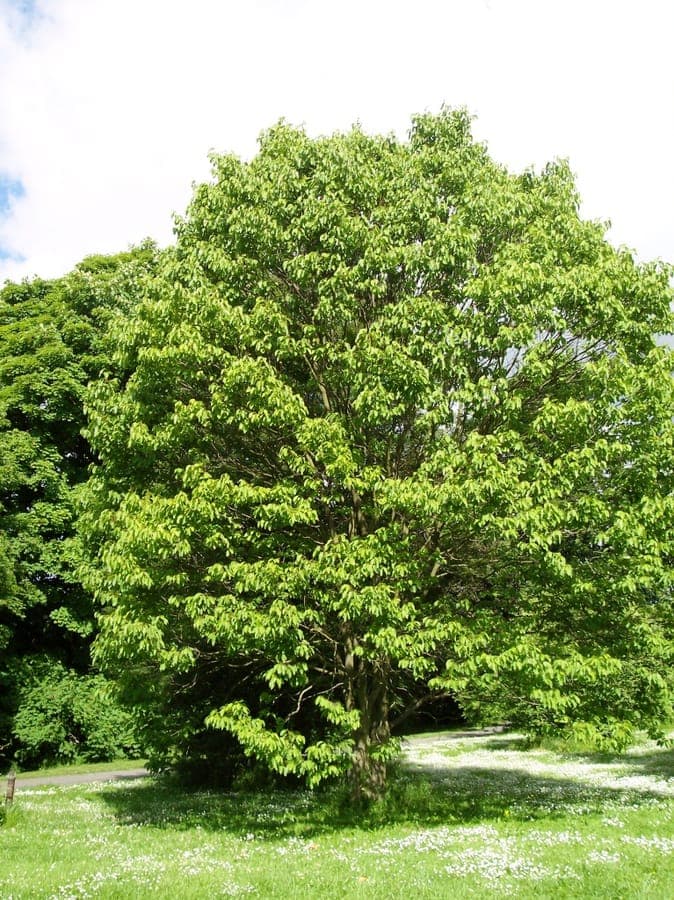
Wikimedia Commons / CC BY-SA 3.0, via Wikimedia Commons
Hovenia dulcis: complete guide
Hovenia dulcis
¿Quieres ver Hovenia dulcis: complete guide en tu jardín?
1 minuto, sin tarjeta de crédito
Overview
Hovenia dulcis, known as the Japanese raisin tree, Chinese raisin tree, oriental raisin tree, or kemponashi, is a fruit-bearing tree from the Rhamnaceae family. This interesting tree originates from the Asian region from India to Japan, with distribution across tropical and subtropical Asia. The tree is especially renowned for its edible fruits and characteristic growth pattern.
The tree is widely cultivated in Asia for its fruits, which are sweet and nutritious. In Europe, however, it is less well-known, although the number of gardens with this tree is slowly growing. The tree can reach considerable size and forms a lovely shade-giver.
Appearance and Bloom
Hovenia dulcis is a deciduous tree that can reach 10-20 meters in height in ideal conditions. The tree has a broad, rounded crown and thick, brown bark that is characteristic. The leaves are elongated, glossy green, and reach lengths up to 15 centimeters.
The flowers are small, greenish-yellow, and appear in clusters. Although they are not spectacular, they attract many pollinators. After blooming, characteristic fruits develop. These are first green, then brown to dark brown. The fruits are edible and have a sweet taste, similar to raisins.
Note that the edible parts are actually the thickened receptacles to which the seeds attach, not the seeds themselves.
Ideal Location
Hovenia dulcis thrives best in completely sunny locations, although it can also grow in partial shade. The tree requires at least 6 hours of sunlight daily. In warm regions, the tree feels most at home.
The tree is well-suited for subtropical climates. In temperate climates, it can grow, but it will grow slower and may not bear fruit every year.
Soil
Hovenia dulcis is not very fussy about soil type. The tree thrives in all kinds of soils, from sand to clay, as long as drainage is reasonably good. The tree can tolerate acidic and alkaline soils, although a neutral pH range is ideal.
Ensure the soil is deep enough for the roots. In containers, good drainage must be provided, with a mixture of garden soil and sand.
Diseño gratis
¿Quieres ver Hovenia dulcis: complete guide en tu jardín? Crea un diseño gratis ahora.
Watering
Once established, Hovenia dulcis is relatively drought-tolerant. During the growing season, especially in warm periods, water regularly. Ensure the soil does not remain permanently wet.
In winter, watering can be reduced. Newly planted trees need more water than established specimens. Check soil moisture levels regularly.
Pruning
Hovenia dulcis requires minimal pruning. The tree grows naturally in a beautiful form. You can remove weak or dead branches in early spring. Form pruning can be done if desired, but is not essential.
Do not remove large branches without good reason, as this can damage the tree.
Maintenance Calendar
In spring, feed with a balanced fertilizer or fruit tree food. During the growing season, feed regularly, e.g., monthly. In autumn, gradually reduce feeding.
Watch for pests such as insects. Check leaf health regularly.
Winter Hardiness
Hovenia dulcis is not fully winter-hardy in cold climates. The tree can grow in temperate climates, but freezing temperatures can cause damage, especially to young trees. In regions where temperatures drop below -10 degrees Celsius, the tree should receive protection.
In subtropical regions, the tree can grow outdoors without special protection.
Companion Plants
Hovenia dulcis combines well with other fruit trees and deciduous trees in similar climates. It also works well as a solitary shade-giver in gardens. Do not plant it too close to other large trees.
In containers, it can be combined with other tropical plants.
Closing Thoughts
Hovenia dulcis is a fascinating and productive tree that has much potential as a fruit tree in warmer regions. With its beautiful appearance, interesting flowers, and edible fruits, it forms a unique addition to the garden. Provide full sunlight, well-draining soil, and regular watering, and you will enjoy the sweet fruits of this Japanese raisin tree for many years.
For more inspiration on exotic fruit trees, visit gardenworld.app.
¿Quieres ver Hovenia dulcis: complete guide en tu jardín? Crea un diseño gratis ahora.
Sube una foto, elige un estilo y obtén un diseño fotorrealista con lista de plantas en menos de un minuto.
Más de 10.000 jardines diseñados
Sin tarjeta de crédito


Plantas similares
Point Reyes ceanothus: complete guide
Ceanothus gloriosus
The Point Reyes ceanothus is an evergreen Californian groundcover with blue flowers. Location, soil and pruning explained in detail.
Santa Barbara ceanothus: complete guide
Ceanothus impressus
Ceanothus impressus rewards a sunny wall with deep blue flowers in March-May. Location, soil, pruning and winter protection explained.
Redstem ceanothus: complete guide
Ceanothus sanguineus
Ceanothus sanguineus is a hardy, deciduous shrub with reddish stems and creamy white flower clusters in June. Care and companions.