
Jerzy Opioła / CC BY-SA 3.0, via Wikimedia Commons
Chamois cress: complete guide
Hornungia alpina
¿Quieres ver Chamois cress: complete guide en tu jardín?
1 minuto, sin tarjeta de crédito
Overview
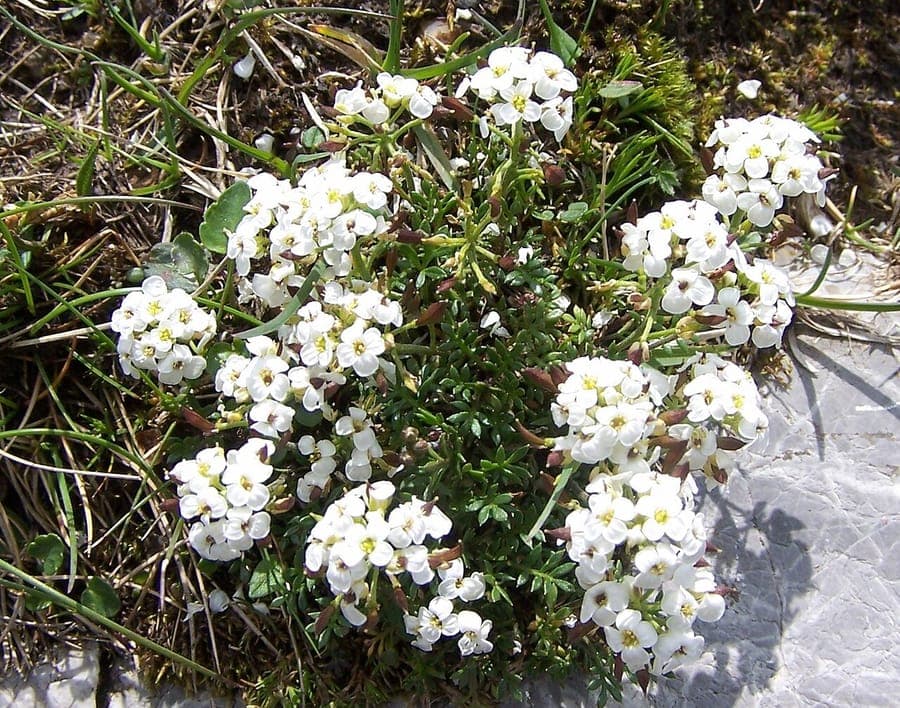
Chamois cress or Alpine cress (Hornungia alpina) is a very small alpine plant from the Brassicaceae family (Cabbage family), native to mountain regions of Europe. This self-seeding dwarf plant reaches only a few centimeters tall and is a classic choice for rock gardens and alpine troughs.
The plant forms compact rosettes and blooms in spring with countless small white flowers. This is a true alpine specialist that thrives on rocky, skeletal soil.
Appearance and bloom
Chamois cress has very small, grayish-green, hairy leaves that grow densely in rosettes. Plants reach only 5 to 15 cm in height. In spring (April-May), countless small white four-petaled flowers appear.
The flowers stand in dense clusters on stiff, upright stems. After flowering, small elongated seed pods form. The plant remains attractive after blooming due to the grayish-green leaf rosettes.
Ideal location
Chamois cress grows best in full sun with at least 5 to 6 hours of direct sunlight daily. Sun is essential for compact growth and abundant flowering.
Ensure a well-ventilated spot. The plant cannot tolerate damp fungi. Place at height or in sloping positions. A south- or west-facing slope is ideal.
Soil
Chamois cress thrives best in very well-draining, poor, skeletal soil. The plant accepts calcareous or neutral pH. The ideal pH range is 6.5 to 7.5.
Tip: Use gravelly soil with grit, sand and small stones. Very poor soil is better than nutrient-rich. The plant is adapted to rocky mountain regions with minimal nutrient availability.
Diseño gratis
¿Quieres ver Chamois cress: complete guide en tu jardín? Crea un diseño gratis ahora.
Watering
Once established, Chamois cress is very drought-tolerant. Water sparingly, especially in wet seasons. The plant tolerates drought much better than wet feet.
During growing period (spring), keep slightly moist. In summer and winter, water minimally.
Pruning
Pruning is usually unnecessary. The plant naturally forms compactly. After flowering, you can remove faded flower stems to prevent self-seeding, unless you want to harvest seed yourself.
Carefully remove dead foliage.
Maintenance calendar
March-April: Flowering. Check water level. May-June: Prevent self-seeding or harvest seed. July-September: Minimal maintenance. Check for dryness. October-February: Winter. Plant rests.
Winter hardiness
Chamois cress is very winter hardy. In northern Europe, it grows without problems. In mountain regions of its native range, it experiences extreme winter conditions.
Winter moisture is a greater risk than frost. Ensure well-ventilated spot in winter.
Companion plants
Beautifully combined with other small alpine plants such as Sedum, Sempervivum (houseleek), Saxifraga (saxifrage), Armeria and Dianthus alpinus. These together form a lush alpine garden.
In trays with scaled alpine species, they form beautiful groups.
Conclusion
Chamois cress is a precious jewel for the alpine garden. Highly suitable for rock gardens, alpine troughs and between paving stones. With good drainage and minimal water, this plant grows for years. Perfect choice for purists and lovers of alpine flora.
Chamois cress and seeds can be purchased from specialized alpine nurseries and online plant retailers at gardenworld.app/en
¿Quieres ver Chamois cress: complete guide en tu jardín? Crea un diseño gratis ahora.
Sube una foto, elige un estilo y obtén un diseño fotorrealista con lista de plantas en menos de un minuto.
Más de 10.000 jardines diseñados
Sin tarjeta de crédito


Plantas similares
Brassica cretica: complete guide
Brassica cretica
Brassica cretica, the Cretan cabbage, grows wild on Aegean cliffs. Discover how to grow this drought-tolerant, yellow-flowered Mediterranean perennial.
Corsican cabbage: complete guide
Brassica insularis
Corsican cabbage is a rare Mediterranean rock cabbage with white flowers and blue-green leaves. Location, soil and winter protection.
Prostrate cabbage: complete guide
Brassica procumbens
Prostrate cabbage is a creeping North African cliff plant with yellow flowers. Discover location, soil type and winter protection.