
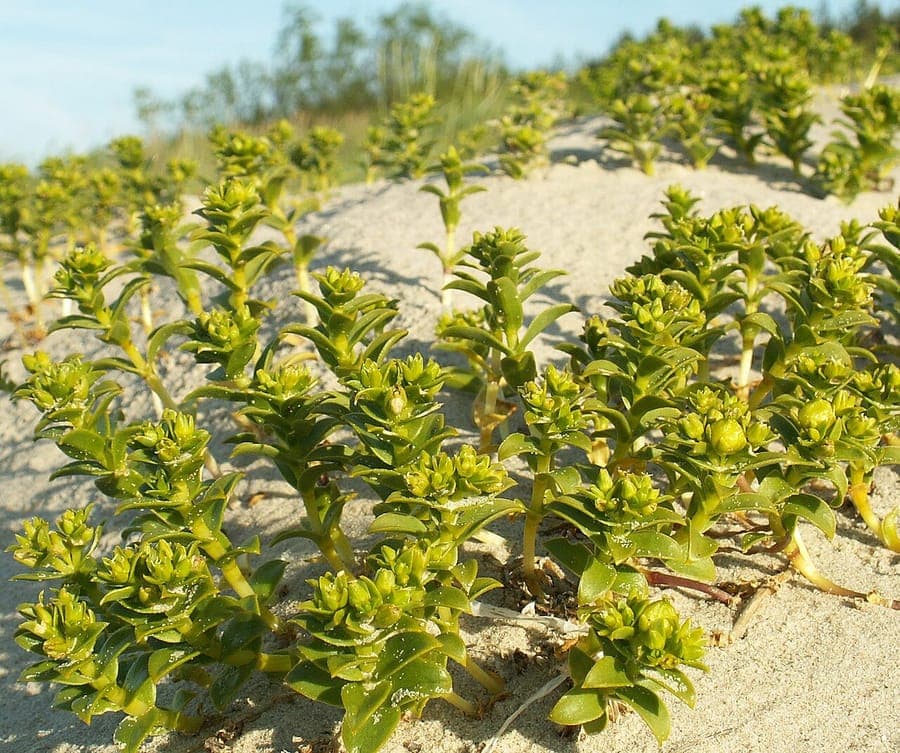
Krzysztof Ziarnek / CC BY-SA 3.0, via Wikimedia Commons
Sea Sandwort: complete guide
Honckenya peploides
¿Quieres ver Sea Sandwort: complete guide en tu jardín?
1 minuto, sin tarjeta de crédito
Overview
Sea Sandwort, scientifically known as Honckenya peploides, is a fascinating coastal beach plant from the Caryophyllaceae family. This low-growing succulent naturally grows on sandy and shale beaches from Europe, Russia to Japan and North America. With its thick, fleshy foliage and white flowers, it's a perfect specimen for salt-loving gardens and coastal areas. This plant behaves as a pioneer species on bare coasts.
Appearance and Bloom
Sea Sandwort reaches heights of only 5-15 cm and forms dense mats of small, green to yellowish foliage. The leaves are small, thick and fleshy, perfectly adapted to salt and sand. The stems are profusely branched and create a compact, cushion-shaped plant. From May to June, small, white to cream-white flowers appear on stem tips. Each bloom is small but numerous, creating a fine mosaic effect.
Ideal Location
This coastal endemic thrives best in full sun in open, windy locations. Sea Sandwort tolerates sea winds and salt spray well. Ideal for coastal areas, sand and shale banks, and even between stone paving. This is a winter-hardy plant for USDA zones 3-7, suitable for Northern Europe. Plant it in gravel beds and between stones.
Soil Composition
Sea Sandwort grows best on sandy, gravelly and nutrient-poor soils. This plant avoids moisture-retaining and heavy clay. Good drainage is essential. Add extra gravel or sand if you have heavy soil. The plant tolerates salt infiltration and sparse nutrients well. Rich soils can lead to overgrowth.
Diseño gratis
¿Quieres ver Sea Sandwort: complete guide en tu jardín? Crea un diseño gratis ahora.
Watering
Honckenya peploides has low water needs once established. Ensure drainage is extremely good. During the first growing period (first month), water moderately. Afterwards, water can be minimal. Seawater or salt water is not a problem for this plant. In very dry spells, sporadic watering can help.
Pruning and Maintenance
Sea Sandwort requires very little maintenance. Dead foliage can be removed. The plant grows naturally compact and needs no pruning. In autumn, dead parts can be removed. Regularly check for weeds around the plant, as it grows low.
Maintenance Calendar
March: Growth begins, inspection April-May: Blooming starts, minimal water June: Peak blooming, seed pod removal July-August: Hottest period, minimal maintenance September-October: Autumn preparation November-February: Winter dormancy, no maintenance
Winter Hardiness
Sea Sandwort is extremely cold-hardy and tolerates temperatures down to -20°C (USDA 3-7). The plant can withstand snow cover. In regularly frozen beaches, Honckenya peploides is a pioneer. No winter protection needed. The deep root system prevents frost heave.
Companion Plants
Sea Sandwort combines well with other salt-tolerant beach plants such as Sedum, sea rocket and beach mugwort. Also suitable as groundcover between stones and paving. Plant spacing: 25-30 cm for natural coverage. Create authentic coastal vegetation.
Closing
Sea Sandwort is essential for coastal gardens and ecologically responsible gardening. With minimal care and maximum ecological significance, it's an excellent choice. Discover how to integrate coastal plants in your front yard on gardenworld.app. Create an authentic seaside atmosphere with this special species via gardenworld.app.
¿Quieres ver Sea Sandwort: complete guide en tu jardín? Crea un diseño gratis ahora.
Sube una foto, elige un estilo y obtén un diseño fotorrealista con lista de plantas en menos de un minuto.
Más de 10.000 jardines diseñados
Sin tarjeta de crédito


Plantas similares
Dianthus karami: complete guide
Dianthus karami
Dianthus karami is a rare Lebanese mountain pink with fringed pink blooms on limestone cliffs, ideal for rock gardens and troughs.
Sicilian pink: complete guide
Dianthus siculus
Discover Dianthus siculus, an elegant purple bloomer from Sicily. Cultivation, June-September flowering and garden combinations.
Alpine mouse-ear chickweed: complete guide
Cerastium pedunculatum
Full growing guide for Cerastium pedunculatum: ideal location, soil, watering, winter hardiness, and companion plants for rock gardens.