
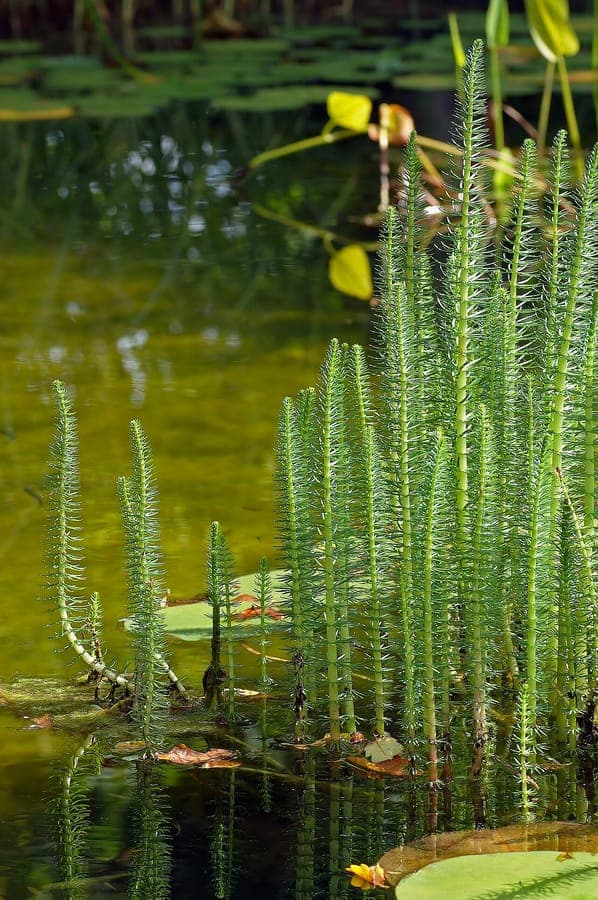
André Karwath aka Aka / CC BY-SA 2.5, via Wikimedia Commons
Hippuris vulgaris: complete guide
Hippuris vulgaris
¿Quieres ver Hippuris vulgaris: complete guide en tu jardín?
1 minuto, sin tarjeta de crédito
Overview
Mare's-tail (Hippuris vulgaris), also known as Horsetail aquatic, is an aquatic plant from temperate climates in Europe, Asia, and North America. This elegant water plant grows both underwater and above the water surface, reaching up to 60 cm tall. The plant is completely hardy, very low-maintenance, and ideal for front garden water gardens and ponds on gardenworld.app.
Appearance and Bloom
Hippuris vulgaris has characteristic, hair-fine leaves growing in circles around thin stems, giving a feathery appearance. The plant grows both underwater and above water, reaching up to 60 cm long. The flowers are very small and greenish, inconspicuous, blooming in May-June. The entire plant works more decoratively through the structure of leaf arrangements than through flowers. Very suitable for creating slender, upright forms in ponds.
Ideal Location
Mare's-tail thrives best in full sun to partial shade. For water gardens and ponds on gardenworld.app, a location with at least 4-6 hours of sunlight daily is ideal. The plant can also grow in partial shade but will grow more horizontally.
Soil and Water
Hippuris vulgaris can grow in (light) mud as well as completely underwater. For front garden ponds: use non-soil material and light gravel. The plant grows via slowly developing roots deep into the silt layer. Water doesn't need to be specially fertile. Water depth: 10-100 cm, with most of the stem underwater.
Watering and Environment
As a water plant, it has no 'watering' in the traditional sense, but rather stable water. Ensure clean, fresh water with natural water circulation. No standing water in a container - this plant needs moving water. Ideal in fountains, flowing water, or well-aerated pond water.
Diseño gratis
¿Quieres ver Hippuris vulgaris: complete guide en tu jardín? Crea un diseño gratis ahora.
Maintenance
Remove wilted above-water parts in autumn. Thin excessively growing plants: this species can grow massively and outcompete other aquatic plants. Pruning is appropriate in October if growth becomes too dominant.
Maintenance Calendar
- March-April: Signs of growth
- May-June: Blooming period (inconspicuous)
- July-August: Rapid growth, eventually thin
- September-October: Growth slowing, autumn cleanup
- November-February: Winter rest, check water for ice
Winter Hardiness
Hippuris vulgaris is fully hardy to -20°C (USDA zone 3-4). The plant overwinters easily in typical Dutch and Belgian ponds. However, ensure sufficient water depth (minimum 50 cm) so roots don't freeze. Under ice, the plant survives without problems.
Pond Companions
Pairs well with:
- Brookweed: similar growth
- Bistorta: flower contrast
- Caltha palustris: early yellow flowers
- Reed (Phragmites): keep height low
- Water mint: aromatic contrast
Protect from overcrowding by: Typha and Scirpus species.
Closing Thoughts
Mare's-tail is a fascinating choice for pond and water garden projects on gardenworld.app. With its elegant feathery leaf structure, complete hardiness, and minimal care requirements, this is a classic aquatic plant. Plant this in sufficient water depth, ensure clean, fresh water, and enjoy years of nature in your front garden.
Want to center your front garden around a pond or water pool? Visit gardenworld.app for advice and inspiration for water gardens.
¿Quieres ver Hippuris vulgaris: complete guide en tu jardín? Crea un diseño gratis ahora.
Sube una foto, elige un estilo y obtén un diseño fotorrealista con lista de plantas en menos de un minuto.
Más de 10.000 jardines diseñados
Sin tarjeta de crédito


Plantas similares
White Beardtongue: complete guide
Penstemon albidus
Discover white beardtongue (Penstemon albidus) - elegant perennial with white to cream flowers. Drought-resistant, perfect for prairie and dry gardens.
Longsepal Beardtongue: complete guide
Penstemon calycosus
Discover longsepal beardtongue (Penstemon calycosus) - beautiful perennial with lilac-blue flowers. For partial shade and moist soil. Ideal for naturalized.
Penstemon cusickii: complete guide
Penstemon cusickii
Discover Cusick's beardtongue, a compact alpine flowering plant with violet-pink blooms. Perfect choice for rock gardens and water-wise landscaping.