
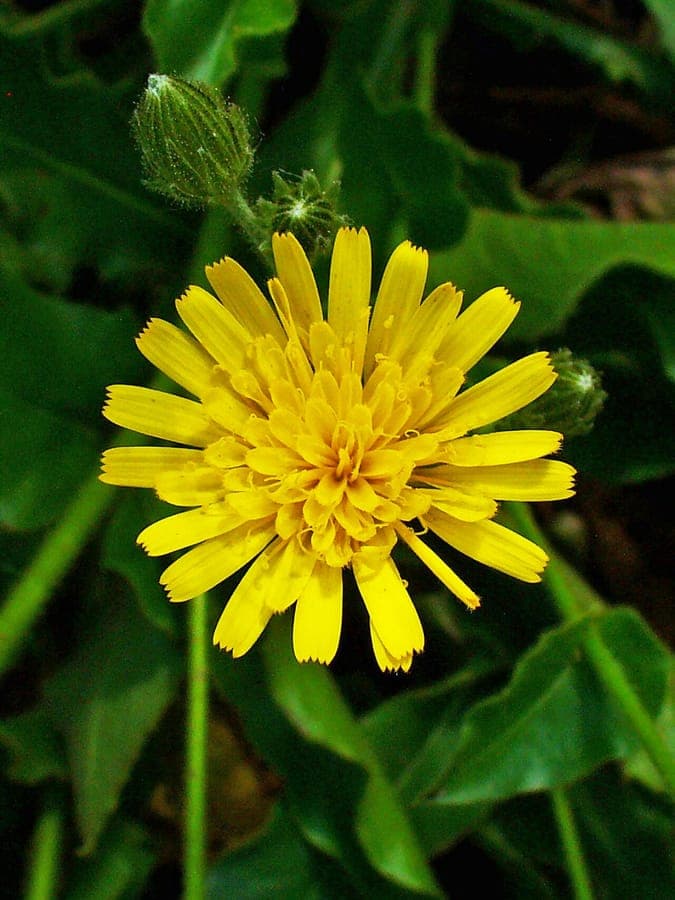
H. Zell / CC BY-SA 3.0, via Wikimedia Commons
Sticky hawkweed: complete guide
Hieracium amplexicaule
¿Quieres ver Sticky hawkweed: complete guide en tu jardín?
1 minuto, sin tarjeta de crédito
Overview
The Sticky Hawkweed (Hieracium amplexicaule), also known as the clasping-leaf hawkweed, is a mountain plant from the Asteraceae family, distributed across Central and Southern Europe and North Africa. This characteristic alpine plant grows on rocks and stony slopes and reaches modest heights to 50-60 cm.
Appearance and bloom
Hieracium amplexicaule forms loosely dense rosettes of oblong, clasping leaves (amplexicaule means embracing stem). Yellow flowers appear in terminal cymes with characteristic black hairs on seeds. Each flower reaches approximately 1.5-2 cm diameter, appearing during June and July.
Ideal location
This mountain plant thrives best on open, sunny locations with minimum 6 hours direct sunlight daily. In the Alps, it grows on south-facing mountain slopes. In gardens, position where unlimited sunny exposure combines with wind protection.
Soil requirements
Sticky Hawkweed proves highly flexible and grows well in lean soils. Optimal mix: 50% sand/grit, 30% peat moss, 20% rock fragments. pH 6.5-7.5. In containers use alpine mix with extra minerals. Plant shows little soil discrimination and thrives in lean ground.
Diseño gratis
¿Quieres ver Sticky hawkweed: complete guide en tu jardín? Crea un diseño gratis ahora.
Watering regime
Once established, highly drought-tolerant. Water only during extreme dry periods in growth season. In containers maintain moderate regular watering. Avoid waterlogging. Winter moisture extremely minimal.
Pruning
Minimal pruning required. Remove yellowed leaves or damaged parts. Seed heads can be removed for neater appearance or retained for self-seeding. No aggressive cutting needed.
Maintenance calendar
April: Check for pests. May-June: Regular watering. June-July: Bloom, minimal intervention. August: Allow seed ripening. September-March: Minimal care.
Winter hardiness
Hieracium amplexicaule proves hardy to approximately -15°C when established. In extreme winter conditions protect with dry mulch layer. Plant shows considerable resilience to extreme weather.
Companion plants
Pairs well with: Sempervivum species, low-growing alpines, Saxifraga species. All share preference for lean, well-draining soils and sunny positions.
Final thoughts
The Sticky Hawkweed belongs among robust mountain plants requiring minimal maintenance. Thanks to drought tolerance and winter hardiness, it forms a resilient element in alpine gardens. Available at specialty garden centers across Europe.
For more information visit gardenworld.app/en and gardenworld.app/en.
¿Quieres ver Sticky hawkweed: complete guide en tu jardín? Crea un diseño gratis ahora.
Sube una foto, elige un estilo y obtén un diseño fotorrealista con lista de plantas en menos de un minuto.
Más de 10.000 jardines diseñados
Sin tarjeta de crédito


Plantas similares
Calendula stellata: complete guide
Calendula stellata
Complete guide to Calendula stellata, the star-flowered marigold from Sicily: location, soil, watering and companion planting tips.
Korean chrysanthemum: complete guide
Chrysanthemum x rubellum
Chrysanthemum x rubellum is a hardy autumn perennial with single pink to copper flowers from August to November. Care and combinations.
Helianthus divaricatus: complete guide
Helianthus divaricatus
Helianthus divaricatus is a North American woodland sunflower with yellow summer blooms, ideal for naturalistic borders and shady edges.