
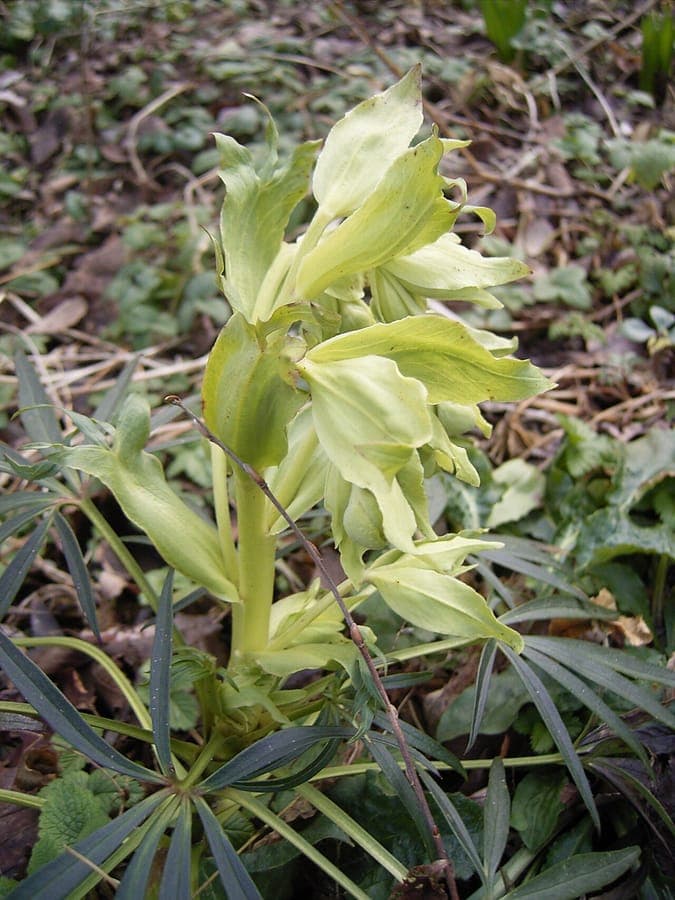
Wikimedia Commons / CC BY-SA 3.0, via Wikimedia Commons
Bear's-foot hellebore: complete guide
Helleborus foetidus
¿Quieres ver Bear's-foot hellebore: complete guide en tu jardín?
1 minuto, sin tarjeta de crédito
Overview
Bear's-foot hellebore (Helleborus foetidus) is a remarkable plant for gardeners who work with shade. Despite its unpleasant common name referencing the smell of crushed leaves, this is a garden essential for cold months. The plant blooms from December through May across USDA zones 5-9, making it invaluable in temperate climates.
Native to Western Europe from Belgium to southern Italy, bear's-foot thrives in woodland gardens and shaded borders. It's a self-sower - given time, a single plant will establish a colony of seedlings, gradually filling bare patches beneath trees.
Appearance & bloom cycle
Bear's-foot grows 30-50 cm tall with distinctive deeply divided, dark green foliage. The leaves are evergreen and provide visual interest year-round, even when flowers fade.
Flowers appear on branching stems from January to May depending on location. Each nodding bloom is small (roughly 2 cm across), greenish-yellow with prominent dark stamens. The subtle color palette appeals to gardeners who prefer quiet elegance over floral showiness. After flowering, distinctive seed pods develop and ripen by August, splitting explosively - the botanical name means "do not touch."
Ideal location
Bear's-foot is shade-loving and perfectly adapted for growing beneath deciduous trees. Dappled light from October to March combined with summer shade creates ideal conditions. Full sun exposure can cause leaf scorch in hot summers.
This hellebore thrives in:
- Dappled shade (85% of daylight ideal)
- Partial shade under beech or birch
- East or north-facing borders
- Woodland edges
Avoid exposed windy sites where cold winds damage emerging flowers.
Soil requirements
Bear's-foot prefers neutral to slightly alkaline soil (pH 7.5-8.0). Well-draining ground is essential - soggy conditions cause root rot. Amend planting holes generously with well-composted bark or leaf mold to improve both drainage and organic content.
The plant originates in European limestone woodlands, so slightly chalky or alkaline soils are optimal. In areas with acidic soil, add ground limestone when planting.
Diseño gratis
¿Quieres ver Bear's-foot hellebore: complete guide en tu jardín? Crea un diseño gratis ahora.
Watering
Water regularly for the first month after planting. Once established, bear's-foot has modest water needs. During dry spells in spring (April-May growing season), provide supplemental water. In winter, natural rainfall usually suffices.
Avoid overhead watering, which promotes fungal disease. Water at the base early in the morning.
Pruning
Maintenance pruning is minimal. Remove spent flowers and seed stems after blooming (May) if you want to control self-seeding. For compacter growth, remove one-third of the oldest stems in late spring.
Don't deadhead individual flowers if you want seeds to develop - this plant self-sows readily, which is usually desirable.
Maintenance calendar
- October-November: Thin seedlings as they emerge
- December-February: Peak flowering - enjoy blooms
- March-April: Remove faded flower stems
- May: Take seed heads only if you want controlled seeding
- June-September: Water during dry spells, minimal other maintenance
Winter hardiness
Hardy to -15°C (5°F), bear's-foot requires no special winter protection in most regions. Heavy, wet winters pose a greater risk - ensure excellent drainage to prevent root rot. In particularly wet years, apply mulch around the plant to keep the root zone from waterlogging.
Companion plants
Bear's-foot grows beautifully with:
- Ivy (Hedera helix) as ground cover
- Ferns such as Polystichum setiferum
- Christmas rose (Helleborus niger) - complementary bloom times
- Foamflower (Tiarella) for lime-green accent
- Bugle (Ajuga reptans) as low-level edging
Avoid aggressive climbers like clematis in the same planting zone.
Closing remarks
Bear's-foot is the sophisticated shade gardener's secret weapon. Find one in bloom (January-March) at local garden centres and place it beneath a tree. Within a few seasons, seedlings will have created a drifting colony of winter interest. On gardenworld.app, discover how hellebores integrate into complete shade-garden designs and explore seasonal planting strategies for year-round visual appeal.
¿Quieres ver Bear's-foot hellebore: complete guide en tu jardín? Crea un diseño gratis ahora.
Sube una foto, elige un estilo y obtén un diseño fotorrealista con lista de plantas en menos de un minuto.
Más de 10.000 jardines diseñados
Sin tarjeta de crédito


Plantas similares
Drummond's anemone: complete guide
Anemone drummondii
Discover Drummond's anemone (Anemone drummondii): a silvery-grey mountain plant for cool rock gardens and alpine troughs.
Korean clematis: complete guide
Clematis serratifolia
Clematis serratifolia is a hardy climber with fragrant yellow bell flowers in August-September. Pruning group 3, location and care tips.
Aquilegia brevistyla: complete guide
Aquilegia brevistyla
Discover Aquilegia brevistyla, the elegant North American columbine. Growing tips, shade tolerance, and design ideas for woodland and shadowed gardens.