
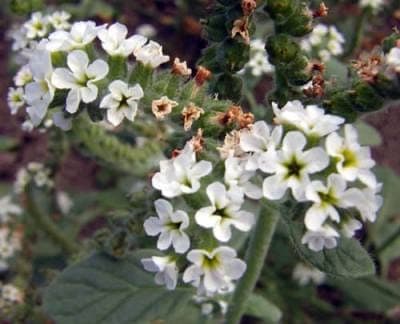
No machine-readable author provided. Aroche assumed (based on copyright claims). / CC BY-SA 2.5, via Wikimedia Commons
European heliotrope: complete guide
Heliotropium europaeum
¿Quieres ver European heliotrope: complete guide en tu jardín?
1 minuto, sin tarjeta de crédito
Overview
The European heliotrope (Heliotropium europaeum) is a small, unassuming annual herb native to the Mediterranean region. This modest plant grows naturally in warm, arid environments and is now distributed across much of Europe, the Mediterranean, and extending into India. Though often overlooked, it offers valuable benefits for dry gardens and requires minimal care.
Appearance and bloom
European heliotrope grows to about 15-30 cm in height, forming a compact, branching structure. The plant features small, grey-green leaves arranged densely along the stems. Flowers appear from July to September, displaying tiny white or pale purple blooms organized in characteristic spiral clusters at branch tips. The plant produces small, distinctive fruits that readily self-disperse.
Ideal location
This species thrives in warm, dry locations with full sun exposure. It requires a minimum of 6 hours of direct sunlight daily. European heliotrope exhibits exceptional tolerance for heat and drought, making it ideal for Mediterranean gardens, rocky slopes, and steppe-like landscapes. It performs wonderfully along sun-baked rocky outcrops and dry grasslands.
Soil
European heliotrope prefers well-draining, lean soils. The plant is highly tolerant of chalky, sandy, and loamy substrates. It struggles in wet, heavy clay soils. For home gardens: ensure good drainage by adding extra sand and grit to soil. A pH range of 6.5-7.5 is optimal.
Watering
Once established, this plant proves remarkably drought-tolerant and requires minimal supplemental water. During extended summer droughts, occasional watering in the first year aids establishment. However, excessive water encourages disease and decline. Underwatering is preferable to overwatering.
Diseño gratis
¿Quieres ver European heliotrope: complete guide en tu jardín? Crea un diseño gratis ahora.
Pruning and maintenance
European heliotrope requires minimal maintenance. Light pruning in early spring helps maintain compact form. Remove any dead or damaged branches. Since it's an annual, the plant naturally dies at season's end, so intensive pruning isn't necessary.
Maintenance calendar
- April-May: Sow seeds directly outdoors or start seedlings indoors
- June-August: Flowering period, minimal care needed
- July-September: Peak bloom, harvest seeds for next year if desired
- October-November: Plant material begins to decline
- December-March: Winter dormancy
Winter hardiness
European heliotrope is not winter hardy and succumbs to first frost. Treat as a summer annual, resowing each spring. In warm climates (USDA zones 10-11), it may overwinter as a perennial. In the Netherlands, Belgium, and parts of western Europe, it occasionally overwinters in sheltered coastal locations.
Companion plants
European heliotrope pairs beautifully with other drought-loving species:
- Lavender (Lavandula species)
- Delphinium
- Sea rocket (Cakile)
- Summer annuals like zinnias
- Salvias (Salvia species)
- Rock plants and sedums
These combinations create stunning, low-maintenance Mediterranean gardens.
Conclusion
European heliotrope is a valuable addition to dry gardens and Mediterranean landscape designs. It demands minimal care, displays exceptional drought tolerance, and offers delicate flowers throughout summer months. Perfect for gardeners seeking low-maintenance plants with genuine character.
Want to incorporate this plant into your garden design? Visit gardenworld.app for inspiration on creating Mediterranean gardens. Discover how gardenworld.app helps you develop a complete dry garden plan!
¿Quieres ver European heliotrope: complete guide en tu jardín? Crea un diseño gratis ahora.
Sube una foto, elige un estilo y obtén un diseño fotorrealista con lista de plantas en menos de un minuto.
Más de 10.000 jardines diseñados
Sin tarjeta de crédito


Plantas similares
Western waterleaf: complete guide
Hydrophyllum occidentale
Full growing guide for western waterleaf (Hydrophyllum occidentale): shade tolerance, soil needs, watering, winter hardiness and naturalistic garden use.
Limestone phacelia (Phacelia affinis): complete guide
Phacelia affinis
Full guide to Phacelia affinis, the limestone phacelia: sowing tips, purple-blue bee flowers, drought tolerance and uses in dry or wildlife gardens.
Pyrenean viper's bugloss: complete guide
Echium asperrimum
Echium asperrimum is a striking biennial from the western Mediterranean with rough bristly stems and vivid blue flowers. A magnet for bees and a bold border plant.