
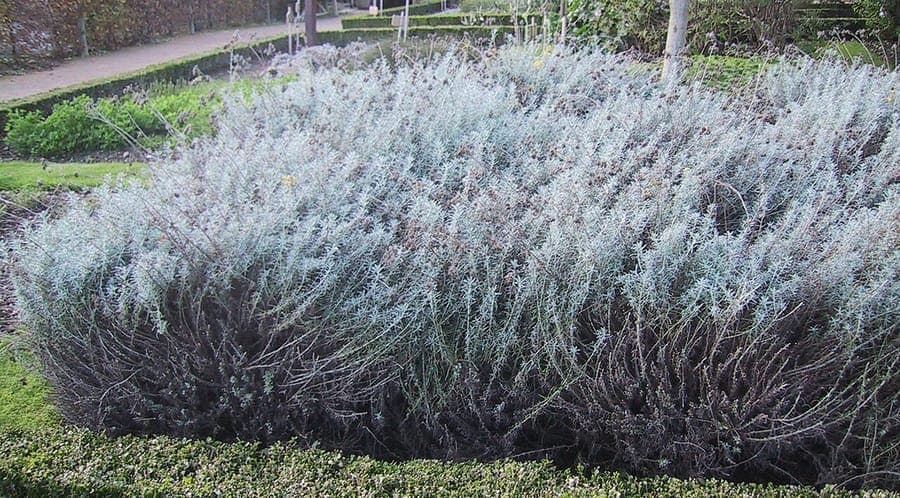
(c) 2005 Zubro / CC BY-SA 3.0, via Wikimedia Commons
Curry plant: complete guide
Helichrysum italicum
¿Quieres ver Curry plant: complete guide en tu jardín?
1 minuto, sin tarjeta de crédito
Overview
The Curry plant or Italian Everlasting (Helichrysum italicum) is an aromatic evergreen shrub from the Asteraceae family, native to the Mediterranean region. This plant is renowned for its strong, spice-like fragrance reminiscent of curry. The fragrance intensifies in warm weather and afternoon.
The Curry plant reaches heights of 40 to 60 cm and forms a compact, olive-like crown. The plant is highly drought-tolerant and ideal for Mediterranean, desert, and rock gardens.
Appearance and bloom
The Curry plant has narrow, silvery-gray leaves that grow densely around the stem. The leaves have interesting texture and are noticeably hairy. In summer, countless small yellow flower buds appear, forming attractive inflorescences together.
The flowers are crisp and retain their color well, making the plant suitable for dried flowers. When you rub between the leaves, a strong curry-like fragrance emerges.
Ideal location
The Curry plant grows best in a very sunny location with at least 6 hours of direct sunlight daily. Full sun is essential for strong growth and intense fragrance production.
Ensure a well-ventilated spot. The plant struggles less well in humid conditions. Avoid shady corners and places with poor air circulation.
Soil
The Curry plant thrives best in very well-draining, poor to moderately fertile soil. The plant is very adaptable and even grows in rocky, skeletal soil.
Tip: Work sand, gravel or perlite into heavy clay. The plant tolerates drought much better than wet feet. Ensure excellent drainage.
Diseño gratis
¿Quieres ver Curry plant: complete guide en tu jardín? Crea un diseño gratis ahora.
Watering
Once established, the Curry plant is highly drought-tolerant. Water regularly in the first growing year, but thereafter only sporadically.
In winter, water very little, especially in cold climates where frost damage is a risk. In Mediterranean climates, the plant can overwinter outside, but in northern Europe, frost protection is needed.
Pruning
The Curry plant tolerates pruning well. Pruning in early spring helps keep the plant compact. You can carefully cut back to approximately two-thirds of original height.
Remove dead or damaged branches as soon as you notice them. This promotes new, healthy growth.
Maintenance calendar
March-April: Pruning and shaping. Fresh soil in pots. May-September: Sporadic watering. Check for pests. October: Winter preparation. Move pots to protected location. November-February: Minimal water, rest period.
Winter hardiness
The Curry plant is not fully winter hardy in northern Europe. In the Netherlands and Belgium, plants must be kept frost-free.
In milder areas (southern Belgium, southwest Netherlands), young plants can overwinter outside with protection. Mulch around the root zone for extra protection.
Companion plants
Beautiful in combination with other drought-tolerant Mediterranean plants such as Lavender, Rosemary, Santolina and Rockrose. Together they form an aromatic, colorful garden.
In pot collections, it combines well with other sulfurous oily plants.
Conclusion
The Curry plant is a perfect choice for anyone seeking a fragrant, drought-tolerant garden plant. Highly suitable for patio herbs, medicinal plants and dried flowers. With minimal maintenance, this plant offers years of fragrance and color.
Curry plants can be purchased at gardenworld.app/en and garden centers.
¿Quieres ver Curry plant: complete guide en tu jardín? Crea un diseño gratis ahora.
Sube una foto, elige un estilo y obtén un diseño fotorrealista con lista de plantas en menos de un minuto.
Más de 10.000 jardines diseñados
Sin tarjeta de crédito


Plantas similares
Calendula stellata: complete guide
Calendula stellata
Complete guide to Calendula stellata, the star-flowered marigold from Sicily: location, soil, watering and companion planting tips.
Korean chrysanthemum: complete guide
Chrysanthemum x rubellum
Chrysanthemum x rubellum is a hardy autumn perennial with single pink to copper flowers from August to November. Care and combinations.
Helianthus divaricatus: complete guide
Helianthus divaricatus
Helianthus divaricatus is a North American woodland sunflower with yellow summer blooms, ideal for naturalistic borders and shady edges.