
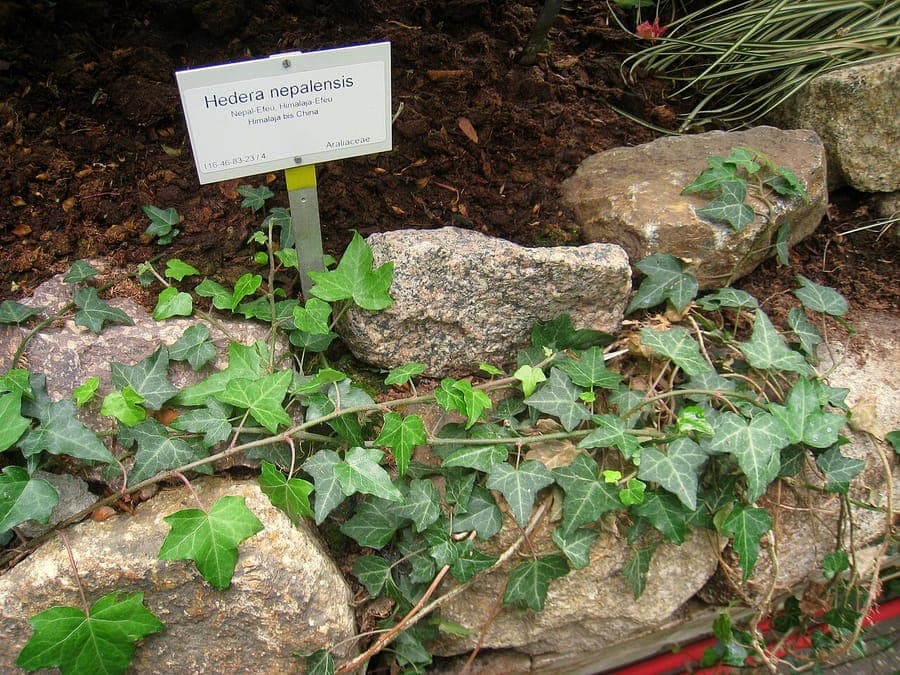
Daderot / Public domain, via Wikimedia Commons
Hedera nepalensis: complete guide
Hedera nepalensis
¿Quieres ver Hedera nepalensis: complete guide en tu jardín?
1 minuto, sin tarjeta de crédito
Overview
Hedera nepalensis, commonly known as Himalayan ivy, is an attractive climbing plant from the Araliaceae family. This slender evergreen climber naturally occurs in mountain regions from Afghanistan to Thailand. With its refined leaf structure and more modest growth than common ivy, it offers elegant solutions for wall coverage and screening. The plant is particularly suited to bare walls, pergolas and garden screens.
Appearance and bloom
Hedera nepalensis is distinguished by its glossy dark green foliage, which is smaller and more refined than other ivy species. The leaves are typically three-lobed and grow in a regular pattern along the stems. The plant grows slowly but steadily, eventually reaching heights of 3 to 4 meters or more, depending on support. In maturity, small, inconspicuous green flowers may appear, followed by characteristic black berries. However, these discrete flowers are not the plant's main feature.
Ideal location
Himalayan ivy thrives in locations with indirect light to partial shade. Direct full sun can cause leaf scorch, especially in warm climates. The plant grows well against north-facing and west-facing walls. As a mountain plant, it tolerates shade from other shrubs and structures well. It can also thrive indoors with adequate light, though outdoor growth is always superior. Avoid very windy locations, as stems can be delicate.
Soil
Hedera nepalensis prefers moisture-retentive but well-draining soil. A mixture of garden soil with organic matter such as compost works well. The plant cannot tolerate waterlogging around its roots. When planted in containers, a mix of potting soil with extra perlite and vermiculite is appropriate. The plant can grow in neutral to slightly acidic soils. Regular compost additions help maintain soil structure.
Watering
Hedera nepalensis enjoys consistently moist soil but not waterlogging. After planting, water regularly until the plant is well established, approximately four to six weeks. Subsequently, you can reduce watering somewhat, but the soil should never dry out completely. During the growth period (April-October), water more than in winter. In containers, water regularly as they dry out faster. Check the top centimeter of soil; if dry, watering is needed.
Diseño gratis
¿Quieres ver Hedera nepalensis: complete guide en tu jardín? Crea un diseño gratis ahora.
Pruning
Hedera nepalensis requires minimal pruning. You can pinch young plants to encourage branching. Remove dead or damaged stems annually. For shape maintenance, light pruning after the growth period is appropriate, especially when the plant grows too vigorously. Because it is a slow grower, regular pruning is unnecessary. Work from the base upward and support stems properly.
Maintenance calendar
February-March: Check for frost damage. Apply fertilizer for growth season. April-September: Growth season. Water regularly. Check for pests. October-November: Growth slows. Less water. November-January: Winter dormancy. Minimal maintenance. Water only if soil becomes very dry.
Winter hardiness
Hedera nepalensis is less winter-hardy than other ivy species, tolerating temperatures from -10 to -12 degrees Celsius. In temperate climates in Northern Europe, it can survive outdoors without protection, but in severe winters some protection helps. Choose a sheltered spot, preferably against a warm wall. In harsh climates, protect the upper portions with reed or burlap. The plant recovers well from frost damage and regrows.
Companion plants
Hedera nepalensis works well with other shade-loving climbers such as Schizophragma and Hedera helix. For ground coverage, supporting Epimedium or Helleborus work well. With beautiful structural plants like Fatsia japonica or Fatshedera, it creates interesting texture combinations. Avoid vigorous growers that would overwhelm the ivy. A single support structure suffices, such as an attractive old wall or pergola.
Closing
Hedera nepalensis is an elegant choice for those wanting vertical greening without an aggressive grower. With its refined foliage and controlled growth, it is ideal for smaller gardens. Available at major garden centers. For inspiration on garden design with climbing plants, visit gardenworld.app and discover how to integrate ivy perfectly. Provide the right location and consistently moist soil, and you will enjoy this beautiful climber for decades. Find more garden ideas at gardenworld.app.
¿Quieres ver Hedera nepalensis: complete guide en tu jardín? Crea un diseño gratis ahora.
Sube una foto, elige un estilo y obtén un diseño fotorrealista con lista de plantas en menos de un minuto.
Más de 10.000 jardines diseñados
Sin tarjeta de crédito


Plantas similares
American marsh pennywort: complete guide
Hydrocotyle americana
Everything about Hydrocotyle americana: location, soil, moisture and winter care. A delicate groundcover for shaded pond edges and boggy garden borders.
Devil's club: complete guide
Oplopanax horridus
Full guide to growing Oplopanax horridus: ideal site, soil, watering, and care for this dramatic spiny woodland shrub.
Water pennywort: complete guide
Hydrocotyle umbellata
Everything about Hydrocotyle umbellata: ideal location, soil, watering, winter care and pond planting. A versatile aquatic plant for garden ponds and boggy spots.