
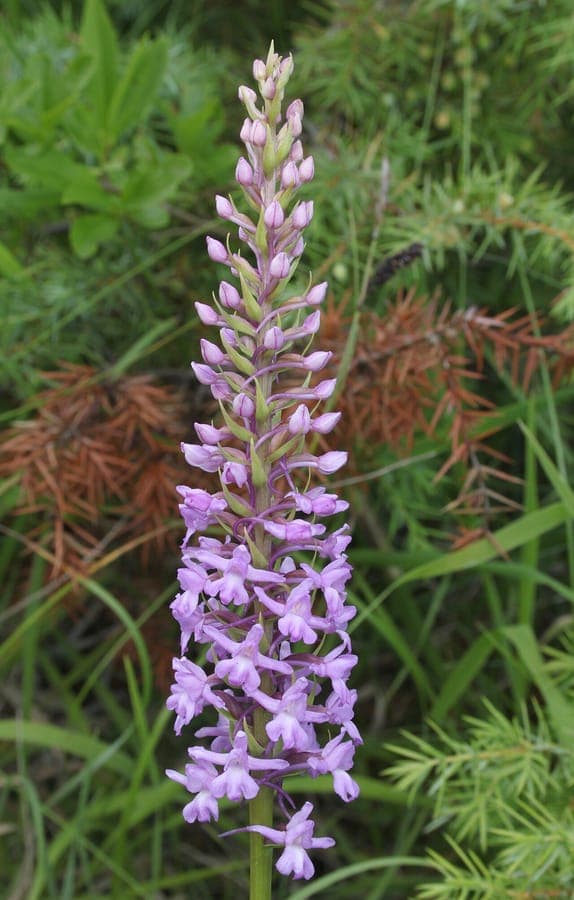
Holger Krisp / CC BY 3.0, via Wikimedia Commons
Gymnadenia conopsea (Fragrant Orchid): complete guide
Gymnadenia conopsea
¿Quieres ver Gymnadenia conopsea (Fragrant Orchid): complete guide en tu jardín?
1 minuto, sin tarjeta de crédito
Overview
Gymnadenia conopsea, commonly known as fragrant orchid or muggenorchis, is an enchanting wild orchid from the Orchidaceae family. This plant originates from Europe through to Northern and Central Asia and naturally grows in mountain meadows, grasslands, and moist terrain. The fragrant orchid is renowned for its intense, pleasant scent that is particularly strong in early summer. This plant is of great conservation importance and appears on many red lists of threatened species across Europe. For garden lovers wanting to create a natural garden with native wild orchids, Gymnadenia conopsea is a perfect choice.
When designing a wildflower or alpine garden on gardenworld.app, you can incorporate species like Gymnadenia conopsea, which provide a natural, ecological appearance. The intense fragrance of this orchid makes every garden a delightful experience and attracts pollinators.
Appearance & Bloom
Gymnadenia conopsea forms an upright, slender stem of 20-50 cm height. The plant grows from small tubers and forms basal, linear leaves. The most striking feature is the dense flower spike at the top of the stem with numerous small flowers ranging in color from pink to dark purple. Each flower is approximately 1 cm wide and has a characteristic long spur that can reach up to 15 mm. The flowers produce a strong, sweet fragrance especially in early morning and late afternoon. The blooming period extends from May to August, depending on altitude.
Ideal Location
Gymnadenia conopsea thrives best in sunny to partially shaded locations. In warmer climates (USDA zones 8-9), the plant can also tolerate some shade. In more northern regions (Netherlands, Belgium, USDA zones 5-6), full sun is recommended. The plant naturally grows on sloped meadows with moderate moisture and loves high-altitude gardens. Avoid completely shaded locations under trees.
Soil Requirements
The soil for Gymnadenia conopsea must have good drainage but also provide some moisture retention. A mixture of sand, garden soil, and some organic matter (approximately 40% sand, 40% soil, 20% humus) is ideal. The plant prefers neutral to slightly alkaline soils (pH 6.5-7.5). Critically important: this orchid depends on mycorrhizal fungi for nutrient uptake, so do not add chemical fertilizers. Instead, incorporate organic material.
Diseño gratis
¿Quieres ver Gymnadenia conopsea (Fragrant Orchid): complete guide en tu jardín? Crea un diseño gratis ahora.
Watering & Moisture
Gymnadenia conopsea prefers moderate moisture. During the growing period (May-August), the soil should never dry out completely. Water regularly but not excessively: the substrate may be moister than normal but not waterlogged. In winter, when the plant enters its dormant phase, you dry out moist soils and water less. In regions with abundant rainfall, the plant grows excellently without additional water.
Cultivation & Propagation
Gymnadenia conopsea propagation is difficult without the help of its natural mycorrhizal partner. For amateurs, it is better to purchase plants from specialist orchid growers. Wild collection of tubers is not recommended given the endangered status. In the garden, some populations multiply through seed dispersal if conditions are optimal. Seeds disperse in late August and September.
Maintenance Calendar
January-April: Dormant phase; keep soil dry. No feeding or watering. May: Growth begins; water carefully. June-July: Flowering period; maintain moist soil, spray regularly (not directly on flowers). August: After blooming, seed dispersal; maintain moisture levels. September-December: Leaves yellowing; gradually water less; plant enters winter dormancy.
Winter Hardiness
Gymnadenia conopsea is fully winter-hardy in temperate climates and can overwinter outdoors in the Netherlands and Belgium (USDA zones 5-6). The underground tubers survive frost without difficulty. Protection in harsh winters is not necessary. In very extreme winters, a blanket of dry leaves (5-10 cm) can be applied as extra protection, though this is usually not needed.
Plant Companions
Gymnadenia conopsea naturally grows in mountain meadows alongside other wild flowers. Good plant partners are other alpine herbs and grass-like plants: Pulsatilla, Gentiana, Dianthus, and low-growing grass. Plant these together in wildflower borders. Avoid strong competition from aggressive grasses or shrubs.
Final Thoughts
Gymnadenia conopsea is a unique, fragrant wild orchid that brings character and natural beauty to any garden. The plant makes modest demands and asks for respect for its dependence on fungi and natural growing conditions. By cultivating this orchid in your garden, you contribute to the conservation of this native species. Always purchase orchid plants from reliable growers found through specialized retailers and ensure they are not wild-collected. Use gardenworld.app to visualize your wildflower garden plan and ensure that Gymnadenia conopsea thrives optimally in the sun and moisture conditions of your garden.
¿Quieres ver Gymnadenia conopsea (Fragrant Orchid): complete guide en tu jardín? Crea un diseño gratis ahora.
Sube una foto, elige un estilo y obtén un diseño fotorrealista con lista de plantas en menos de un minuto.
Más de 10.000 jardines diseñados
Sin tarjeta de crédito


Plantas similares
Ram's-head lady's slipper: complete guide
Cypripedium arietinum
Everything you need to know about growing Cypripedium arietinum, a rare woodland orchid for cool, moist garden settings. Soil, care and planting tips.
Sparrow's-egg lady's slipper: complete guide
Cypripedium passerinum
Everything about growing Cypripedium passerinum, a cold-hardy subarctic orchid suited to cool, moist, shaded garden spots. Soil, care and companion plants.
Algerian Butterfly-orchid: complete guide
Platanthera algeriensis
Everything about Platanthera algeriensis, the rare Mediterranean orchid with greenish flowers native to Algeria, Morocco, Corsica and Spain.