
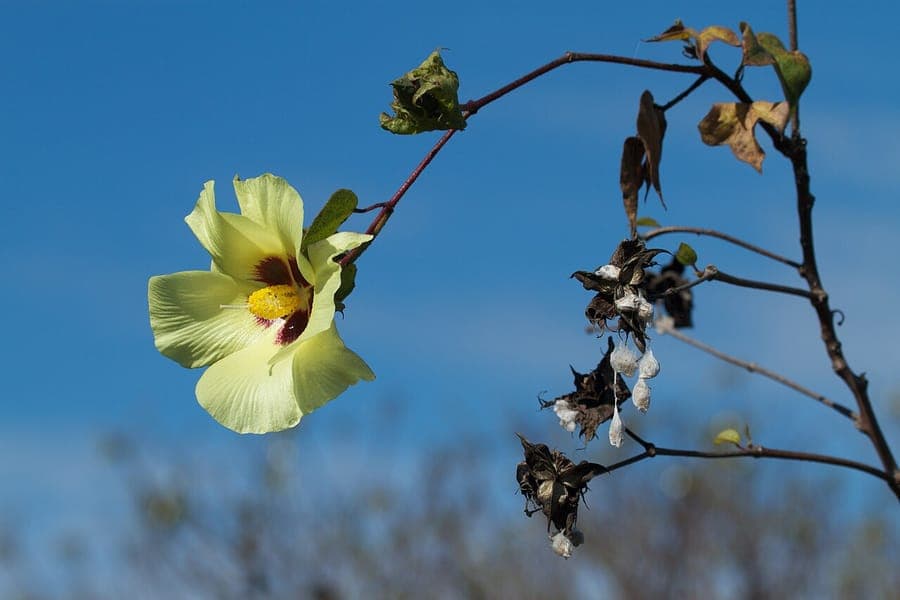
Brian Gratwicke / CC BY 2.0, via Wikimedia Commons
Pima cotton: complete guide
Gossypium barbadense
¿Quieres ver Pima cotton: complete guide en tu jardín?
1 minuto, sin tarjeta de crédito
Overview
Gossypium barbadense, better known as Pima cotton or American Pima cotton, is a tropical to subtropical shrub from the Malvaceae family. This valuable plant produces long, fine cotton fiber used for the most luxurious textile products. Native to the Andean region of South America (Colombia to Peru), it has spread to tropical and subtropical regions worldwide. Although best suited to warm climates, modern varieties can also be grown in temperate regions as a seasonal crop.
Appearance and bloom
The Pima cotton plant grows as a densely-branched shrub, typically 1-2 meters tall and equally wide under ideal conditions. The plant has dark green glossy leaves with characteristic lobing. The flowers are yellow with red or purple centers, very striking and attractive to pollinators. After fertilization, cotton bolls form - characteristic seed holders covered with long, fine fibers. These fibers are the valuable product. The plant becomes spectacular as the bolls ripen and open.
Ideal location
Pima cotton requires warm, sunny locations with at least 6-8 hours of direct sunlight daily. The plant is a heat lover and doesn't grow well in cold conditions. In temperate climates this must be grown in full sun in the warmest available spot. Protection from strong winds is important as these can damage the plant. In tropical regions mild shade during extremely hot periods is beneficial.
Soil
Pima cotton thrives best on well-draining, fertile soil with pH 6.0-7.0. The plant requires adequate organic matter and minerals. Heavy soils must be amended with sand and compost. This plant is hungry and requires more nutrition than many other crops. Pre-feeding with phosphate and potassium is crucial for good fiber/boll development. Mid-season fertilization greatly improves yields.
Diseño gratis
¿Quieres ver Pima cotton: complete guide en tu jardín? Crea un diseño gratis ahora.
Watering
Pima cotton requires regular, deep watering especially during growth and boll formation. Maintain soil moisture at 60-80% capacity. Too much water can cause rot, but insufficient water leads to poor yields. Drip irrigation or soaker hoses are ideal for this plant. In rainy periods supplemental watering can be minimal.
Pruning
Some pruning is beneficial. In early season remove lower branches to improve air circulation. Topping the plant in mid-season can encourage bushier growth. Remove damaged or diseased branches immediately. Avoid over-pruning which can reduce blooming. Careful pruning results in better air circulation and healthier plants.
Maintenance calendar
May-June: Seed preparation and soil preparation. June-July: Seeding and germination. July-August: Vegetative growth. August-September: Blooming period. September-October: Boll development and ripening. October-November: Boll opening and harvest preparation. November-December: Harvesting.
Winter hardiness
Pima cotton is very frost-sensitive and dies at temperatures below 10 Celsius. The plant doesn't grow well below 15 degrees. In temperate European climates this must be grown as an annual summer crop, planted after the last spring frost. In subtropical regions it can grow as a perennial plant.
Companion planting
In garden contexts Pima cotton can be planned with other tropical/subtropical crops. Companion plants can be okra, eggplant, peppers. Avoid allelopathic plants. Crop rotation is recommended to prevent diseases.
Closing
Gossypium barbadense Pima cotton is a fascinating crop for warm-climate gardeners interested in textile production. With luxury-quality fiber and reasonably simple cultivation, you can grow your own cotton! Visit tropical garden centers or seed suppliers for authentic Pima cultivars. gardenworld.app/en offers more inspiration for gardens with unique crops.
¿Quieres ver Pima cotton: complete guide en tu jardín? Crea un diseño gratis ahora.
Sube una foto, elige un estilo y obtén un diseño fotorrealista con lista de plantas en menos de un minuto.
Más de 10.000 jardines diseñados
Sin tarjeta de crédito


Plantas similares
Crimean linden: complete guide
Tilia × euchlora
Crimean linden is an elegant, fast-growing shade tree ideal for large gardens. Discover cultivars, spacing, maintenance tips and winter hardiness.
California flannelbush: complete guide
Fremontodendron californicum
Everything about California flannelbush (Fremontodendron californicum): sunny placement, drainage, pruning and care for this spectacular yellow-flowering shrub.
Hairy rose mallow: complete guide
Hibiscus moscheutos subsp. lasiocarpos
Full growing guide for hairy rose mallow (Hibiscus moscheutos subsp. lasiocarpos): location, soil, watering, winter hardiness and garden design tips.