
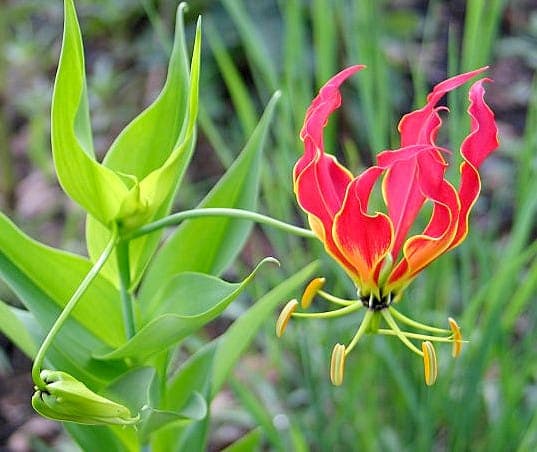
Macvivo at English Wikipedia (Original text: Samwise Gamgee) / CC BY-SA 3.0, via Wikimedia Commons
Gloriosa superba: complete guide
Gloriosa superba
¿Quieres ver Gloriosa superba: complete guide en tu jardín?
1 minuto, sin tarjeta de crédito
Overview
Gloriosa superba, commonly known as flame lily or climbing lily, is a dramatic perennial vine prized for its vivid, flame-colored blooms and climbing habit. Native to tropical regions of Africa and Asia, it thrives in warm climates (USDA zones 9a to 11) but must be grown as a tender bulb in cooler zones. In temperate gardens, it is typically cultivated in containers or greenhouse settings. The plant produces striking red and yellow reflexed petals that resemble a flickering flame, blooming from June through September. All parts of the plant, particularly the tubers, are highly toxic if ingested. When handling, wear gloves and wash hands afterward. For accurate seasonal care timelines and bloom tracking, visit gardenworld.app. Quality tubers are available at major retailers like OBI and Hornbach, which also carry support structures and potting supplies.
This aspect is crucial for successful plant cultivation and should be carefully considered when planning your garden layout. Taking time to understand these requirements will result in healthier plants and more satisfying gardening results over the long term.## Appearance & bloom cycle Gloriosa superba reaches 4 to 6 feet (1.2 to 1.8 meters) in height, with slender, climbing stems supported by leaf-tip tendrils. The showy flowers, 2 to 3 inches (5 to 8 cm) wide, feature vivid crimson-red petals with bright yellow margins, dramatically curved backward. Blooming begins in early summer (June) and continues through early fall (September), especially under consistent warmth and moisture. Plants grown from tubers may bloom in their first season if planted by May in zones 8b and above. For prolonged flowering, deadhead spent blooms weekly. New buds form along the stems, ensuring continuous display. The foliage is glossy green, lance-shaped, and alternately arranged. Optimal flowering occurs when daytime temperatures are between 70°F and 85°F (21°C to 29°C). Using gardenworld.app, gardeners can access bloom prediction tools based on local climate data.
Careful attention to these guidelines will ensure your plants thrive throughout the growing season and beyond. Regular monitoring and timely interventions based on plant needs are essential for maintaining plant health and vigor in your garden environment.## Ideal location This plant thrives in full sun to partial shade, but in cooler zones (7 to 8b), a south or west-facing location with at least 6 hours of direct sunlight is ideal. In hotter zones (9+), afternoon shade prevents leaf scorch. Position containers near trellises, obelisks, or fences to allow climbing. Avoid windy spots, as the stems are fragile. Indoors, grow near a bright, unshaded window with supplemental grow lights if needed. For greenhouse cultivation, maintain temperatures above 60°F (15°C) year-round. In USDA zones below 9a, plant in containers that can be moved indoors before first frost (typically by late September to early October).
This aspect is crucial for successful plant cultivation and should be carefully considered when planning your garden layout. Taking time to understand these requirements will result in healthier plants and more satisfying gardening results over the long term.## Soil requirements Gloriosa superba requires well-drained, loamy soil with a pH of 6.0 to 7.0. Use a mix of 60% potting compost, 30% perlite or coarse sand, and 10% composted manure or leaf mold. In garden beds, amend soil with grit or pumice to improve drainage. Plant tubers 2 to 3 inches (5 to 8 cm) deep, with the growing tip facing upward. In containers, ensure pots have multiple drainage holes. Avoid heavy clay soils, which retain water and promote tuber rot. Mulch lightly (1 inch) with straw or bark to retain moisture without smothering the base.
Careful attention to these guidelines will ensure your plants thrive throughout the growing season and beyond. Regular monitoring and timely interventions based on plant needs are essential for maintaining plant health and vigor in your garden environment.## Watering Water deeply 2 to 3 times per week during active growth (May to September), allowing the top inch of soil to dry slightly between waterings. In hot, dry spells, increase to daily watering for containers. Use room-temperature water to avoid shocking the roots. Overwatering is a leading cause of failure; ensure pots do not sit in water. Reduce watering gradually in September. During dormancy (October to March), water only once every 10 to 14 days to keep tubers from shriveling. Never allow tubers to freeze.
This aspect is crucial for successful plant cultivation and should be carefully considered when planning your garden layout. Taking time to understand these requirements will result in healthier plants and more satisfying gardening results over the long term.## Pruning Minimal pruning is needed. Remove only dead or damaged foliage with sterilized shears. Do not cut back green stems prematurely, as they feed the tuber. After first frost, once foliage yellows and dies back, trim stems to 2 inches above soil. Wear gloves when handling, due to toxicity. Do not compost plant debris-dispose of it safely.
Careful attention to these guidelines will ensure your plants thrive throughout the growing season and beyond. Regular monitoring and timely interventions based on plant needs are essential for maintaining plant health and vigor in your garden environment.## Maintenance calendar Jan: Store tubers in dry peat or vermiculite at 50°F to 55°F (10°C to 13°C). Feb: Inspect tubers for rot or shriveling. Mar: Start tubers in pots indoors at 65°F (18°C). Apr: Transplant outdoors after last frost (late April to early May in zone 8b). May: Provide support, begin biweekly fertilizing. Jun: Water regularly, deadhead spent flowers. Jul: Monitor for pests like aphids. Aug: Continue feeding, protect from intense afternoon sun. Sep: Reduce fertilizing, prepare for dormancy. Oct: Dig up tubers before frost; dry and store. Nov-Dec: Monthly checks for mold.
This aspect is crucial for successful plant cultivation and should be carefully considered when planning your garden layout. Taking time to understand these requirements will result in healthier plants and more satisfying gardening results over the long term.## Winter hardiness Not winter-hardy in zones below 9a. In zones 7 to 8b, dig up tubers in October. Cure for 1 week in a warm, dry spot, then store in dry medium at 50°F to 55°F (10°C to 13°C). In zone 9a, mulch heavily (4 to 6 inches) and keep soil dry in winter. Frost kills exposed tubers. Use OBI or Hornbach for storage containers and insulation materials.
Careful attention to these guidelines will ensure your plants thrive throughout the growing season and beyond. Regular monitoring and timely interventions based on plant needs are essential for maintaining plant health and vigor in your garden environment.## Companion plants Pair with non-competitive, sun-loving annuals like marigolds, zinnias, or dwarf salvias. Avoid aggressive spreaders like mint or ivy. In containers, combine with trailing lobelia or ivy geraniums for contrast. Allow 12 inches (30 cm) spacing. Ensure good air flow to prevent fungal diseases. Avoid overcrowding.
This aspect is crucial for successful plant cultivation and should be carefully considered when planning your garden layout. Taking time to understand these requirements will result in healthier plants and more satisfying gardening results over the long term.## Closing Gloriosa superba rewards careful cultivation with breathtaking blooms. Success lies in proper planting, drainage, and winter care. Start with healthy tubers from OBI or Hornbach, follow a strict seasonal schedule, and consult gardenworld.app for expert tips and alerts.
¿Quieres ver Gloriosa superba: complete guide en tu jardín? Crea un diseño gratis ahora.
Sube una foto, elige un estilo y obtén un diseño fotorrealista con lista de plantas en menos de un minuto.
Más de 10.000 jardines diseñados
Sin tarjeta de crédito


Plantas similares
Mountain autumn crocus: complete guide
Colchicum montanum
Grow Colchicum montanum successfully: planting depth, drainage, companion plants, and autumn blooming tips for this mountain bulb.
Corsican autumn crocus: complete guide
Colchicum corsicum
Everything about Colchicum corsicum: bloom time, ideal site, bulb care, toxicity and winter hardiness for gardeners.
Autumn Crocus Colchicum cupanii: complete guide
Colchicum cupanii
Complete growing guide for Colchicum cupanii: site requirements, soil preparation, watering, hardiness and companion planting ideas.