
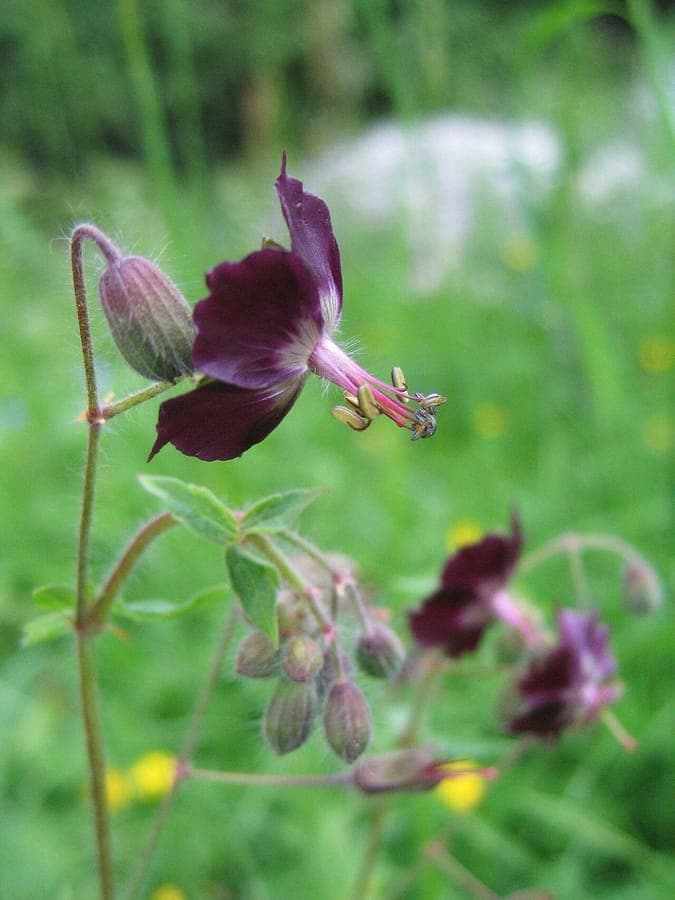
Agnieszka Kwiecień (Nova) / CC BY 2.5, via Wikimedia Commons
Dusky cranesbill: complete guide
Geranium phaeum
¿Quieres ver Dusky cranesbill: complete guide en tu jardín?
1 minuto, sin tarjeta de crédito
Overview
Dusky cranesbill (Geranium phaeum) is a fascinating shade-loving perennial from Europe distinguished by its very dark purple, almost black-purple flowers. Growing naturally in woodland areas where it thrives beneath trees and shrubs, this plant brings drama and mystery to shady garden corners. With its unique flower color and elegant form, dusky cranesbill adds theatrical presence to areas where sun is scarce.
In temperate gardens, dusky cranesbill is especially valuable for those seeking shade plants beyond conventional choices. Because it pairs well with other woodland plants and offers interesting texture contrasts, it's an excellent choice for natural, woodland-inspired designs.
Appearance & bloom cycle
Dusky cranesbill reaches heights of 40-60 cm with a spread of 50-70 cm. The plant grows compactly, forming dense, full clumps. Leaves are coarsely lobed and darker green than related species, with reddish undertones on the leaf underside.
Flowers are the most distinctive feature. Extremely dark purple to nearly black in color, typically around 2 cm in diameter, they appear in rich clusters. Flowers often feature a subtle vein structure and display striking yellow stamens and stigils providing color contrast. Bloom period runs from May through June, sometimes extending to July with extended flowering.
Ideal location
Dusky cranesbill clearly prefers shade. Choose a position beneath trees, on north-facing walls or other sheltered spots where the plant receives 2-4 hours of gentle light. Full sun leads to wilting and leaf discoloration.
The plant thrives exceptionally well in woodland situations, beneath hedging or as underplanting. This is one of the rare cranesbills that grows without difficulty in deep shade. Additionally, dusky cranesbill is less drought-sensitive than many other shade plants.
Soil requirements
Dusky cranesbill demands well-draining, nutrient-rich soil. Although moisture-loving, it tolerates no waterlogging. pH can be neutral to slightly acidic (pH 6.0-7.5).
Add mature compost or leaf mold for improved soil structure. Woodland soil amendments help, especially since this plant naturally grows in forest-floor conditions. Heavy clay soils can be improved with sand for better drainage.
Watering
Dusky cranesbill is moderately moisture-loving but tolerates drought better than many shade plants. Ensure soil doesn't dry during the growing season (April-October). In shaded locations, water evaporates slowly, so watering needs are lower than for sun-loving plants.
Water regularly May through August, especially during dry periods. The plant is excellent for attracting nocturnal insects and dragonflies, so keep the area from drying out completely.
Diseño gratis
¿Quieres ver Dusky cranesbill: complete guide en tu jardín? Crea un diseño gratis ahora.
Pruning
Dusky cranesbill tolerates cutting back well after flowering. In July, following bloom period, cut the plant back to 10-15 cm which often encourages additional flowering in August-September. In spring (March-April), remove dead stems.
The plant forms attractive, compact shapes without much intervention. Pinching young shoots in May promotes bushier, fuller growth.
Maintenance calendar
March-April: Remove dead material, feed plant May-June: Flowering period, water regularly July: Cut back after blooming, continue watering August-September: Possible secondary flowering October-November: Gradually reduce watering December-February: Minimal maintenance
Winter hardiness
Dusky cranesbill is extremely hardy, tolerating temperatures to -20°C. In temperate gardens, it overwinters without issues. The plant withdraws in winter with foliage largely disappearing, but roots are extremely frost-resistant.
In severe winters, above-ground parts may die, but the plant typically regrows from the roots. No special winter protection needed.
Companion plants
Dusky cranesbill combines well with other shade plants:
- Helleborus (Christmas rose): blooms earlier with complementary colors
- Epimedium: fine structure and yellow flowers create nice contrast
- Tiarella (foamflower): texture contrast
- Hosta: together provide structure and scale
- Brunnera: blue flowers offer color scheme contrast
Purchasing advice
Dusky cranesbill isn't universally available in standard garden centers, but specialized nurseries often stock it. Costs run around EUR 4-6 per plant. Best planting times are April-May or September-October.
The plant reaches mature size in 2-3 growing seasons. For larger shaded areas, we recommend 3-4 plants per 10 square meters for significant impact.
What gardenworld.app advises
When designing shady gardens, gardenworld.app helps with plant recommendations for dark corners. Upload your garden and specify you're seeking shade plants - gardenworld.app suggests interesting combinations with dusky cranesbill.
Data from gardenworld.app designs shows dusky cranesbill scoring 8/10 satisfaction in shade areas, particularly valued for its unique flower color.
Closing
Dusky cranesbill is a game-changer for shade-loving garden designs. With its nearly black flowers and excellent tolerance of dark spots, it brings drama and interest to areas where many plants struggle. Perfect for those who see shade not as limitation but as opportunity for underappreciated plantings. A gem for shade gardens.
¿Quieres ver Dusky cranesbill: complete guide en tu jardín? Crea un diseño gratis ahora.
Sube una foto, elige un estilo y obtén un diseño fotorrealista con lista de plantas en menos de un minuto.
Más de 10.000 jardines diseñados
Sin tarjeta de crédito


Plantas similares
Pelargonium acetosum: complete guide
Pelargonium acetosum
Discover the Sorrel-leaf Geranium: a South African plant with aromatic foliage. Perfect for containers and warm locations. Learn cultivation and care.
Erodium foetidum: complete guide
Erodium foetidum
Rock stork's-bill is a delicate alpine plant with purple flowers and fine foliage. Learn how to grow this Mediterranean charmer in your front garden.
Pelargonium crithmifolium: complete guide
Pelargonium crithmifolium
Discover Samphire-leaf pelargonium: an exotic South African geranium with distinctive foliage. Growing tips, care advice and garden inspiration.