
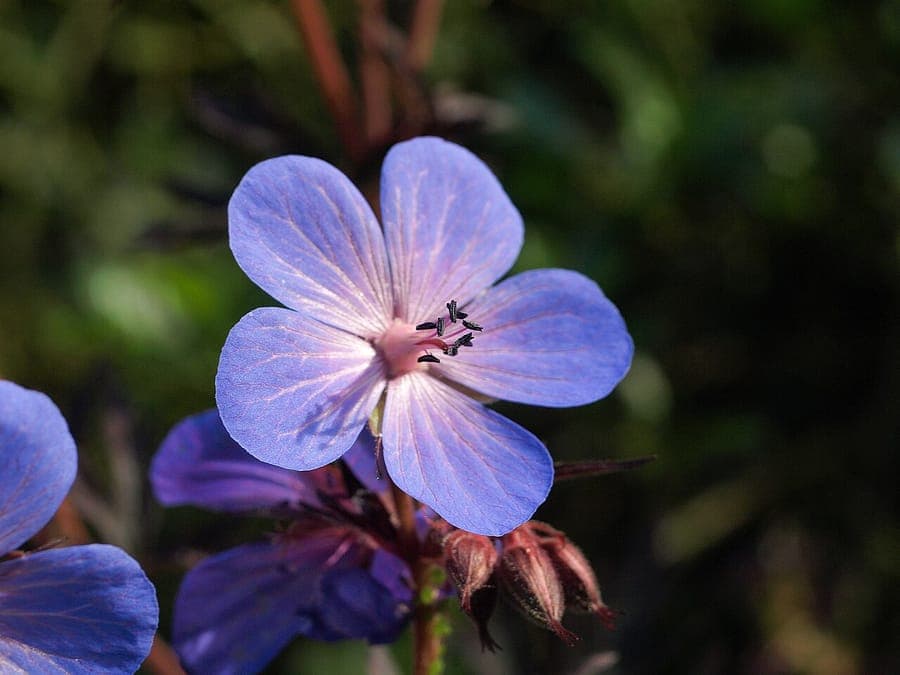
Roman Köhler / Public domain, via Wikimedia Commons
Geranium himalayense: complete guide
Geranium himalayense
¿Quieres ver Geranium himalayense: complete guide en tu jardín?
1 minuto, sin tarjeta de crédito
Overview
Geranium himalayense, better known as Himalayan crane's-bill or blue-eyed geranium, is a beautiful flowering perennial from the Geraniaceae family. This robust plant from the Himalayan mountains is popular with gardeners for its long flowering period, striking blue flowers and attractive leaf texture. It makes an ideal groundcover or front border perennial.
Appearance and bloom
Geranium himalayense grows as a low, spreading mat approximately 30-40 cm tall. The flowers are blue-purple with darker veins and appear over an extended period: June through September. The flowers attract bees and other pollinators. The foliage is deeply cut and contributes much to the visual impact. In autumn, leaves take on beautiful reddish tints.
Ideal location
This plant thrives in full sun to partial shade. In warmer climates, partial shade works better to maintain flowering. At least 4-5 hours of direct sunlight daily is ideal. Geranium himalayense tolerates open, exposed positions well and works excellently as an edging plant along pathways.
Soil
Geranium himalayense is not particular about soil. Well-draining soil is preferred, but the plant accepts average to slightly dry soils. Add organic matter at planting. A pH of neutral to slightly acidic is ideal. The plant tolerates even poor soils, though richer soils produce better foliage growth.
Watering
Regular watering during growth period (spring-summer). Once established, the plant is fairly drought-tolerant. During dry spells, water regularly, especially young plants. Keep winter watering minimal. Overwatering can cause root rot.
Diseño gratis
¿Quieres ver Geranium himalayense: complete guide en tu jardín? Crea un diseño gratis ahora.
Pruning
Minimal pruning required. After flowering, light cutting back can make the plant more compact. In late autumn, the stem mass can be removed. Young plants can be deadheaded for maximum foliage formation.
Maintenance calendar
APRIL: Initial growth, basic maintenance. MAY-JUNE: Rapid growth, regular watering. JULY-SEPTEMBER: Peak blooming, minimal maintenance. OCTOBER-NOVEMBER: Autumn coloring and above-ground dieback. DECEMBER-MARCH: Above-ground dead but underground growth preparation.
Winter hardiness
Geranium himalayense is extremely hardy (zone 3-9, down to -35C). This makes it an ideal choice for much of Europe. In the Netherlands, Belgium and Germany it grows without protection. The underground roots easily survive harsh winters.
Companion plants
Geranium himalayense combines beautifully with: Lavandula: Contrasting purple flowers and silvery foliage. Salvia: Complementary blue tones. Alchemilla mollis: Yellow-green enhances blue effect. Sempervivum/Sedum: For growth-contrasting texture.
Closing
Geranium himalayense is an essential perennial for edging, groundcover and mixed borders. With its long flowering period, robustness and winter hardiness, it provides value throughout the season. For more perennial recommendations and garden design, visit gardenworld.app/en.
Gardenworld.app helps you with perennial combinations and garden schemes.
¿Quieres ver Geranium himalayense: complete guide en tu jardín? Crea un diseño gratis ahora.
Sube una foto, elige un estilo y obtén un diseño fotorrealista con lista de plantas en menos de un minuto.
Más de 10.000 jardines diseñados
Sin tarjeta de crédito


Plantas similares
Pelargonium acetosum: complete guide
Pelargonium acetosum
Discover the Sorrel-leaf Geranium: a South African plant with aromatic foliage. Perfect for containers and warm locations. Learn cultivation and care.
Erodium foetidum: complete guide
Erodium foetidum
Rock stork's-bill is a delicate alpine plant with purple flowers and fine foliage. Learn how to grow this Mediterranean charmer in your front garden.
Pelargonium crithmifolium: complete guide
Pelargonium crithmifolium
Discover Samphire-leaf pelargonium: an exotic South African geranium with distinctive foliage. Growing tips, care advice and garden inspiration.