
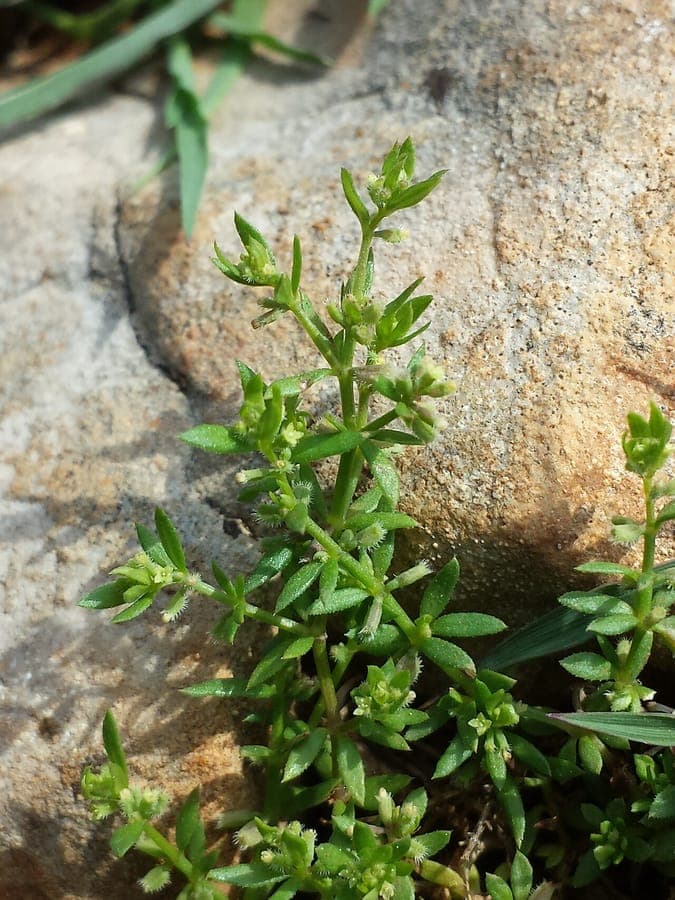
Stefan.lefnaer / CC BY-SA 4.0, via Wikimedia Commons
Yellow wall bedstraw: complete guide
Galium murale
¿Quieres ver Yellow wall bedstraw: complete guide en tu jardín?
1 minuto, sin tarjeta de crédito
Overview
Yellow wall bedstraw (Galium murale) is a delicate, low ground-covering plant from Mediterranean regions. Also known as wall bedstraw or small goosegrass, this charming plant belongs to the Rubiaceae family. With its fine flowers and slender growth habit, it is ideal for rock gardens, wall crevices, and border fronts. The plant behaves as both an annual and short-lived perennial, depending on climate conditions.
This plant is highly valued by gardeners and professionals for its versatile properties.## Appearance & bloom
Yellow wall bedstraw grows to approximately 15-30 cm tall with a slender, branched stem. The leaves are extremely fine and needle-like, giving the plant a delicate appearance. During the growing season (April to June), numerous small, bright yellow flowers appear in clusters. The flowers attract many pollinators and provide interest for many weeks. After flowering, small hooked fruits develop for seed dispersal.
Ideal location
Choose a sunny to partially shaded spot for yellow wall bedstraw. Full sun promotes richer flowering. The plant also grows in more shaded corners, although blooming is less profuse there. Plant it in rock gardens, wall crevices, as a border front, or in containers. It tolerates windy situations well.
Soil
Yellow wall bedstraw prefers well-draining, poor to moderate soils. This plant works best on sandy, rocky, or gravelly soil. Avoid nutrient-rich soils, which lead to excessive foliage at the expense of flowers. A pH between 6.0-7.5 is ideal. Add sand or gravel to heavy soils for better drainage.
Diseño gratis
¿Quieres ver Yellow wall bedstraw: complete guide en tu jardín? Crea un diseño gratis ahora.
Watering
Water moderately during the growing season, but once established, yellow wall bedstraw is extremely drought-tolerant. Excess water increases susceptibility to rot. Water only when the soil feels dry. In regions with regular rainfall, supplemental watering is usually unnecessary. During dry summers, some extra water may be welcome.
Pruning
Yellow wall bedstraw requires minimal pruning. When the plant fades after flowering, you can lightly cut it back to maintain compactness. For hardy varieties, you can remove wilted stems in early spring. Generally, allow the plant to retain its natural form.
Maintenance calendar
Spring: Plant seeds or cuttings for the new season. Summer: Enjoy rich flowering. Provide water during extreme drought. Autumn: Allow seeds to ripen for next year. Winter: In mild climates, the plant may persist; in cold climates, the above-ground part dies back.
Winter hardiness
Yellow wall bedstraw is hardy to -15 degrees Celsius. In colder regions, it functions as an annual. In temperate climates, it can be perennial. In very cold climates, protect it in winter with mulch or straw matting.
Companion plants
Combine yellow wall bedstraw with other rock garden plants such as small sedums, thyme, or pink family species. It combines beautifully with purple-foliaged plants for contrast. Underplant larger shrubs with yellow wall bedstraw for texture.
Closing
Yellow wall bedstraw brings a delicate charm to any rock garden or border zone. With minimal care and attractive yellow flowers, it is a wonderful choice for ground cover in Mediterranean and dry garden styles. Follow this guide for years of blooming.
Available at leading garden centers. Visit gardenworld.app/en for designs that perfectly integrate yellow wall bedstraw into your garden plan.
¿Quieres ver Yellow wall bedstraw: complete guide en tu jardín? Crea un diseño gratis ahora.
Sube una foto, elige un estilo y obtén un diseño fotorrealista con lista de plantas en menos de un minuto.
Más de 10.000 jardines diseñados
Sin tarjeta de crédito


Plantas similares
Oregon bedstraw: complete guide
Galium oreganum
Everything about Oregon bedstraw (Galium oreganum): shade planting, soil requirements, care and use as a low groundcover in woodland and shade gardens.
Awned woodruff: complete guide
Asperula aristata
Full guide to growing Asperula aristata, the awned woodruff: sunny location, alkaline soil, minimal watering, and companion plants for dry or rock gardens.
Purple woodruff: complete guide
Asperula purpurea
Full guide to Asperula purpurea, purple woodruff: sunny sites, chalky soil, watering, pruning, winter hardiness and companion plants for rock and dry gardens.