
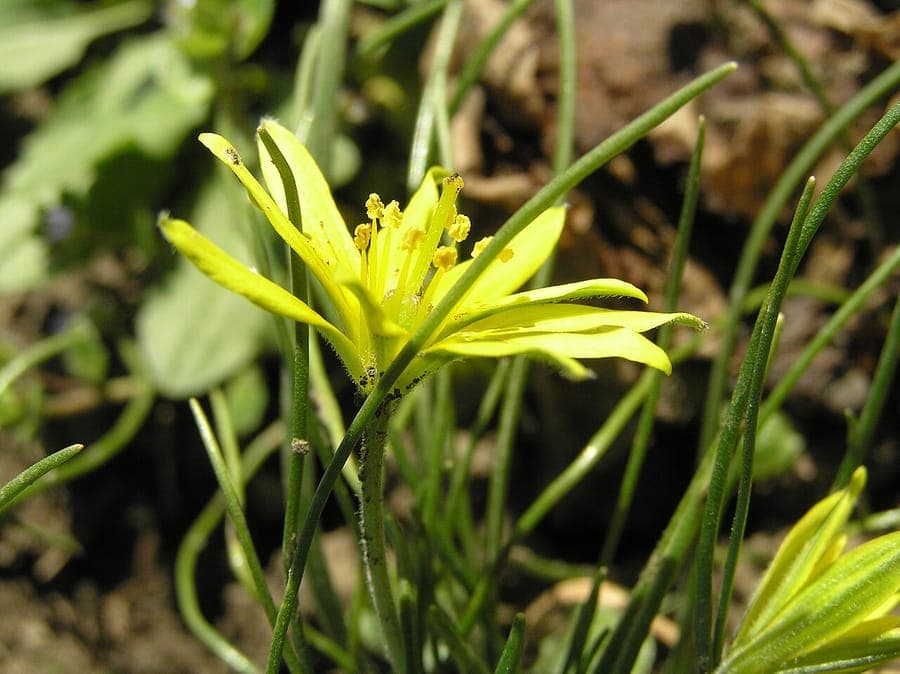
Rabe19 / Public domain, via Wikimedia Commons
Hairy star of bethlehem: complete guide
Gagea villosa
¿Quieres ver Hairy star of bethlehem: complete guide en tu jardín?
1 minuto, sin tarjeta de crédito
Overview
Hairy star of bethlehem (Gagea villosa), also known as "field star" and "woolly bloom flower", is a charming bulb from the lily family. The plant thrives from Europe to South Iran and provides reliable annual spring display. It is especially popular for naturalistic garden styles and Mediterranean gardens.
Appearance & Bloom
Hairy star of bethlehem grows to about 10 to 20 centimeters tall. The plant features characteristic hairy (villosa) leaves that originate at the base. Yellow flowers appear from March to April, depending on local weather conditions. Each flower displays a classic six-pointed star form in soft yellow or cream.
Ideal Location
Choose a sunny position to half-shade. The plant thrives excellently in rock gardens, gravel beds, and along garden edges. Prefers well-draining terrain, especially on slopes or raised beds. Combines well with other Mediterranean growing forms.
Soil
Hairy star of bethlehem grows excellently in mineral-rich, well-draining soils. A pH of 7 to 7.5 is ideal. The plant is tolerant of lean soils but grows stronger in moderate nutrient richness. Add gravel or sand to clayey soils.
Diseño gratis
¿Quieres ver Hairy star of bethlehem: complete guide en tu jardín? Crea un diseño gratis ahora.
Watering
Once established, hairy star of bethlehem needs minimal water. Bulbs in ground emerge with natural rainfall. During dry periods in March-April, keeping more moist can be beneficial. After blooming, allow to dry out completely.
Pruning
No pruning is needed. Withered flowers can be removed. Let leaves fully yellow and dry before removing so bulbs store enough food.
Maintenance Calendar
August-September: plant bulbs 10 centimeters deep. December-February: growth period underground. March-April: blooming in yellow. May-June: leaves yellow and dry. July-August: bulbs rest dry.
Winter Hardiness
Hairy star of bethlehem is completely hardy. The plant grows frost-resistant and survives temperatures to -20 degrees Celsius. Winter protection is not needed. In wet limestone areas, extra drainage can be helpful.
Companion Plants
Combine hairy star with crocuses, muscari, small tulips, and other Mediterranean flowering plants. The hairy leaves provide interesting contrast with smooth, blue-tinted plants. Beautiful foreground planting for emerging perennials.
Closing
Hairy star of bethlehem offers years of self-multiplying bloom with minimal effort. Available at garden centers across Europe. Discover more plants on gardenworld.app/nl and gardenworld.app/en.
¿Quieres ver Hairy star of bethlehem: complete guide en tu jardín? Crea un diseño gratis ahora.
Sube una foto, elige un estilo y obtén un diseño fotorrealista con lista de plantas en menos de un minuto.
Más de 10.000 jardines diseñados
Sin tarjeta de crédito


Plantas similares
Reverchon's gagea: complete guide
Gagea reverchonii
Full guide to Gagea reverchonii, Reverchon's gagea: rare Pyrenean bulb with bright yellow spring flowers, soil needs and companion planting.
Leafy gagea: complete guide
Gagea foliosa
Gagea foliosa is a rare Mediterranean bulb with bright yellow star-shaped flowers blooming February to March in well-drained rocky settings.
Tubular gagea: complete guide
Gagea fragifera
Gagea fragifera is a mountain bulb with golden-yellow star flowers blooming May to July on subalpine slopes from Europe to the Himalaya.