
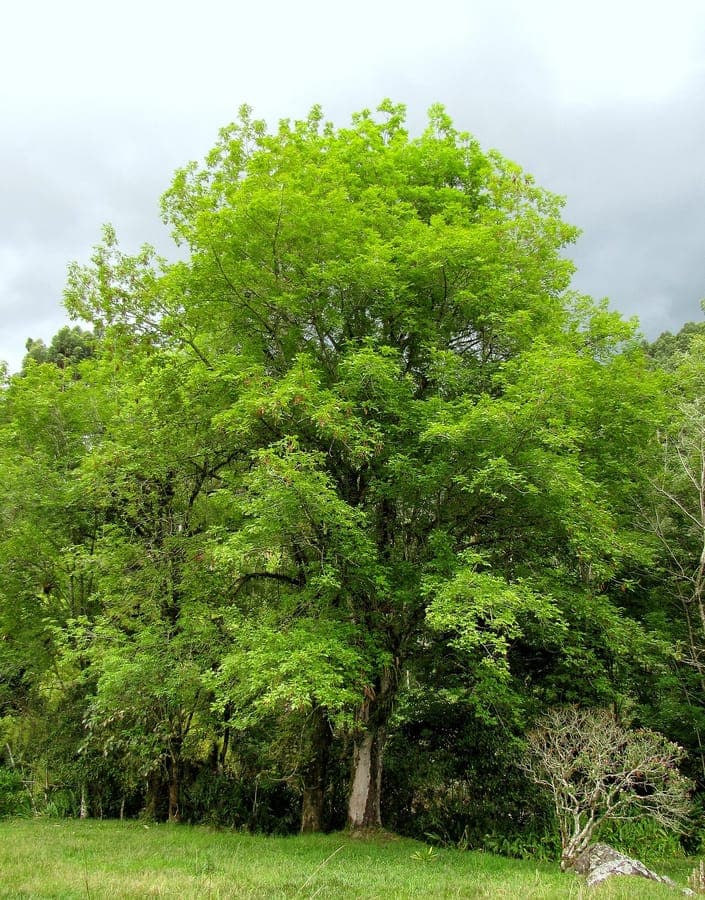
Alejandro Bayer Tamayo from Armenia, Colombia / CC BY-SA 2.0, via Wikimedia Commons
Shamel ash: complete guide
Fraxinus uhdei
¿Quieres ver Shamel ash: complete guide en tu jardín?
1 minuto, sin tarjeta de crédito
Overview
Shamel ash (Fraxinus uhdei), also known as tropical ash or Fresno in Spanish, is an elegant deciduous tree from the Oleaceae family native to Mexico and Central America. This graceful tree stands out for its dense, luxurious leaf mass and elegant form. In warm climates, it grows rapidly to a large, valuable shade tree. With its fast growth, elegant foliage, and adaptation to warm conditions, Shamel ash offers an excellent choice for larger gardens and landscape planting in subtropical regions.
Appearance and bloom
Shamel ash grows rapidly to a large, upright deciduous tree, typically 12-18 meters tall in cultivation. The trunk is fairly straight with grey-brown bark. The leaves are large, glossy, pinnate, composed of 7-9 leaflets 4-8 cm long. The foliage is dense and leafy in summer. Fall color is typically yellow to ochre. In summer (May to August), small green flowers appear in broad flower clusters; these are not very conspicuous but attract pollinators. After bloom, elongated winged fruits develop and hang elegantly.
Ideal location
Select a sunny to lightly shaded location for Shamel ash. At least 5-6 hours of direct sunlight daily promotes optimal growth. In very warm climates, light afternoon shade is beneficial. Protect from strong winds in young years; this tree develops strong wood as it ages. This is a tree that adapts to diverse climates, but thrives best in warm, moderately dry to moderately moist conditions. Plant in an open, airy location.
Soil
Shamel ash grows on diverse soils, from poor to nutrient-rich. It prefers well-drained, moderately moist soil but tolerates drought once established. pH can be neutral to slightly alkaline. Add organic matter (compost, leaf mold) when planting to stimulate young plant growth. Drainage is important; waterlogging can be harmful. This tree is quite adaptable to soil quality and nutrients once established.
Watering
Regular watering is important in the first year. Apply approximately 2-3 cm of water weekly during the growing period (May to October), distributed one to two times per week. In extremely hot or dry periods, supplemental water may be needed. Once established (after 1-2 years), this tree is very drought-tolerant and requires minimal moisture supplementation. Winter: in warmer climates, minimal watering; in temperate areas, no watering during the leafless period.
Diseño gratis
¿Quieres ver Shamel ash: complete guide en tu jardín? Crea un diseño gratis ahora.
Pruning
Minimal pruning is usually needed for healthy form. In young years, you may remove some lower branches to form a clean trunk. Regularly remove dead or crossing branches. This tree grows rapidly and can sometimes become overly vigorous; light annual pruning helps maintain compact form. Avoid heavy pruning on mature trees. Prune in spring or late summer.
Maintenance calendar
February-March: Leaf emergence, light shaping. April-May: Growth explosion, regular watering. June-August: Flowering period, adjust watering according to weather. September-October: Growth slows, reduce watering. November-January: Leaf drop, minimum maintenance. Year-round: Remove dead branches, inspect for damage.
Winter hardiness
Shamel ash is moderately hardy to USDA zones 8-9 (minimum temperatures around -9 to -6 degrees Celsius). In cold regions, young tree protection may be useful. In very cold areas, this species is less suitable; this tree is better for warmer Mediterranean or subtropical climates. In temperate climates, it survives outdoor wintering in protected locations. In moderately cold winters, partial or complete leaf drop may occur.
Companion plants
Shamel ash provides excellent shade. Beneath its canopy, shade and heat-tolerant plants grow well: Hellebores, Liriope, Salvia, Lantana, and drought-tolerant groundcovers. This is also a good tree for combination with other large trees in parkland settings. The dense foliage provides excellent bird and insect habitat. Avoid dense groundcovers directly against the trunk due to root competition.
Closing thoughts
Shamel ash is an incredibly valuable tree for warm climates. With its rapid growth, elegant foliage, and adaptability to various conditions, it offers value for large gardens, parks, and landscape planting in subtropical and warm Mediterranean zones. This is not a tree for very cold regions, but for gardeners in warm conditions. Start with young trees and provide regular watering in the first years; you'll see a fast-growing, impressive tree develop that provides value for decades.
¿Quieres ver Shamel ash: complete guide en tu jardín? Crea un diseño gratis ahora.
Sube una foto, elige un estilo y obtén un diseño fotorrealista con lista de plantas en menos de un minuto.
Más de 10.000 jardines diseñados
Sin tarjeta de crédito


Plantas similares
Rough menodora: complete guide
Menodora scabra
Full guide to Menodora scabra: a drought-tolerant desert subshrub with bright yellow flowers, ideal for rock gardens and xeriscapes.
Fraxinus dipetala: complete guide
Fraxinus dipetala
California ash or two-petal ash from southwestern USA. Beautiful spring flowers, drought-tolerant. Experimental choice for warm Mediterranean front gardens.
Syringa komarowii: complete guide
Syringa komarowii
Syringa komarowii is a striking lilac from central China with elegant flower spikes and lovely foliage. Discover the complete care guide here.