
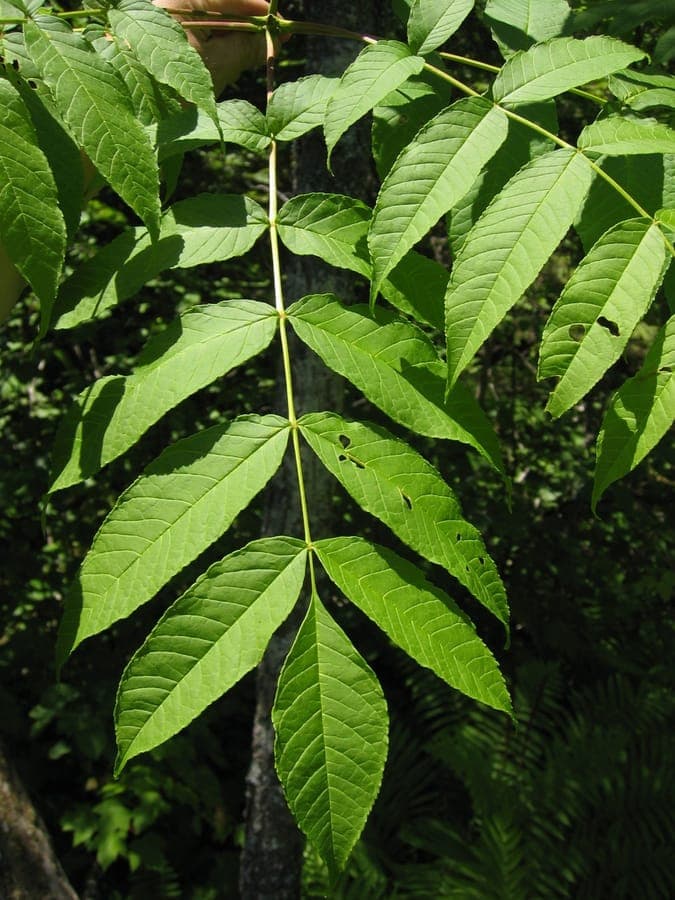
Keith Kanoti, Maine Forest Service, USA / CC BY 3.0 us, via Wikimedia Commons
Black Ash: complete guide
Fraxinus nigra
¿Quieres ver Black Ash: complete guide en tu jardín?
1 minuto, sin tarjeta de crédito
Overview
The Black Ash (Fraxinus nigra) is a graceful, native shade tree from North America, native to eastern Canada and the northeastern United States. This stylish, upright tree is valued for its ornamental value, fine foliage and golden autumn colors. Mature trees reach a height of 12-20 meters with a slender, upright-growing crown.
Appearance & bloom
The Black Ash is a medium to large tree with reddish-brown to black foliage and a slender, upright-growing crown. The leaves are compound, consisting of dozens of small leaflets that grow elegantly along the leaf stalks. The leaves are bright green in summer and change to golden-yellow to orange-brown in early autumn. The tree produces small white flowers in spring, followed by yellowish winged seeds (samaras).
Ideal location
This tree thrives best in full sun to half-shade with at least 4-6 hours of sunlight per day. Place in locations with good drainage and air circulation. Very suitable for parks, public green areas and large gardens. The tree tolerates wet sites well and grows excellently along waterside. Ideal as a shade tree or for screening.
Soil
The Black Ash is very adaptable to various soil types. Grows well on sandy, clayey and wet soils. Optimal is moderately rich, well-draining soil with pH 5.5 to 7.5. Plant at depth so the root collar is level with soil surface. Heavy clay can be lightened with sand. The tree tolerates wet feet well.
Watering
After the first growing year, regular watering for mature trees is not critical. During severe drought periods, watering helps prevent wilting. Water young trees regularly the first growing year. Mulch around base keeps soil moist. The tree naturally grows on wet sites.
Diseño gratis
¿Quieres ver Black Ash: complete guide en tu jardín? Crea un diseño gratis ahora.
Pruning
Minimal pruning is needed. The tree forms a natural, upright shape naturally. Remove only dead, damaged or disease-affected branches. Form pruning can be done after leaf fall in winter. Avoid heavy pruning that disturbs the natural shape. Young trees can be guided with a single leader.
Maintenance calendar
March-April: Inspect for winter damage and begin watering young trees. May-June: Growing season; flowering period with minimal care. July-September: Summer growth; water as needed. October-November: Enjoy autumn color; allow leaf fall. December-February: Winter dormancy; no pruning needed; remove dead wood only.
Winter hardiness
The Black Ash is very cold-hardy to about -35 degrees Celsius. Throughout Europe very tolerant of cold and frost. Originally from northern Canada, this tree is exceptionally winter-hardy. No winter protection needed.
Companion plants
Combine with other native North American trees such as birches, pines and oaks. Underplanting with shade-loving shrubs and grasses is possible. Beautiful as a background for deciduous trees. Not suitable for dense planting due to shade production.
Closing
The Black Ash is a beautiful, cold-hardy ornamental tree for large gardens, parks and public spaces. Available from tree nurseries in the Netherlands, Belgium, France, Germany and throughout Europe. In the Netherlands: Intratuin; In Germany: OBI/Hornbach (larger formats); In France: Truffaut/Jardiland.
¿Quieres ver Black Ash: complete guide en tu jardín? Crea un diseño gratis ahora.
Sube una foto, elige un estilo y obtén un diseño fotorrealista con lista de plantas en menos de un minuto.
Sin tarjeta de crédito


Plantas similares
Rough menodora: complete guide
Menodora scabra
Full guide to Menodora scabra: a drought-tolerant desert subshrub with bright yellow flowers, ideal for rock gardens and xeriscapes.
Fraxinus dipetala: complete guide
Fraxinus dipetala
California ash or two-petal ash from southwestern USA. Beautiful spring flowers, drought-tolerant. Experimental choice for warm Mediterranean front gardens.
Syringa komarowii: complete guide
Syringa komarowii
Syringa komarowii is a striking lilac from central China with elegant flower spikes and lovely foliage. Discover the complete care guide here.