
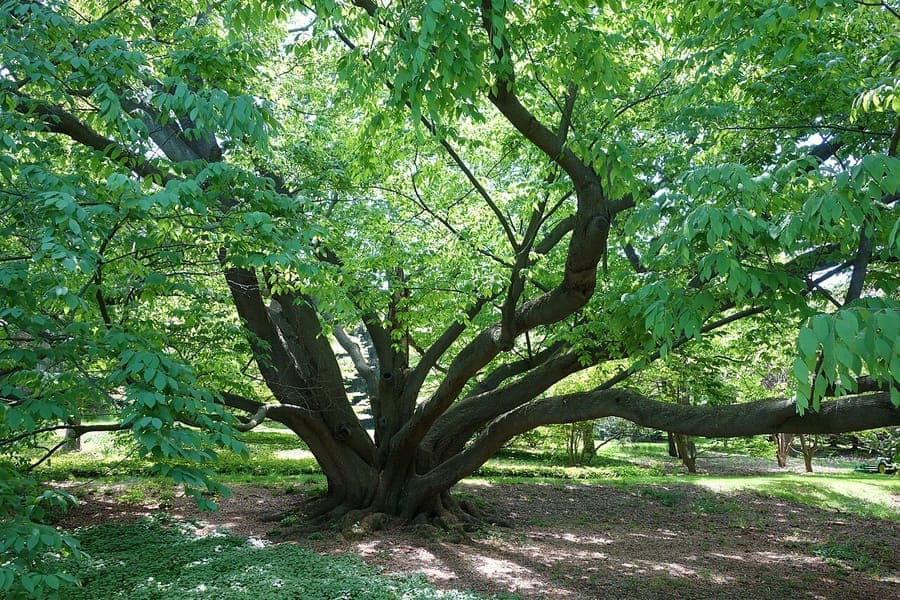
Daderot / CC0, via Wikimedia Commons
Chinese Beech (Fagus engleriana): complete guide
Fagus engleriana
¿Quieres ver Chinese Beech (Fagus engleriana): complete guide en tu jardín?
1 minuto, sin tarjeta de crédito
Overview
The Chinese Beech, scientifically known as Fagus engleriana, is a rare and elegant tree native to central and southern China. This impressive tree is celebrated for its fine, delicate leaves and spectacular fall foliage. Named after botanist Adolf Engler, this tree offers subtle beauty contrasting with more common beeches. For gardeners seeking something special, Chinese Beech is a true jewel offering years of appreciation.
Appearance and bloom
The Chinese Beech is a medium to large tree, reaching 15-20 meters at maturity. Leaves are fine and elegantly oval, much thinner and more refined than common beech. They are dark green during growing season with glossy surface. The leaf stalks are notably long and slender, giving foliage graceful, flowing appearance. Small, inconspicuous flowers appear in spring, but these aren't the highlight. True splendor manifests in autumn when leaves change from green to golden, orange and red tones. The color transformation is often slow and gradual, providing extended interest.
Ideal location
The Chinese Beech thrives best in well-lit locations receiving at least 4-6 hours direct sunlight daily. However, in gentler temperate regions with cooler summers, it accepts light shade. As a woodland tree from valleys and hillsides, it grows better with some wind protection. Plant in location with shelter from strong winds. The tree prefers deep, rich soil, so position carefully in moisture-retentive ground with organic matter.
Soil
The Chinese Beech prefers deep, fertile, well-draining soil. pH ideally ranges 6.5 to 7.0, though it accepts slightly acidic soil. Heavy clay soils must be improved with organic matter, especially compost and peat moss. The tree benefits greatly from full mulch layer around trunk base retaining moisture and cooling roots in summer. If soil is poor, regular spring compost application is beneficial.
Watering
The Chinese Beech requires regular watering, especially in first growing year and during dry periods. The tree prefers soil that remains moist but not saturated. Water deeply but not constantly. Drip irrigation system works well for young trees. Once established, the tree tolerates considerable drought thanks to its deep root system. However, during extreme drought, supplemental watering prevents diseased leaves and premature leaf drop.
Diseño gratis
¿Quieres ver Chinese Beech (Fagus engleriana): complete guide en tu jardín? Crea un diseño gratis ahora.
Pruning
The Chinese Beech requires minimal pruning once established. In early years, light formative pruning helps create desired shape. Remove birth defects, downward hanging branches, and crossing branches. Later, conduct only maintenance pruning in late winter, removing dead or damaged branches. Avoid pruning healthy wood as beeches recover slowly from heavy pruning.
Maintenance calendar
Mar-Apr: Examine winter damage; spring compost dressing May-Jun: Growth full; regular watering Jul-Aug: Growth continuous; maintain water in dry periods Sep-Oct: Fall color; minimal intervention; enjoy spectacular show Nov-Mar: Rest period; check for damaged branches
Winter hardiness
The Chinese Beech is reasonably hardy in temperate climates. It can tolerate temperatures to about -15 to -20 degrees Celsius, though young trees need more careful handling. In very cold areas, protection from icy winter winds is beneficial. Young trees particularly benefit from windbreaks in first few years. Once deeply rooted, the tree grows with determination.
Companion plants
The Chinese Beech combines beautifully with shade-tolerant shrubs and underplanting. Planting options include azaleas, rhododendrons, and native wildflowers. The light shade the tree provides creates perfect microclimate for these plants. Avoid strong competitors for water and nutrients beneath tree. Simple mulch communities work better than dense plantings.
Closing thoughts
The Chinese Beech is a unique and valuable choice for gardeners with space for a more subtle, refined tree. With its fine foliage, elegant branching structure, and spectacular fall color, it provides years of beauty. While it demands more careful care than many other trees, it is worthwhile. This is a tree adding narrative and character to landscape, perfect for gardeners preferring refined natural beauty.
The Chinese Beech is rare but available from specialized tree nurseries in the UK. Visit gardenworld.app for more information on planting exotic trees. Consult gardenworld.app for guidance on choosing the right location and soil preparation for your Chinese Beech.
¿Quieres ver Chinese Beech (Fagus engleriana): complete guide en tu jardín? Crea un diseño gratis ahora.
Sube una foto, elige un estilo y obtén un diseño fotorrealista con lista de plantas en menos de un minuto.
Más de 10.000 jardines diseñados
Sin tarjeta de crédito


Plantas similares
Lucombe oak: complete guide
Quercus crenata
Lucombe oak (Quercus crenata): a majestic semi-evergreen giant with corky bark, perfect for large gardens, parks, and country estates.
Blue oak: complete guide
Quercus douglasii
Discover the blue oak, a drought-tolerant Californian shade tree with striking blue-green foliage, ideal for large, climate-resilient gardens.
Quercus montana: complete guide
Quercus montana
Quercus montana, the chestnut oak, is a rugged American shade tree with deeply furrowed bark and large acorns, well suited to dry, rocky, spacious gardens.