
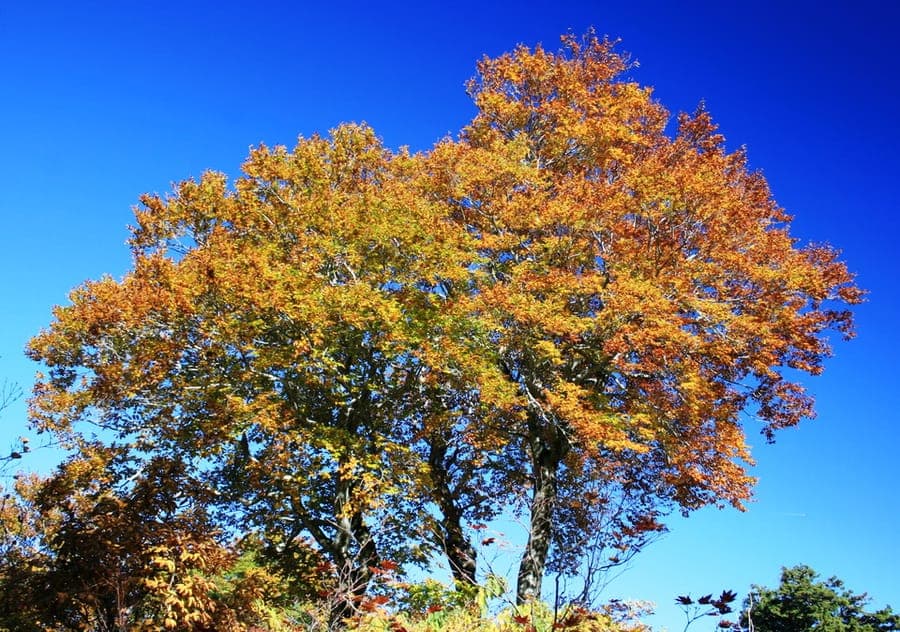
Alpsdake / Public domain, via Wikimedia Commons
Fagus crenata: complete guide
Fagus crenata
¿Quieres ver Fagus crenata: complete guide en tu jardín?
1 minuto, sin tarjeta de crédito
Overview
Fagus crenata, better known as Japanese beech or Siebold's beech, is a majestic deciduous tree from the Fagaceae family. This Asian tree hailing from Japan is known for its elegant structure, lustrous foliage and spectacular autumn colors. Increasingly, European gardeners are growing this impressive tree as an alternative to European beech.
Appearance and bloom
Fagus crenata is a large, columnar tree reaching 20-30 meters. The leaves are relatively small, oval and have lightly crenate edges (explaining the name "crenata"). In autumn they color brilliantly orange and red. The tree bark is brown and furrowed. Small inconspicuous flowers appear in spring, followed by edible beech nuts.
Ideal location
Japanese beech thrives best in full sun to half-shade. This tree provides best foliage and autumn colors with at least 6 hours of direct sunlight daily. Plant in a location protected from severe winds, although once established the tree is fairly wind-resistant.
Soil
Fagus crenata prefers nutrient-rich, well-draining soils. Unlike many other beeches, this species tolerates slightly more moisture than Fagus sylvatica. A pH of neutral to slightly acidic is ideal (6.0-7.0). Heavy clay soils can be improved with additions of organic matter.
Watering
During the growth phase (first 2-3 years), water regularly, especially during dry periods. Once established, Fagus crenata needs regular rainfall but is fairly drought-tolerant for a beech. Ensure good drainage - waterlogging can cause root rot.
Diseño gratis
¿Quieres ver Fagus crenata: complete guide en tu jardín? Crea un diseño gratis ahora.
Pruning
Minimal pruning is needed. The tree forms an elegant shape naturally. Remove dead branches, crossing branches or diseased branches in winter. Large pruning operations can damage the tree - prefer gradual sanitation.
Maintenance calendar
JANUARY-MARCH: Winter dormancy; prune in late January/February. APRIL-MAY: Leaf expansion, minimal maintenance. JUNE-AUGUST: Growth completed, moisture management important. SEPTEMBER-OCTOBER: Autumn coloring spectacular; no maintenance needed. NOVEMBER-DECEMBER: Leaf fall, preparation for winter.
Winter hardiness
Fagus crenata is hardy to zone 5 (-25C), suitable for much of Europe. In southern England, Belgium, Netherlands and France it thrives excellently. In colder regions (German mountains, Scandinavia), additional protection may be helpful for young trees.
Companion plants
Understory and woodland edge planting: Early European wildflowers (liverwort, bilberry) support bird populations. Japanese beech combines beautifully with other Asian trees: Acer palmatum varieties, Prunus serrulata.
Closing
Fagus crenata is an impressive tree for large gardens and landscapes. With its unique foliage and autumn coloring, this Japanese beech deserves a place in modern garden designs. For more tree suggestions and garden design, visit gardenworld.app/en.
Gardenworld.app helps you with landscape-scale designs with AI guidance.
¿Quieres ver Fagus crenata: complete guide en tu jardín? Crea un diseño gratis ahora.
Sube una foto, elige un estilo y obtén un diseño fotorrealista con lista de plantas en menos de un minuto.
Más de 10.000 jardines diseñados
Sin tarjeta de crédito


Plantas similares
Lucombe oak: complete guide
Quercus crenata
Lucombe oak (Quercus crenata): a majestic semi-evergreen giant with corky bark, perfect for large gardens, parks, and country estates.
Blue oak: complete guide
Quercus douglasii
Discover the blue oak, a drought-tolerant Californian shade tree with striking blue-green foliage, ideal for large, climate-resilient gardens.
Quercus montana: complete guide
Quercus montana
Quercus montana, the chestnut oak, is a rugged American shade tree with deeply furrowed bark and large acorns, well suited to dry, rocky, spacious gardens.