
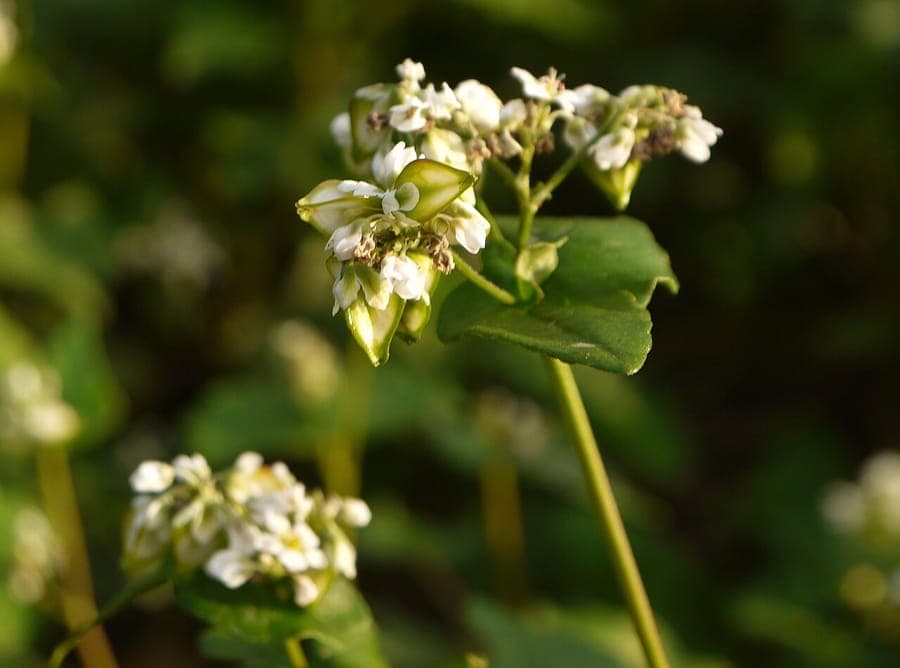
STRONGlk7 / CC BY-SA 3.0, via Wikimedia Commons
Common buckwheat: complete guide
Fagopyrum esculentum
¿Quieres ver Common buckwheat: complete guide en tu jardín?
1 minuto, sin tarjeta de crédito
Overview
Common buckwheat (Fagopyrum esculentum) is a unique annual crop plant from the knotweed family (Polygonaceae). Originally from Tibet and China, this fast-growing crop has established itself worldwide as an important food crop. With elegant, finely branched stems, pale pink-white flowers, and triangular nut-like seeds, buckwheat forms a beautiful grower in gardenworld.app gardens with food and ecological goals.
Buckwheat is both beautiful and useful - the ideal combination.
Appearance and Bloom
Common buckwheat is characterized by:
- Stems: Green or red-tinted, hollow, finely branched
- Leaves: Heart-shaped, soft, dark green
- Flowers: June through September, small white to pale-pink flowers in dense clusters
- Seeds: Triangular, dark brown when mature, ripen in 12-16 weeks
- Growth: 40-80 cm tall, 30-40 cm wide, modest upright habit
Flower development is continuous: plants bloom over weeks, new flowers replacing old continuously. Highly attractive to honeybees and other pollinators.
Ideal Location
Buckwheat grows best in:
- Full sun (minimum 6-7 hours direct light)
- Well-ventilated locations
- Well-draining, non-compacted soils
- Open gardens, fields, rough borders
- Perfect for permaculture and food gardens on gardenworld.app
Soil
- Type: Well-draining, moderately fertile soil
- pH: Neutral to acidic (6.0-7.5); flexible
- Nutrients: Moderate; buckwheat thrives even on poor soils
- Moisture: Moderately dry to normal
- Preparation: Work heavy soils with compost
Watering
- Growth: Regular water until bloom
- Bloom/Seed set: Less water; drought-tolerant phase
- System: Drip irrigation ideal
- Warning: Excess water leads to leaf production at seed expense
Diseño gratis
¿Quieres ver Common buckwheat: complete guide en tu jardín? Crea un diseño gratis ahora.
Harvesting and Maintenance
- No pruning required; plant grows naturally upright
- Flowers produce continuously until frost; no intervention needed
- Seed harvest: wait until seeds dark brown and hard
- Cut seed heads, dry, thresh by hand or machine
- Very low-maintenance crop; no fertilizer after planting
Maintenance Calendar
| Month | Activity |
|---|---|
| May | Direct sow in open ground |
| Jun | Emergence in 7-10 days; thin seedlings |
| Jul | Crop growth; minimal maintenance |
| Aug-Sep | Bloom and seed set; continuous harvest possible |
| Sep-Oct | Seed harvest when ripe |
| Nov | Incorporate residues or compost |
Winter Hardiness
- Sensitivity: Frost-sensitive; annual
- Growth: Dies at first night frost (below 0°C)
- Season: Pure summer crop; May through October
- Seed dormancy: Seeds can overwinter in cold soil
Companion Plants
Buckwheat combines interestingly with:
- Sunflower family (Helianthus)
- Herb gardens (Origanum, Thymus)
- Bird seed plants (Linaria, Reseda)
- Cover crop relatives (Phacelia)
- Open ground combinations
Buckwheat works well as green manure and bird feed crop in sequence.
Seed Production and Harvest
Buckwheat is highly productive:
- Seed yield: 20-30 grams per plant under ideal conditions
- Seed size: 6-7 mm triangular kernels
- Seed longevity: 4-5 years stored conditions
- Sprout speed: Average 85% germination
- Nutritional value: Interesting gluten-free grain
Final Thoughts
Common buckwheat is the compared wonder-crop for gardenworld.app gardens with food-ecological goals. With elegant white flowers, pollinator appeal, and nutritious harvest, it bridges beauty and functionality. Sow direct in May, harvest seed in October, and you have both bird feed and basis for future crops. Buckwheat teaches how nutrition and beauty are intertwined.
¿Quieres ver Common buckwheat: complete guide en tu jardín? Crea un diseño gratis ahora.
Sube una foto, elige un estilo y obtén un diseño fotorrealista con lista de plantas en menos de un minuto.
Más de 10.000 jardines diseñados
Sin tarjeta de crédito


Plantas similares
Crosby's wild buckwheat: complete guide
Eriogonum crosbyae
Full guide to growing Eriogonum crosbyae: ideal site, soil, watering, winter hardiness and companion plants for this rare western wild buckwheat.
Spreading buckwheat: complete guide
Eriogonum effusum
Full guide to growing Eriogonum effusum: ideal site, soil, watering, winter hardiness and companion plants for this prairie subshrub from the American West.
Tall woolly buckwheat: complete guide
Eriogonum elatum
Full guide to Eriogonum elatum: siting, soil, watering, pruning and companion plants for this elegant white-flowered buckwheat from the western United States.