
Seán A. O'Hara / CC BY 2.0, via Wikimedia Commons
Upright myrtle spurge: complete guide
Euphorbia rigida
¿Quieres ver Upright myrtle spurge: complete guide en tu jardín?
1 minuto, sin tarjeta de crédito
Overview
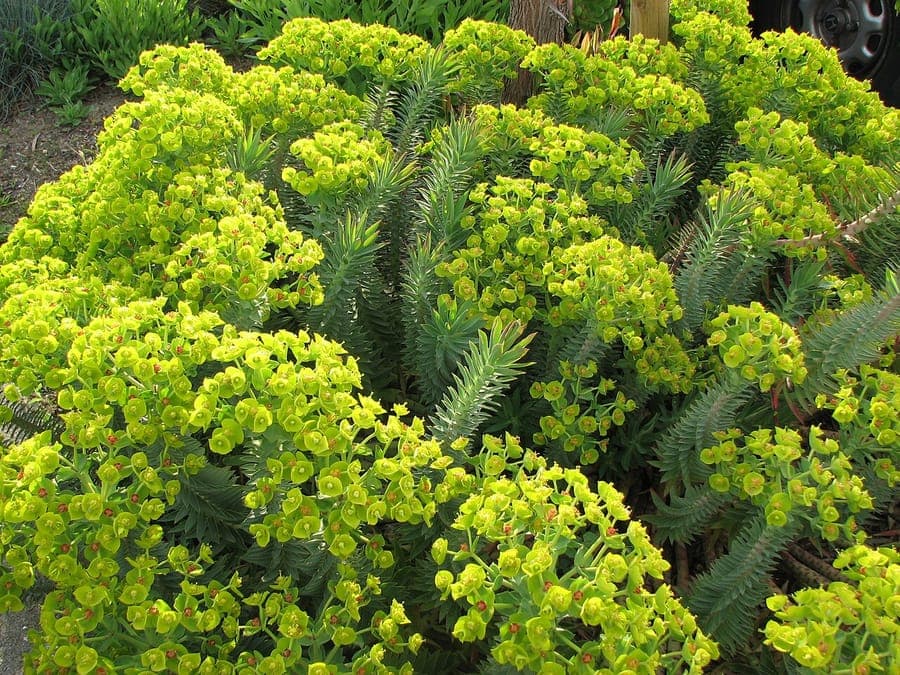
The upright myrtle spurge (Euphorbia rigida, also known as Euphorbia biglandulosa) is an imposing succulent from the Mediterranean and Southwest Asian regions. This remarkable shrub belongs to Euphorbiaceae and thrives in rocky, arid mountain terrain from North Africa through Iran. With its distinctly stiff, blue-green stems and golden cyathia flowers, it makes an architectural statement in any front yard. This plant delivers year-round visual impact with virtually zero maintenance demands.
Appearance and Bloom
Upright myrtle spurge forms a dense, upright shrub 60 to 100 centimeters tall and equally broad. Stems are distinctly rigid, densely clothed in blue-green leaves with a waxy surface. This foliage composition creates a futuristic, sculptural appearance that commands attention. Spring bloom (April through June) produces clusters of golden cyathia atop branch tips - subtle yet striking against the blue-green backdrop. Post-bloom, stem architecture remains the visual focus through seasons.
Ideal Location
Full sun exposure is absolutely non-negotiable. Aim for eight or more hours of direct sunlight daily to produce the most compact, vividly blue-green specimens. This plant excels in south-facing terrain, pergola-backed rock beds, and arid slopes. Its natural alpine origin makes it ideal for elevated beds where drainage is exceptional. Wind is no obstacle - it actually reinforces the upright stance.
Soil
Extremely well-draining, gritty soil is absolutely mandatory. Heavy clay causes inevitable root rot. Optimal soil mix: 30% garden loam, 50% coarse sand, 20% volcanic grit or perlite. pH between 6.0 and 8.0 is acceptable - these plants actually prefer slightly alkaline substrates. Compacted, dense soils guarantee failure. Thorough pre-planting soil preparation is essential.
Watering
Once fully established, water requirements are minimal. During growth periods (March through May and September through October), occasional watering supports vigor, particularly for young specimens. Monthly waterings during dry spells suffice. Summer and winter need virtually no supplemental moisture. Overwatering represents the most common failure cause. Protection from stagnant, wet feet is critical - excellent drainage is non-negotiable.
Diseño gratis
¿Quieres ver Upright myrtle spurge: complete guide en tu jardín? Crea un diseño gratis ahora.
Pruning
Minimal pruning is required for health. A cautious early-spring pruning removes dead or frost-damaged stems (March). Avoid aggressive pruning - these plants recover slowly from severe cutting. For young specimens, light tip-pinching encourages branching density. Since rigid structure persists naturally, formative pruning is typically unnecessary.
Maintenance Calendar
March-May: Growth period; weekly drought checks adequate. Remove dead material. Golden flowers bloom. June-August: Summer dormancy; minimal water, maximum sun. Plants rest significantly. September-October: Autumn growth resumes; occasional water acceptable. November-February: Winter dormancy; no water, no pruning, no intervention.
Winter Hardiness
Upright myrtle spurge tolerates cold to approximately -10 to -12 degrees Celsius, depending on clone and growing location. Throughout the Netherlands, Belgium, and France, no external winter protection is needed. In regions with severe winters (Germany, northern Europe), protection from winter wet (not cold) becomes critical. Snow actually protects; the real danger is soggy soil in winter months.
Companion Plants
Upright myrtle spurge creates striking architectural combinations with:
- Santolina chamaecyparissus (cotton lavender, silver-gray foliage)
- Salvia rosmarinus (rosemary in diverse forms)
- Agapanthus (Agapanthus, blue-purple spheres)
- Achillea filipendulina (yarrow, golden masses)
- Dianthus carthusianorum (Carthusian pink, fragrant)
This palette creates distinctly Mediterranean, water-conserving landscapes. Stone hardscape (tufa, slate) reinforces sculptural presentation.
Conclusion
Upright myrtle spurge is a statement plant for gardeners seeking architectural structure and drama without continuous labor. With minimal maintenance, this Mediterranean alpine proves its worth year after year. Perfect for contemporary, sustainable garden design. Discover its integration potential at gardenworld.app. Create your ideal front garden at gardenworld.app.
¿Quieres ver Upright myrtle spurge: complete guide en tu jardín? Crea un diseño gratis ahora.
Sube una foto, elige un estilo y obtén un diseño fotorrealista con lista de plantas en menos de un minuto.
Más de 10.000 jardines diseñados
Sin tarjeta de crédito


Plantas similares
Woolly mercury: complete guide
Mercurialis tomentosa
All about Mercurialis tomentosa, the woolly mercury from southwestern Europe: site, soil, watering, care and garden design tips.
Shurur: complete guide
Euphorbia fruticosa
Everything about Shurur: cultivation in dry climates, xeriscaping, care and tips for drought-resistant gardens in warm climates
Glary spurge: complete guide
Euphorbia glareosa
Everything about glary spurge: cultivation, maintenance, frost hardiness and use in Mediterranean and mountain-inspired gardens