
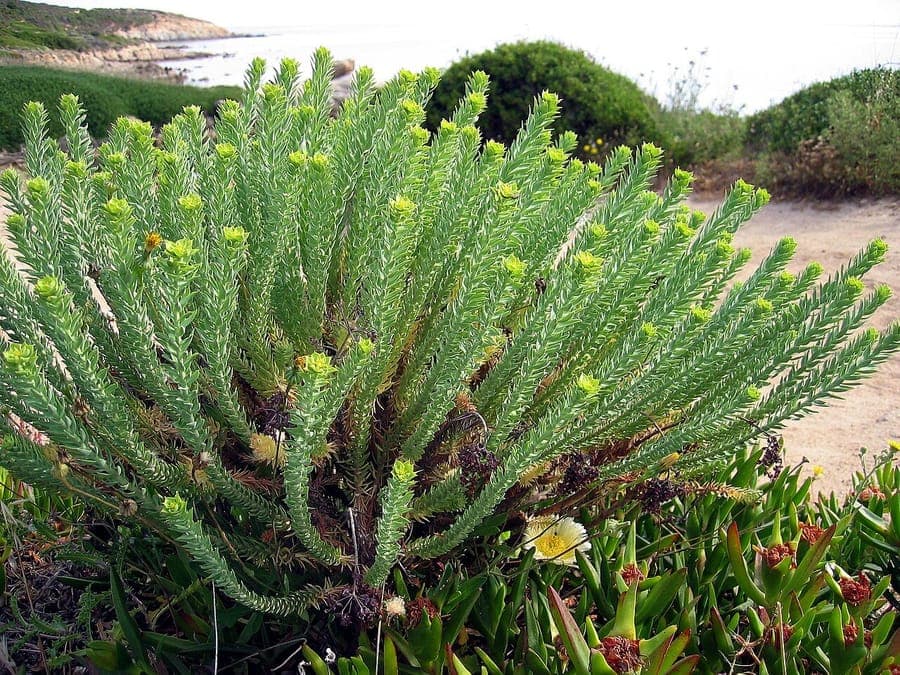
User:Tigerente / CC BY-SA 3.0, via Wikimedia Commons
Sea spurge: complete guide
Euphorbia paralias
¿Quieres ver Sea spurge: complete guide en tu jardín?
1 minuto, sin tarjeta de crédito
Overview
Sea spurge (Euphorbia paralias) is a distinctive Mediterranean coastal specialist, native to saltspray-drenched dunes from Portugal eastward. This compact, succulent-leaved plant reaches just 30-50 cm and thrives where other plants struggle - in poor, sandy, saline-influenced soils. Its blue-green, fleshy foliage and modest golden flowers make it invaluable for challenging coastal and xeriscape gardens.
Appearance and bloom cycle
Sea spurge develops a low, spreading habit with densely-packed, fleshy blue-grey foliage that appears distinctly different from other Euphorbia species. Individual leaves are rounded, waxy, and drought-adapted. The plant remains evergreen throughout the year in frost-free regions. From May to July, modest yellow-green inflorescences appear at stem tips, less flamboyant than some relatives but striking against the cool leaf colouration. Persistent seed capsules extend ornamental value into autumn.
Ideal location
Sea spurge demands full sun - provide at least 6-7 hours of direct daily light for best health and compact growth. This is a heat-lover; position against south-facing walls, on gravel terraces, or in the hottest, most sheltered corner available. In British gardens, it's marginal outdoors (USDA 8-9) except in the warmest southern counties and coastal areas. Elsewhere, it's best grown in containers moved to shelter in winter. Wind exposure is less problematic than insufficient heat.
Soil requirements
This is where sea spurge differs fundamentally from other Euphorbia's. It demands very poor, sharply-drained sandy substrate: aim for 70% sharp sand or gravel, 20% small pebbles, 10% minimal compost. The plant actually tolerates saline soils - it evolved on salt-spray-drenched dunes. In containers, use 60% perlite, 30% coarse sand, 10% loam-based compost. Avoid nutrient-rich soils and heavy clay; poor ground is preferable to fertile ground.
Watering
Minimal watering required. After establishment, water sparingly. In cooler climates, rainfall usually provides sufficient moisture. Summer droughts are actively welcomed. Potted specimens need watering only once every 2-3 weeks in summer; less in cooler months. Container-grown plants fail far more from overwatering than from drought. Ensure container drainage is immaculate - place pots on pot feet, never standing in saucers.
Diseño gratis
¿Quieres ver Sea spurge: complete guide en tu jardín? Crea un diseño gratis ahora.
Pruning
Minimal work needed. Remove genuinely dead branches if they develop; otherwise leave the plant to maintain its naturally compact form. Winter growth that extends unevenly can be trimmed. Always wear gloves; the white sap causes skin irritation. This plant rarely becomes unruly, so focus intervention only on genuine dead wood removal.
Maintenance calendar
- January-February: Provide frost protection in harsh years using horticultural fleece
- March-April: Light inspection; remove dead wood
- May-June: Flowering begins; normal watering during establishment
- July-August: Very dry period; withhold supplemental water
- September-October: Gradually reduce watering
- November-December: Minimal water, frost protection if necessary
Winter hardiness
Sea spurge is only marginally hardy to -5 to -10°C, making it tender in most northern regions. In mild southern areas, it survives outdoors; elsewhere, grow in pots and move to shelter during winter months. In non-frost-free regions, container cultivation is essential, over-wintering specimens in an unheated greenhouse or conservatory. The plant remains evergreen in warm climates, providing valuable winter structure.
Companion plants
Sea spurge combines beautifully with other drought-tolerant Mediterranean plants and xeriscape principles. Space plants 30-40 cm apart. Ideal companions include:
- Limonium species (sea lavender) in pink or purple tones
- Artemisia and silver-leaved shrubs
- Santolina (cotton lavender)
- Sedum species for succulent hardiness
- Cistus (rockroses) for continuous flowering
These companions share sea spurge's heat-loving, drought-tolerant character.
Closing
Sea spurge is a character plant for gardeners who embrace challenges and possess excellent south-facing sites. It demands precisely what most plants don't receive: abundant light, minimal water, sparse feeding. Use Gardenworld.app to discover which Mediterranean companions thrive alongside sea spurge and how to create an authentic coastal planting style. Gardenworld.app helps you assemble the correct sun-loving, drought-resistant combinations, perfect for heat-conscious gardeners.
¿Quieres ver Sea spurge: complete guide en tu jardín? Crea un diseño gratis ahora.
Sube una foto, elige un estilo y obtén un diseño fotorrealista con lista de plantas en menos de un minuto.
Más de 10.000 jardines diseñados
Sin tarjeta de crédito


Plantas similares
Woolly mercury: complete guide
Mercurialis tomentosa
All about Mercurialis tomentosa, the woolly mercury from southwestern Europe: site, soil, watering, care and garden design tips.
Shurur: complete guide
Euphorbia fruticosa
Everything about Shurur: cultivation in dry climates, xeriscaping, care and tips for drought-resistant gardens in warm climates
Glary spurge: complete guide
Euphorbia glareosa
Everything about glary spurge: cultivation, maintenance, frost hardiness and use in Mediterranean and mountain-inspired gardens