
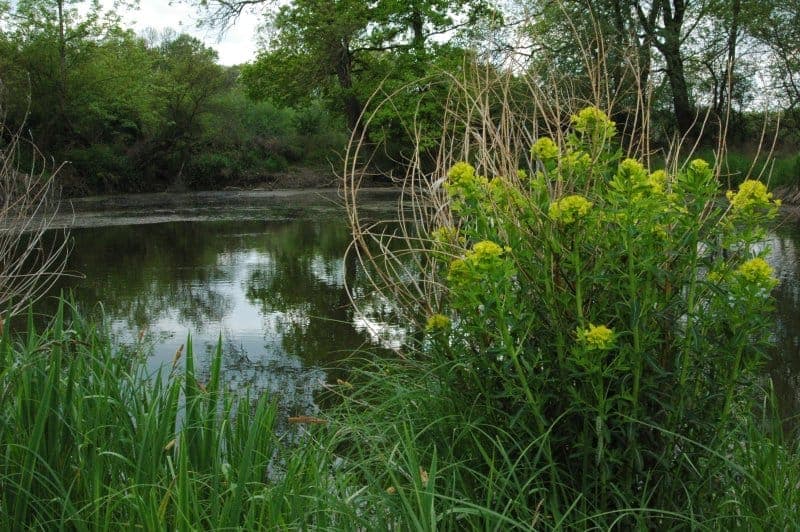
Stanislav Doronenko / CC BY 3.0, via Wikimedia Commons
Marsh spurge: complete guide
Euphorbia palustris
¿Quieres ver Marsh spurge: complete guide en tu jardín?
1 minuto, sin tarjeta de crédito
Overview
Marsh spurge (Euphorbia palustris) is a robust perennial that brings elegant structure to any garden design. Native to wetlands across Europe and extending to Xinjiang, this deciduous spurge forms upright clumps 50-80 cm tall, displaying chartreuse flower bracts from April through July. Its architectural form and fine texture make it valuable for naturalistic planting schemes.
Appearance and bloom cycle
Marsh spurge develops dense, vertical stems clothed in narrow, glossy leaves arranged in neat spiral patterns. The foliage emerges mid-spring in soft grey-green, maturing to deeper forest tones. From late March onwards, branching inflorescences develop at stem tips, displaying the signature yellowish-green bracts that characterise the genus. These pseudo-flowers persist for up to 12 weeks, creating continuity in the garden. By late summer, seed capsules mature to tan, adding rustic interest through autumn.
Ideal location
Marsh spurge thrives in full sun to partial shade, requiring 4-6 hours of direct light daily for optimal branching and colour development. It's fully hardy throughout the UK and northern European zones (USDA 4-8). Position plants where their columnar habit reads clearly against lighter backgrounds - against a dark yew hedge or beside silver-leaved companions, the effect is spectacular. Sheltered sites work better than extremely exposed windswept locations, though the plant rarely requires staking.
Soil requirements
Unlike many spurges, which prefer lean, sharply drained ground, marsh spurge specifically evolved for wetter conditions. Amend planting holes with generous organic matter: aim for 50-60% quality border soil, 25-30% well-rotted compost, and 10-15% horticultural grit. The plant tolerates clay-based soils provided they contain sufficient humus. pH range 6.0-7.5 is ideal. If your garden has naturally boggy patches, this is the spurge for you - it'll outperform almost any other Euphorbia in those conditions.
Watering
Keep soil consistently moist during the growing season (May-September), never allowing it to dry completely between waterings. Young plants in their first two seasons need weekly deep watering unless rain provides equivalent moisture. Established specimens require watering during dry spells lasting more than 10 days without rain. Apply 25-30 litres per square metre in extended dry periods. Mulch with 5 cm of compost in spring to buffer moisture fluctuations and suppress weeds - an 80cm plant can lose 300ml per day through transpiration in July.
Diseño gratis
¿Quieres ver Marsh spurge: complete guide en tu jardín? Crea un diseño gratis ahora.
Pruning
Minimal intervention needed. In March, remove any winter-damaged or crossing stems using sharp secateurs. Dead-head spent flower stems in late July if tidiness is priority - the plant will appreciate energy redirected to foliage. To encourage bushier growth on leggy specimens, cut back the top 15 cm of each stem in early April; this stimulates 3-4 side shoots per cut. Always wear gloves; the white sap irritates skin and eyes. Rinse tools with water after cutting to prevent sap drying on metal.
Maintenance calendar
- January-February: Monitor for waterlogging; improve drainage if puddling occurs
- March: Prune dead wood, apply 5cm mulch, feed with balanced NPK fertiliser
- April-May: Weekly watering as growth accelerates; watch for emerging pests
- June-July: Peak watering period; stake if necessary in windy gardens
- August-September: Reduce feeding, allow seed set for self-seeding potential
- October-November: Cut back to 10 cm above soil once frost nips foliage
- December: Full dormancy; minimal intervention needed
Winter hardiness
Marsh spurge is cold-hardy to -20°C, making it reliable throughout the British Isles and temperate Europe. The plant undergoes complete dormancy, with all top growth dying back completely in November. The rhizomatous root system survives even harsh winters intact. In unusually severe years, mulch with extra straw for protection, though this is rarely necessary. Spring emergence is reliably vigorous, with shoots emerging in April even after the hardest winters.
Companion plants
Marsh spurge works superbly in mixed borders alongside other moisture-tolerant perennials. Space plants 50-60 cm apart to allow mature width development. Excellent companions include:
- Lobelia cardinalis (Cardinal flower) for red spike contrast
- Primula japonica (Japanese primrose) for sequence colour
- Hosta varieties for foliage density
- Iris sibirica for spiky vertical accents
- Ligularia for bold leaf texture
Each creates distinct visual layers whilst sharing similar cultural requirements.
Closing
Marsh spurge deserves recognition as one of Europe's underrated perennials. Its refined architecture, extended season of interest, and genuinely impressive hardiness make it invaluable for contemporary garden design. Plan your entire planting scheme with Gardenworld.app, which helps select plant combinations matched to your soil conditions and light exposure. Use Gardenworld.app's plant suggestions to integrate marsh spurge into borders that reflect your garden's unique character and microclimate conditions.
¿Quieres ver Marsh spurge: complete guide en tu jardín? Crea un diseño gratis ahora.
Sube una foto, elige un estilo y obtén un diseño fotorrealista con lista de plantas en menos de un minuto.
Sin tarjeta de crédito


Plantas similares
Woolly mercury: complete guide
Mercurialis tomentosa
All about Mercurialis tomentosa, the woolly mercury from southwestern Europe: site, soil, watering, care and garden design tips.
Shurur: complete guide
Euphorbia fruticosa
Everything about Shurur: cultivation in dry climates, xeriscaping, care and tips for drought-resistant gardens in warm climates
Glary spurge: complete guide
Euphorbia glareosa
Everything about glary spurge: cultivation, maintenance, frost hardiness and use in Mediterranean and mountain-inspired gardens