
Andrew Hankey / CC BY-SA 4.0, via Wikimedia Commons
Euphorbia obesa: complete guide
Euphorbia obesa
¿Quieres ver Euphorbia obesa: complete guide en tu jardín?
1 minuto, sin tarjeta de crédito
Overview
Euphorbia obesa, commonly known as the Baseball Plant, is a remarkable succulent from South Africa. The plant earns its name from its distinctive spherical growth pattern that remarkably resembles a baseball. With striking red-green markings and unusual texture, it is a favorite among plant collectors worldwide.
The Baseball Plant reaches only 15 to 20 centimeters in height and grows extremely slowly. This makes it perfect for small collections and limited spaces. The plant rarely flowers indoors, but when it does, tiny discrete yellow flowers appear at the top.
Appearance and Bloom
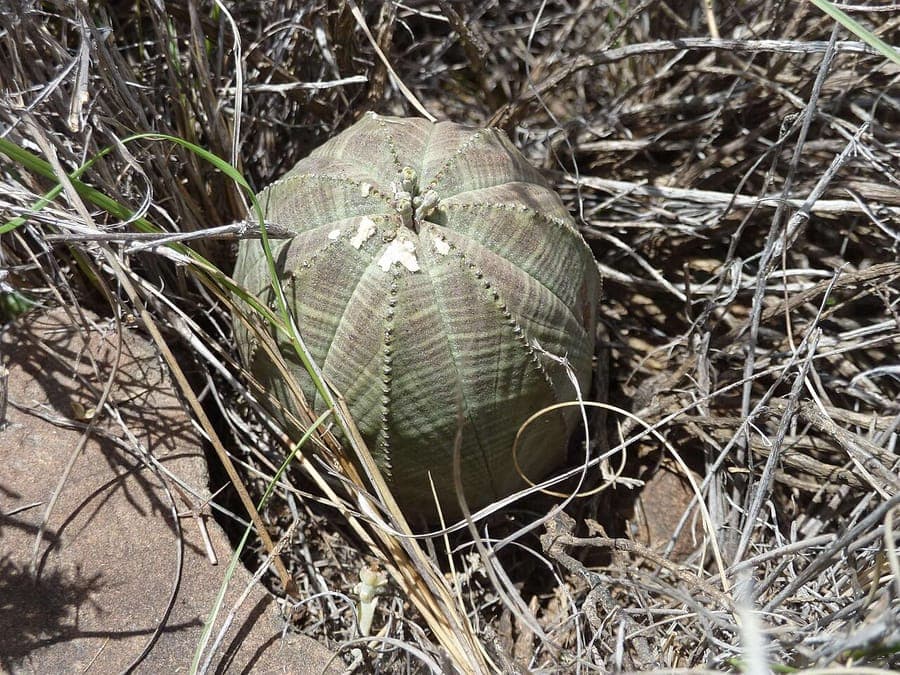
The characteristic form of Euphorbia obesa is unmistakable. The plant grows in a strict spherical silhouette with prominent red-green lines stretching vertically across its body. It truly resembles the surface of a baseball.
Rather than true leaves, the plant has small scale-like protrusions. This adaptation suits its natural South African habitat where drought is frequent. Flowering is rare indoors, but when it occurs, the small yellow flowers are inconspicuous and appear at the plant's summit.
Growth of this species is extremely slow. Under favorable conditions, it gains only a few centimeters yearly. This means the same plant can maintain its size for years.
Ideal Location
Euphorbia obesa thrives in very sunny positions. This plant requires six to eight hours of direct sunlight daily. A south-facing window is ideal, or a sunny outdoor spot during the growing season.
Temperature is crucial for this plant. It prefers conditions between 18 to 25 degrees Celsius. Protect from temperatures below 10 degrees Celsius, as this causes severe damage.
Moisture levels must remain low. This succulent needs no humid environments. Instead, it thrives in dry conditions mimicking its natural habitat.
Soil
Soil selection is critical for success. Regular potting soil retains far too much moisture and causes root rot. Use specialized cactus or succulent soil instead.
If specialized soil is unavailable, create your own mix by combining regular potting soil with fine gravel, perlite, or broken terracotta in a 1:1 or even 1:2 ratio. This ensures excellent drainage.
The pot itself matters as much as the soil. Always choose pots with drainage holes. Clay or terracotta pots are superior to plastic because they allow better moisture evaporation.
Diseño gratis
¿Quieres ver Euphorbia obesa: complete guide en tu jardín? Crea un diseño gratis ahora.
Watering
This is perhaps the most critical care aspect. Euphorbia obesa is drought-tolerant and needs very little water. Water only when soil is completely dry, typically once every two to four weeks during the growing season.
During winter dormancy from October to March, water even less frequently. Often the plant requires no water at all during these months. Always check if soil is completely dry before watering.
Overwatering is the primary killer of this species. The plant tolerates drought far better than excess moisture. It is always better to underwater than overwater.
Pruning
Regular pruning is rarely needed for Euphorbia obesa. The plant grows slowly and naturally maintains a compact, spherical shape.
If damaged, diseased, or dead parts appear, remove them carefully. Wear gloves as the plant's sap is toxic and causes skin irritation.
If size adjustment is desired, proceed cautiously. Pruning requires many years of healing due to extremely slow growth rates.
Maintenance Calendar
Spring and summer (March-September) are growing seasons. Water moderately when soil is dry. Position the plant in very sunny locations. Monitor for pests.
Autumn and winter (October-February) are dormant periods. Water rarely or not at all. Maintain temperatures between 10 to 15 degrees Celsius if possible. No feeding required.
Feeding: Once monthly during growing season, provide highly diluted cactus fertilizer. This is optional as the plant survives without supplemental nutrition.
Winter Hardiness
Euphorbia obesa is completely non-hardy and cannot survive outdoors in temperate climates. The plant cannot tolerate temperatures below 10 degrees Celsius.
If grown outdoors during summer, bring it inside when night temperatures drop below 15 degrees Celsius. This typically occurs in October.
Indoors on a sunny windowsill or under grow lights, the plant can thrive year-round.
Companion Plants
Euphorbia obesa pairs well with other slow-growing succulents. Consider combining it with:
- Echeveria species
- Sedum varieties
- Smaller Aloe species
- Gasteria plants
- Lithops (living stones)
Combining these succulents in shared containers creates attractive miniature landscapes.
Closing Remarks
The Baseball Plant is a unique choice for any plant collector. With its distinctive form and minimal care requirements, it suits anyone wanting exotic plants but with limited time or space.
Success with Euphorbia obesa depends on three principles: abundant sunlight, excellent drainage, and very moderate watering. Remember these fundamentals, and your Baseball Plant will flourish for years.
For more information on succulents, visit gardenworld.app for comprehensive guides and tips. Enjoy growing this fascinating plant!
¿Quieres ver Euphorbia obesa: complete guide en tu jardín? Crea un diseño gratis ahora.
Sube una foto, elige un estilo y obtén un diseño fotorrealista con lista de plantas en menos de un minuto.
Más de 10.000 jardines diseñados
Sin tarjeta de crédito


Plantas similares
Woolly mercury: complete guide
Mercurialis tomentosa
All about Mercurialis tomentosa, the woolly mercury from southwestern Europe: site, soil, watering, care and garden design tips.
Shurur: complete guide
Euphorbia fruticosa
Everything about Shurur: cultivation in dry climates, xeriscaping, care and tips for drought-resistant gardens in warm climates
Glary spurge: complete guide
Euphorbia glareosa
Everything about glary spurge: cultivation, maintenance, frost hardiness and use in Mediterranean and mountain-inspired gardens