
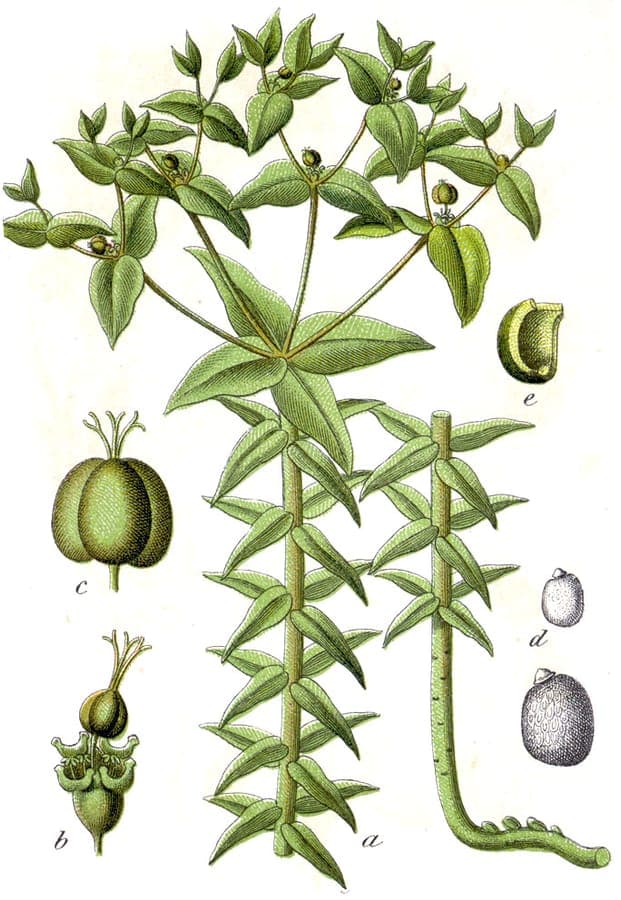
Johann Georg Sturm (Painter: Jacob Sturm) / Public domain, via Wikimedia Commons
Caper spurge: complete guide
Euphorbia lathyris
¿Quieres ver Caper spurge: complete guide en tu jardín?
1 minuto, sin tarjeta de crédito
Overview
Caper spurge (Euphorbia lathyris), also known as gopher plant or mole plant, is a striking biennial traditionally grown as a reputed deterrent to moles and voles in gardens. Reaching 60-120 cm tall, it forms an elegant columnar plant that commands attention through its distinctive cross-paired leaf arrangement.
While scientific evidence for anti-mole effectiveness remains debated, the plant continues to be widely cultivated and makes a fascinating structural addition to borders or as background plantings.
Appearance & bloom cycle
Caper spurge grows as an upright column with opposite leaves arranged in a characteristic cross-pattern along the stem. In year one, the plant produces only foliage; in year two, inconspicuous green flowers appear in May-June in the leaf axils.
Following flowering, the plant produces distinctive large seed capsules. All parts are highly toxic and require careful handling.
Ideal location
Caper spurge thrives optimally in full sun. The plant is tolerant and accepts lighter shade adequately, though growth is less robust. A warm, sunny location produces the best results.
Soil requirements
Caper spurge is unfussy and grows satisfactorily on virtually all soil types. It accepts both rich and impoverished soils equally, provided drainage is adequate. Waterlogged soils are not well tolerated.
Watering
Once established, caper spurge is extremely drought-tolerant. Newly planted specimens require regular watering, but thereafter need moisture only in exceptional droughts.
Diseño gratis
¿Quieres ver Caper spurge: complete guide en tu jardín? Crea un diseño gratis ahora.
Pruning & maintenance
The plant requires no pruning. In year one it produces only foliage, forming an attractive green mass. In year two flowers and seed capsules appear. After seed production the plant dies naturally - normal for biennials.
To prevent excessive self-seeding, remove flowers before they open.
Maintenance calendar
Year 1:
- April-May: Plant seedlings or sow seed directly
- June-September: Growth of leafy rosettes
Year 2:
- April-May: Flowering begins
- June-July: Seed capsules ripen
- July-August: Natural senescence
Winter hardiness
Caper spurge is relatively hardy. In temperate climates (USDA zones 6-9) the biennial cycle completes without problem. In very severe winters, biennial seedlings may suffer damage.
Companion plants
Caper spurge pairs well with:
- Allium - ornamental seed heads
- Ornamental grasses - complementary structure
- Agapanthus - blue flowers offset green euphorbia
- Other biennials like foxglove or mulleins
Closing
While mole-deterrent claims remain contested, caper spurge is an architecturally striking plant. Its bold form and height make it perfect for background plantings or as a structural element. Most garden centers stock seed and young plants.
On gardenworld.app you can design a garden where this bold biennial serves effectively as vertical accent or structural backdrop in your overall garden composition.
¿Quieres ver Caper spurge: complete guide en tu jardín? Crea un diseño gratis ahora.
Sube una foto, elige un estilo y obtén un diseño fotorrealista con lista de plantas en menos de un minuto.
Más de 10.000 jardines diseñados
Sin tarjeta de crédito


Plantas similares
Woolly mercury: complete guide
Mercurialis tomentosa
All about Mercurialis tomentosa, the woolly mercury from southwestern Europe: site, soil, watering, care and garden design tips.
Shurur: complete guide
Euphorbia fruticosa
Everything about Shurur: cultivation in dry climates, xeriscaping, care and tips for drought-resistant gardens in warm climates
Glary spurge: complete guide
Euphorbia glareosa
Everything about glary spurge: cultivation, maintenance, frost hardiness and use in Mediterranean and mountain-inspired gardens