
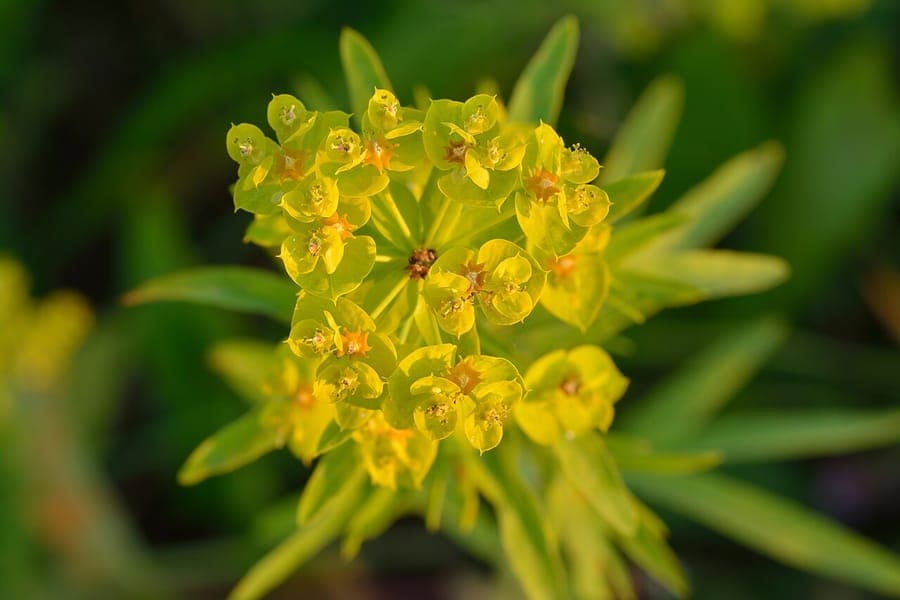
Ivar Leidus / CC BY-SA 3.0, via Wikimedia Commons
Leafy spurge: complete guide
Euphorbia esula
¿Quieres ver Leafy spurge: complete guide en tu jardín?
1 minuto, sin tarjeta de crédito
Overview
Leafy spurge (Euphorbia esula), also called Hungarian spurge or wolf's milk, is a vigorous perennial of Eurasian origin that has naturalized across Europe. Reaching 50-80 cm tall, it is valued for its fine, feathery foliage texture and extended yellow-green blooms from late spring through summer.
While attractive, leafy spurge can self-seed prolifically - in some regions it is regarded as invasive. Nevertheless, in most European gardens it remains a dependable and long-lived perennial.
Appearance & bloom cycle
Leafy spurge develops into an upright plant densely clothed in linear-lanceolate leaves that give it a distinctly elegant, fine-textured appearance. From May to July, characteristic yellow-green flowers appear in umbrella-like clusters (cyathia) that attract numerous insects. The flowers are followed by interesting seed capsules that mature through summer.
The entire plant remains attractive through winter, providing structure even when deciduous plants have retreated.
Ideal location
Leafy spurge performs best in full sun but tolerates part shade adequately. It is remarkably site-tolerant, thriving from seaside to mountains, in wet soils and parched locations. Careful siting is wise if you want to manage self-seeding. In open borders where volunteer seedlings pose no problem, the plant can be deployed to full advantage.
Soil requirements
Leafy spurge is outstandingly tolerant of soil type. It thrives on acidic, neutral, and alkaline soils and accepts both rich and impoverished ground equally well. Good drainage is the main requirement; prolonged waterlogging can cause root decay.
On poor, dry soils where little else establishes, leafy spurge feels at home. This makes it ideal for sparse, rocky hillsides and slopes.
Diseño gratis
¿Quieres ver Leafy spurge: complete guide en tu jardín? Crea un diseño gratis ahora.
Watering
Once established, leafy spurge is remarkably drought-tolerant. Newly planted specimens require regular watering for their first month, but thereafter need supplemental moisture only in unusually dry periods.
In temperate climates with decent rainfall, watering is usually unnecessary. The plant is a robust grower unbothered by occasional water stress. Containerized specimens require more frequent watering.
Pruning
Leafy spurge can be cut entirely to the ground in late autumn or early spring. Some gardeners prefer this approach; others leave the seed capsules intact to feed birds through winter.
If you wish to prevent self-seeding, remove seed capsules before they split. If the plant becomes bare at the base, cut it back to approximately 15 cm to stimulate basal regrowth.
Maintenance calendar
April-May: Growth begins; water if needed May-July: Peak flowering display, magnificent yellow-green August-September: Seed capsules ripen and split October: Seeds disperse naturally or are removed by hand November-March: Dormancy; plant can remain in place
Winter hardiness
Leafy spurge is fully hardy throughout European gardens to USDA zone 5. It withstands extreme cold and deep snow without damage. In most regions the plant can remain in the garden all winter.
Companion plants
Leafy spurge pairs well with:
- Stipa (Feather grasses) - similar fine texture
- Salvia (Sage) - purple flowers contrast yellow-green
- Achillea - yellow and red tones complement
- Echinops (Globe thistle) - blue flowers offset yellow
Closing
Leafy spurge is a practical choice for gardeners seeking robust perennials that largely fend for themselves. Most garden centers stock young plants in spring at modest cost. On gardenworld.app you can design a garden where this vigorous plant plays an effective role alongside compatible perennials.
¿Quieres ver Leafy spurge: complete guide en tu jardín? Crea un diseño gratis ahora.
Sube una foto, elige un estilo y obtén un diseño fotorrealista con lista de plantas en menos de un minuto.
Más de 10.000 jardines diseñados
Sin tarjeta de crédito


Plantas similares
Woolly mercury: complete guide
Mercurialis tomentosa
All about Mercurialis tomentosa, the woolly mercury from southwestern Europe: site, soil, watering, care and garden design tips.
Shurur: complete guide
Euphorbia fruticosa
Everything about Shurur: cultivation in dry climates, xeriscaping, care and tips for drought-resistant gardens in warm climates
Glary spurge: complete guide
Euphorbia glareosa
Everything about glary spurge: cultivation, maintenance, frost hardiness and use in Mediterranean and mountain-inspired gardens