
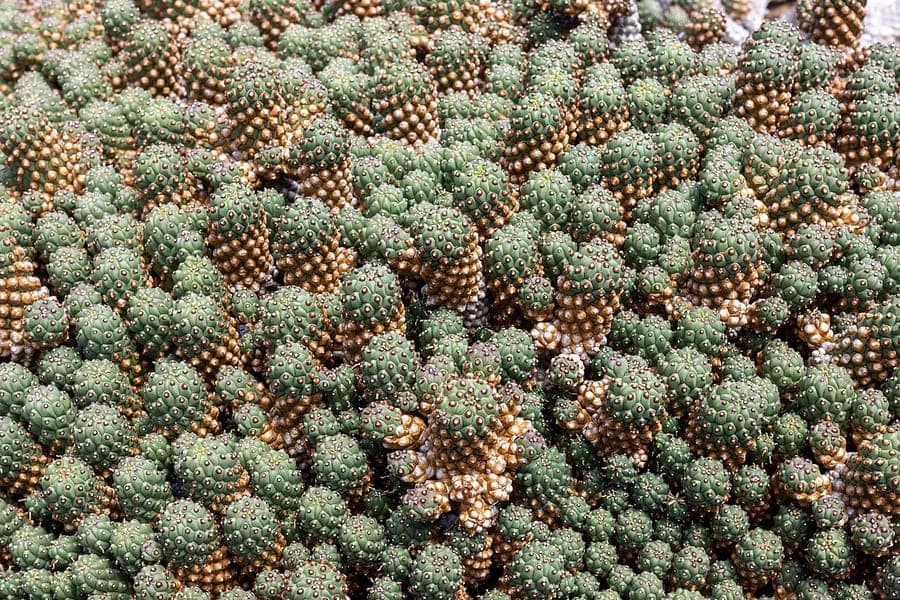
Photograph by Mike Peel (www.mikepeel.net). / CC BY-SA 4.0, via Wikimedia Commons
Euphorbia caput-medusae: complete guide
Euphorbia caput-medusae
¿Quieres ver Euphorbia caput-medusae: complete guide en tu jardín?
1 minuto, sin tarjeta de crédito
Overview
Euphorbia caput-medusae, better known as Medusa's-head, is one of the most striking and photogenic succulents you can find. This South African treasure features winding, tentacle-like branches growing from a central stem - precisely like the serpents atop Medusa's head from Greek mythology.
Despite its exotic appearance, this plant is actually reasonably straightforward to cultivate, provided you understand the essentials: sun, drainage, and careful watering. Perfect for plinths, rooftop gardens, windowsills, and those seeking something genuinely extraordinary.
Appearance and Growth
The plant forms a compact, rounded base approximately 15-30 cm in diameter, from which writhing branches emerge. The branches are green, succulent, and feature interesting textured surfaces of small, scale-like leaves. The growth pattern creates that characteristic Medusa appearance.
Growth is slow but steady. In warm climates it may grow several decimeters annually. In less ideal conditions progress is very slow, though this actually produces a finer, more compact plant.
Yellow cyathia appear during the summer season scattered along the branches, though these are not particularly spectacular. The plant itself is the statement piece.
Ideal Location
Medusa's-head demands full sun - at least 6-8 hours of direct daily sunlight. More sun produces more compact growth and better coloring. In very warm climates, some afternoon shade may be useful, but generally: the more sun, the better.
Use as solitary accent on a plinth, on a windowsill, on a rooftop section, or in a pot you can move outdoors. It looks stunning against neutral backgrounds.
Soil
Drainage is critical - perhaps even more so than for other succulents, as this plant abhors wet feet. Use cactus or succulent compost, or create your own: standard potting soil mixed with sand and perlite (5:3:2 ratio).
Ensure your pot has abundant drainage holes. No fertilization needed - this plant grows slowly and actually thrives better in poor conditions.
Diseño gratis
¿Quieres ver Euphorbia caput-medusae: complete guide en tu jardín? Crea un diseño gratis ahora.
Water and Irrigation
This is where many people make mistakes. Medusa's-head wants very careful watering - much more cautious than you probably imagine.
During the growing period (spring-summer) you may maintain moderate moisture, but not wet. The top 1-2 cm of potting soil may dry between waterings. In autumn, you gradually reduce, and in winter the plant enters near-dormancy and wants virtually no water.
The rule: better too little than too much. Overwatering almost always leads to rot.
Propagation
You can propagate this plant from seed or cuttings. Cuttings work best - cut healthy branches, allow them several days to dry until the wounds callus, then place in dry, sandy potting soil. After several weeks they develop roots.
Seed sowing is also possible, though more patient work.
Pruning
Pruning is virtually unnecessary. The plant naturally forms that beautiful Medusa shape. Remove only dead or diseased branches. You may gently rotate some grown branches if desired, but carefully - this plant is somewhat fragile.
Maintenance Calendar
March-April: Growing period begins. Water carefully. May-July: Full growth. Maintain moderate moisture. August-September: Growth slows. Gradually reduce water. October-November: Plant enters dormancy. Minimal water. December-February: Complete rest. Almost no water.
Frost and Winter
Medusa's-head is frost-sensitive. It does not tolerate temperatures below approximately -5 to 0°C. In Netherlands and Belgium it must certainly stay indoors during winter, in cool but frost-free environment (approximately 10-15°C). In warm Southern European climates it may overwinter outdoors with protection.
Companion Plants
Combine with other succulents:
- Other Euphorbia species
- Aloe and agave
- Jade plants
- Sedums
- Gravel and gravel beds as background
It looks spectacular as a solitary specimen!
Safety Precautions
The sap causes skin irritation. Wear gloves for all work. Keep children and pets away - toxic if ingested.
Closing Thoughts
Medusa's-head is a genuine collector's plant not for the faint-hearted, yet extraordinarily beautiful for those seeking something genuinely extraordinary. This is a conversation-starter that ensures attention.
Seek specialized nurseries - not universally available. Make your garden unforgettable with gardenworld.app. Discover more exotic succulents.
¿Quieres ver Euphorbia caput-medusae: complete guide en tu jardín? Crea un diseño gratis ahora.
Sube una foto, elige un estilo y obtén un diseño fotorrealista con lista de plantas en menos de un minuto.
Más de 10.000 jardines diseñados
Sin tarjeta de crédito


Plantas similares
Woolly mercury: complete guide
Mercurialis tomentosa
All about Mercurialis tomentosa, the woolly mercury from southwestern Europe: site, soil, watering, care and garden design tips.
Shurur: complete guide
Euphorbia fruticosa
Everything about Shurur: cultivation in dry climates, xeriscaping, care and tips for drought-resistant gardens in warm climates
Glary spurge: complete guide
Euphorbia glareosa
Everything about glary spurge: cultivation, maintenance, frost hardiness and use in Mediterranean and mountain-inspired gardens