
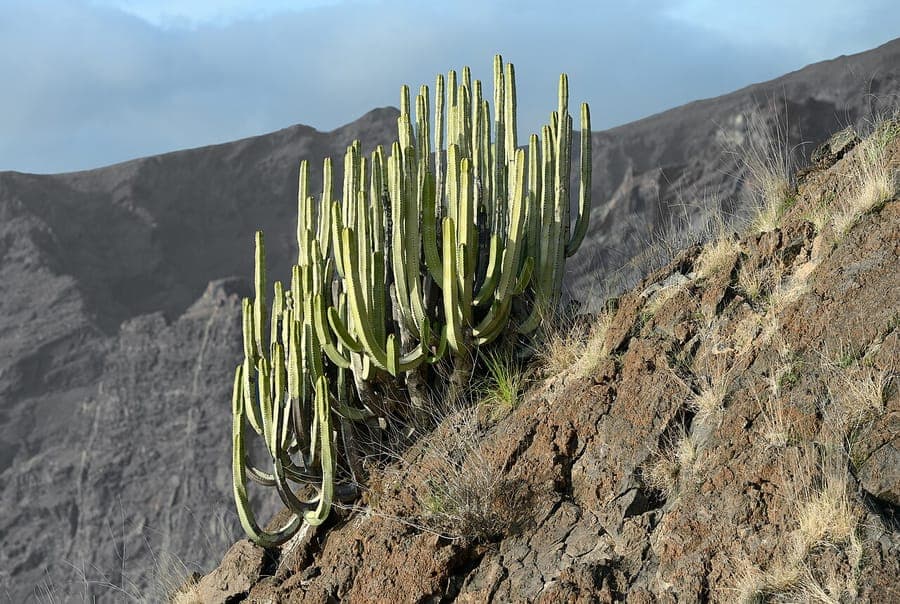
Cayambe / CC BY-SA 3.0, via Wikimedia Commons
Euphorbia canariensis: complete guide
Euphorbia canariensis
¿Quieres ver Euphorbia canariensis: complete guide en tu jardín?
1 minuto, sin tarjeta de crédito
Overview
Euphorbia canariensis, commonly known as Canary Island spurge or Kanaren-Wolfsmilch, is a remarkable succulent from the Euphorbiaceae family. This colossal succulent originates from the Canary Islands and is known for its dramatic, candelabra-like growth with massive grey-green fleshy stems. In gardens, it is used as a sculptural element, in containers on terraces and for xeriscaping in very dry environments.
The plant can reach 4-6 meters in height in its homeland, but in temperate climates usually 1-3 meters in containers. These are exotic dryland plants requiring minimal water and maintenance. The plant is frost-sensitive and is therefore usually overwintered in containers in colder climates.
Appearance and bloom
Euphorbia canariensis has massive, grey-green fleshy stems branching in a candelabra-like, almost symmetrical pattern. The stems are unmarked except for small spine-like protrusions where former leaf clusters were. Growth is slow but continuous when kept warm.
The flowers are subtle and inconspicuous - small yellowish-green florets in small clusters on branch tips. The bloom appears in spring and produces small seed capsules. Many horticulturists appreciate this plant purely for its sculptural form, not for the flowers.
Ideal location
Euphorbia canariensis must absolutely be placed in full sun for optimal growth and compact form. At least 6-8 hours of direct sun daily is necessary. In shade, the plant grows very sparsely and can become leggy and misshapen.
The plant tolerates very heat well and can grow in south-facing spots with reflected heat from walls. This is actually beneficial as it stimulates faster growth. Protection from cold wind is, however, important in temperate climates.
Soil requirements
Euphorbia canariensis requires excellently draining soil and cannot grow in heavy clay. Use special cactus/succulent potting soil, or make your own mix with 40% gravel, 40% sand, 20% regular potting soil. Drainage is much more important than nutrition - the plant grows well in poor soils.
PH is not critical, but neutral to slightly alkaline soil (pH 6.5-8.0) is preferred. Salt tolerance is high, making this plant suitable for coastal garden environments.
Watering
Euphorbia canariensis is extremely drought-tolerant and requires very sparingly watering. During the growing season (May-October), water gently when the soil feels completely dry - approximately every 2-3 weeks. In winter (November-April), water is virtually not needed.
Overwatering is the most common cause of death for this plant. Ensure pots have excellent drainage and never let water stand around the roots. Water less rather than more. In its native Canary Islands habitat, the plant receives minimal rainfall and has adapted to obtain most of its water from fog and dew condensation on the leaves at night. This is why sudden heavy watering can shock the plant. A practical approach is to water deeply but infrequently, allowing the soil to dry out completely between waterings. During the winter dormancy period when growth is minimal, some growers keep their plants completely dry, only providing water if the stems begin to show signs of shrivelling significantly. This extreme dry treatment ensures the plant's survival and promotes robust growth when the growing season resumes in spring.
Diseño gratis
¿Quieres ver Euphorbia canariensis: complete guide en tu jardín? Crea un diseño gratis ahora.
Pruning
Euphorbia canariensis requires no formative pruning under normal circumstances. The plant naturally grows in an interesting candelabra pattern. Remove only dead or diseased branches.
If the plant becomes too large, a few branches can be carefully removed at their base. This stimulates branching lower down. Always wait until cut areas have dried before working further.
Maintenance calendar
March-April: Plant begins new growth after winter, water very sparingly. May-June: Growth accelerates, gradually increase watering. July-August: Peak growth period, water carefully every 2-3 weeks. September-October: Growth slows, reduce watering to once a month. November-December: Plant at rest, minimal watering. January-February: Plant sleeps, no watering needed.
Winter hardiness
Euphorbia canariensis is very frost-sensitive and can be severely damaged below 5 degrees Celsius. In areas with winters above -5 degrees, it can overwinter outside under wall protection. In colder areas, it must be overwintered in containers in a greenhouse or sunroom at 5-10 degrees.
Light frost damage (surface scorching) sometimes recovers in spring, but severe freezing permanently damages the plant.
Companion plants
In containers, Euphorbia canariensis combines well with other succulents such as Agave, Aloe and large Aeonium species. For contrast, add lower succulents like Echeveria or Sedum. In xeriscaping gardens, it combines well with other dryland plants such as lavender, rosemary and other Mediterranean shrubs.
Limit container companions to 1-2 other plants to maintain the sculptural form of the Euphorbia. If planting in large containers, blue-foliaged Agave americana creates striking textural contrast with the grey-green stems of the Euphorbia. Lower golden sedums and silver-leaved dusty miller add colour detail without competing for visual dominance. In frost-free xeriscaping gardens in Mediterranean climates, Euphorbia canariensis can anchor a bed of drought-tolerant plants including Olive trees, Cistus, and purple-flowered Lavandula stoechas for a truly Mediterranean aesthetic.
Closing thoughts
Euphorbia canariensis is a statement plant for gardeners seeking dramatic, exotic elements. The colossal form makes it a sculpture in itself. Although it is frost-sensitive and requires extra care in cold climates, the plant is actually very easy to maintain when correctly positioned and overwintered.
Order via gardenworld.app/en for large container plants. For advice on container selection and winter storage, visit gardenworld.app/en.
¿Quieres ver Euphorbia canariensis: complete guide en tu jardín? Crea un diseño gratis ahora.
Sube una foto, elige un estilo y obtén un diseño fotorrealista con lista de plantas en menos de un minuto.
Más de 10.000 jardines diseñados
Sin tarjeta de crédito


Plantas similares
Woolly mercury: complete guide
Mercurialis tomentosa
All about Mercurialis tomentosa, the woolly mercury from southwestern Europe: site, soil, watering, care and garden design tips.
Shurur: complete guide
Euphorbia fruticosa
Everything about Shurur: cultivation in dry climates, xeriscaping, care and tips for drought-resistant gardens in warm climates
Glary spurge: complete guide
Euphorbia glareosa
Everything about glary spurge: cultivation, maintenance, frost hardiness and use in Mediterranean and mountain-inspired gardens