
HermannSchachner / CC0, via Wikimedia Commons
Broad-leaved spindle: complete guide
Euonymus latifolius
¿Quieres ver Broad-leaved spindle: complete guide en tu jardín?
1 minuto, sin tarjeta de crédito
Overview
Euonymus latifolius, known as broad-leaved spindle, is a vigorous shrub from the Celastraceae family, native to southern Europe and the Mediterranean region (France through Iran). This is a valuable addition for gardeners wanting larger foliage: the leaves are much larger than related species, and the autumn colours combined with red fruits are truly spectacular.
This shrub is hardy throughout Britain and offers many advantages: fast-growing, frost-resistant, attractive to birds and pollinators, and provides substantial seasonal interest. Equally suitable for hedging and screening.
Appearance & bloom cycle
Euonymus latifolius grows as a compact to medium shrub, usually 1.5-3 metres tall (can reach 4 metres in ideal conditions). The leaves are large (5-12 cm), lance-shaped, glossy dark green, and very striking. During the growing season foliage remains dark green, but in autumn colours beautifully: red to purple.
Flowers are small, just a few millimetres, purplish to dark red, blooming May-June. They're not showy, but attractive to insects.
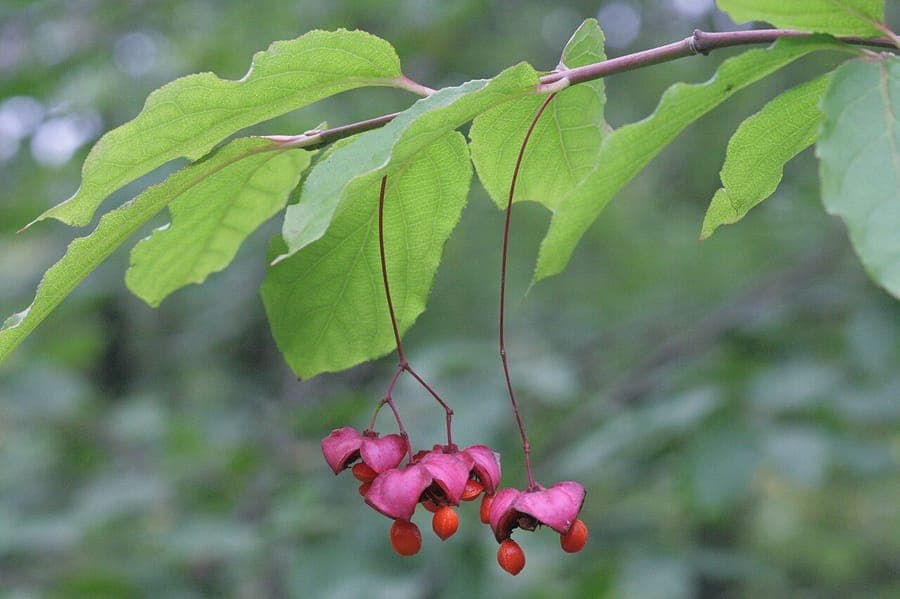
Much attention is deserved by the fruit set: fruits are very striking – pink to red, about 1.5 cm across, with four wings and orange seed-covers inside. These fruits appear September-October and persist into November. Birds adore them.
Ideal location
Choose a sunny to part-shaded position. The plant grows in shade too, but autumn colours will be less intense. Full sun (6-8 hours daily) gives the best colours.
Wind is no issue; this robust shrub tolerates it well. Shelter isn't essential.
The plant is excellent for hedging, screening, and boundary planting. Also beautiful in mixed shrub or woodland borders. Growth is upright and neat.
Soil requirements
Euonymus latifolius is quite undemanding. It grows well in most soils provided they're not permanently waterlogged. Neutral to slightly acidic (pH 6.5-7.5) is ideal, but also slightly alkaline (to pH 8.0) is acceptable.
The plant accepts sand, clay and silt soils. Humus helps, especially with sandy soils. Avoid prolonged waterlogging.
Water thoroughly after planting to aid root establishment.
Diseño gratis
¿Quieres ver Broad-leaved spindle: complete guide en tu jardín? Crea un diseño gratis ahora.
Watering
Once well-established, the plant tolerates drought reasonably well. Young plants, however, need regular watering (1-2 times weekly during dry spells). After 2-3 years the plant usually thrives independently.
During very dry summers, even established plants benefit from supplemental watering. Water only when soil feels dry.
For container planting: regular garden water is fine. Water until soil is moist throughout.
Pruning
Pruning is scarcely necessary, though possible. Euonymus latifolius naturally grows compactly and forms a neat shape with minimal intervention. You can prune in March to maintain compactness, but this is entirely optional.
As a screen, one annual June pruning keeps shape neat.
Pruned shoots can be used for border edging.
Maintenance calendar
March-April: Best planting season. Plant grows quickly thereafter. Water regularly. Exposed roots? Water first!
May-June: Flowering (inconspicuous). Continue watering during dry spells.
July-September: Growth continues. Fruit set. Plant is at its finest now.
October-November: Autumn colours peak. Fruits now fully visible. Bird feed preventatively important.
December-February: Plant is leafless. No watering needed. Pruning work can be undertaken.
Winter hardiness
Excellent: Euonymus latifolius is very hardy throughout Britain. Down to about -20°C presents no problem. Extremely frost-resistant. No protection needed.
Companion plants
Euonymus latifolius combines well with other autumn-bloomers and fruit-producers: rowan (Sorbus), Cornus, Ilex. Also beautiful alongside red-leafed Acer species.
Lower growing: bergenia, Helleborus, ornamental grasses. Climbing plants like ivy along the shrub create interesting combinations.
Widely available from many garden centres. Online plant suppliers stock various sizes.
Final thoughts
Euonymus latifolius is a valuable addition to any British garden. Fast-growing, hardy, attractive to birds and insects, and with spectacular seasonal interest. After the first year, the plant usually thrives independently with minimal maintenance.
On gardenworld.app you can commission a garden design where this shrub is perfectly incorporated with thought to autumn colours and wildlife feeding. Our designers understand how to maintain seasonal interest.
This shrub is arguably one of the most underrated additions to modern British gardens. It truly deserves far more attention!
¿Quieres ver Broad-leaved spindle: complete guide en tu jardín? Crea un diseño gratis ahora.
Sube una foto, elige un estilo y obtén un diseño fotorrealista con lista de plantas en menos de un minuto.
Más de 10.000 jardines diseñados
Sin tarjeta de crédito


Plantas similares
Fringed grass of Parnassus: complete guide
Parnassia fimbriata
Everything about Fringed grass of Parnassus (Parnassia fimbriata): growing, soil, watering and care. A delicate mountain perennial with white fringed flowers.
Euonymus cornutus: complete guide
Euonymus cornutus
Horned spindle is an intriguing shrub from central China with distinctive winged seed capsules. Learn how to grow this unique plant.
Large-Winged Spindle: complete guide to this Far Eastern shrub
Euonymus macropterus Rupr.
Discover Large-Winged Spindle (Euonymus macropterus), an elegant Japanese shrub prized for spectacular winged fruits. Perfect for Asian gardens and woodland plantings.