
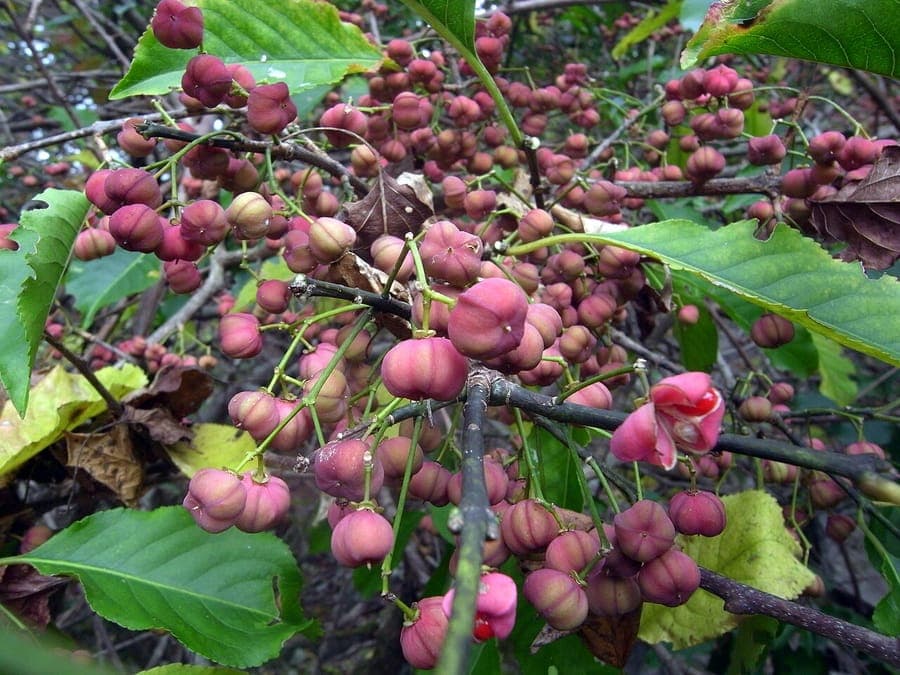
Dalgial / CC BY 3.0, via Wikimedia Commons
Euonymus hamiltonianus: complete guide
Euonymus hamiltonianus
¿Quieres ver Euonymus hamiltonianus: complete guide en tu jardín?
1 minuto, sin tarjeta de crédito
Overview
Euonymus hamiltonianus, commonly called Hamilton's spindle or Himalayan spindle, is an elegant deciduous to semi-evergreen shrub native to the Himalayan region. This plant naturally occurs from Afghanistan to Japan and is valued for its attractive foliage and colorful autumn seed capsules. The winged cork-like ridges on stems give this plant its "spindle" common name.
This versatile shrub offers year-round interest and performs excellently as a specimen, in mixed borders, or as informal hedging. Its preference for temperate climates makes it ideal for northern European gardens.
Appearance and Bloom
Euonymus hamiltonianus grows as a compact shrub reaching 2 to 5 meters tall, depending on cultivar. Slender, arching branches bear narrow to lance-shaped leaves with finely serrated margins. In spring, inconspicuous greenish or whitish flowers appear in small clusters.
The true spectacle emerges in September-October: distinctive four-sided seed capsules split open to reveal shocking pink seed coverings that hang gracefully. This display lasts many weeks and attracts birds eager to feast on the fleshy seed arils. Foliage turns brilliant shades of orange-red before dropping.
Ideal Location
Select a spot with partial shade to full sunlight for Euonymus hamiltonianus. The plant thrives with 4-6 hours of direct sun. In very hot climates, afternoon shade prevents leaf scorch.
The plant is wind-tolerant and makes an excellent windbreak. Avoid still, very warm locations with stagnant air that encourage fungal diseases. Good air circulation supports healthy foliage.
Soil
Euonymus hamiltonianus makes moderate soil demands. It prefers moist, well-draining soil but adapts to both acidic and neutral pH. Weakly alkaline soils are acceptable. Good soil structure promotes vigorous growth.
Working in organic matter at planting time enhances soil biology and water retention. The plant grows in diverse soil types but rejects permanently waterlogged or extremely dry conditions. Composted bark and leaf mould improve performance significantly.
Watering
Euonymus hamiltonianus requires regular moisture, especially during the growing season. Young plants need weekly watering through the first growing season. Established plants tolerate moderate drought but perform better with consistent moisture.
As foliage reddens in autumn, gradually reduce watering. Excellent drainage is essential - waterlogging causes root rot and fungal problems. Mulching maintains moisture stability and moderates temperature fluctuations.
Diseño gratis
¿Quieres ver Euonymus hamiltonianus: complete guide en tu jardín? Crea un diseño gratis ahora.
Pruning
Euonymus hamiltonianus requires minimal pruning. The plant grows naturally elegant without drastic cutting back. You may remove dead wood in early spring and thin excessive growth.
For more compact, bushy forms, selectively prune in June to promote branching without sacrificing flowering and fruiting. Cutting back too severely may prevent seed capsule formation that season.
Maintenance Calendar
Spring: Remove dead wood. Begin regular watering. Apply slow-release balanced fertilizer. Scout for pest damage.
Summer: Continue consistent watering. Observe growth patterns. Selective pruning in June for bushier habit. Monitor for scale insects and spider mites.
Autumn: Cease feeding. Gradually reduce watering as foliage colors. Enjoy dramatic pink seed capsules and autumn foliage display. Allow natural leaf fall.
Winter: Plant enters dormancy. Frost protection generally unnecessary in most northern European zones. Pruning can wait until spring.
Winter Hardiness
Euonymus hamiltonianus exhibits good cold hardiness in northern European conditions. The plant survives temperatures to about -20 degrees Celsius, though -15 degrees is the comfortable minimum. Young plants may suffer frost damage during severe winters.
Winter protection as burlap wrapping around the stem helps in severe conditions. In prolonged freeze-thaw cycles with wet soil, roots can suffer. Excellent drainage therefore becomes critical for survival.
Companion Plants
Combine Euonymus hamiltonianus successfully with:
- Viburnum species: similar seasonal preferences
- Cornus alba: red stems contrast with green euonymus
- Philadelphus: fragrant white spring flowers
- Sambucus: darker foliage for contrast
- Ribes: bird food and seasonal color
- Hedera (ivy): ground cover beneath and around
Avoid strong competitors like Ilex aquifolium that would overwhelm the more refined euonymus.
Closing
Euonymus hamiltonianus is a valuable addition to any mixed border or hedging scheme. With minimal maintenance requirements, attractive foliage throughout the growing season, and spectacular autumn pink seed capsule display, this Himalayan plant deserves prominent placement. Plant in partial shade to full sun in almost any well-draining soil.
Finding plants is straightforward at larger nurseries offering deciduous shrub collections. Use as mixed shrub borders, specimens, or informal hedging where its graceful form shines.
¿Quieres ver Euonymus hamiltonianus: complete guide en tu jardín? Crea un diseño gratis ahora.
Sube una foto, elige un estilo y obtén un diseño fotorrealista con lista de plantas en menos de un minuto.
Más de 10.000 jardines diseñados
Sin tarjeta de crédito


Plantas similares
Fringed grass of Parnassus: complete guide
Parnassia fimbriata
Everything about Fringed grass of Parnassus (Parnassia fimbriata): growing, soil, watering and care. A delicate mountain perennial with white fringed flowers.
Euonymus cornutus: complete guide
Euonymus cornutus
Horned spindle is an intriguing shrub from central China with distinctive winged seed capsules. Learn how to grow this unique plant.
Large-Winged Spindle: complete guide to this Far Eastern shrub
Euonymus macropterus Rupr.
Discover Large-Winged Spindle (Euonymus macropterus), an elegant Japanese shrub prized for spectacular winged fruits. Perfect for Asian gardens and woodland plantings.