
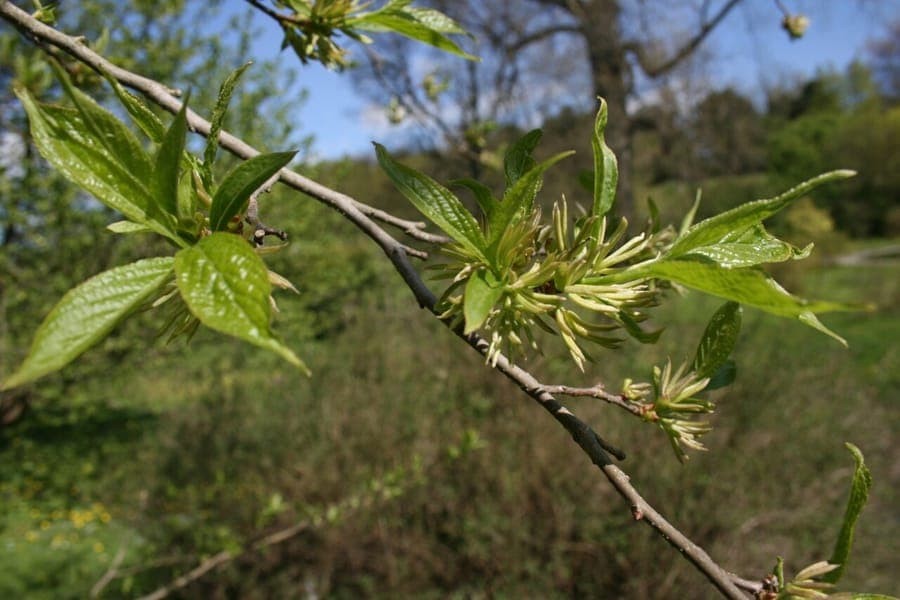
Sten Porse / CC BY-SA 3.0, via Wikimedia Commons
Eucommia ulmoides: complete guide
Eucommia ulmoides
¿Quieres ver Eucommia ulmoides: complete guide en tu jardín?
1 minuto, sin tarjeta de crédito
Overview
Eucommia ulmoides, commonly known as gutta-percha tree or du zhong in Chinese, is a unique tree from the monotypic Eucommiaceae family. Native to Central and South China, this remarkable tree has been used in traditional Chinese medicine for centuries. The tree is notable for its elastic, rubber-like sap present within leaves and stems.
This is a relatively rare tree in Western gardens, making it an intriguing choice for collectors and ethnobotanical plant enthusiasts. In its native habitat, the tree grows larger, but in temperate climates, it typically reaches 12-15 meters tall.
Appearance and bloom
Eucommia ulmoides features attractive, ovate to lance-shaped leaves arranged alternately along branches. The foliage is bright green, smooth-margined, and exhibits interesting architectural structure. A unique characteristic: breaking a leaf reveals fine threads of elastic gutta-percha-like material inside.
Flowers are inconspicuous: small, greenish blooms appear in early spring before leaves emerge. Male and female flowers occur on the same tree. Following pollination, small two-winged fruits (samaras) develop, displaying interesting spiral-descent patterns when released.
Ideal location
Eucommia ulmoides enjoys full sun to light shade. Minimum 6 hours of direct sunlight daily promotes optimal growth and leaf development. The tree is adaptable and performs well in open garden settings.
It suits large gardens and parks, though younger trees grow well in large containers. The tree appeals to contemporary gardeners for its interesting architectural form and unique properties.
Soil
Eucommia ulmoides is reasonably flexible with soil types but prefers well-drained, moderately fertile soil. Soil pH from 5.5 to 7.5 is ideal. The tree tolerates both acidic and alkaline soils.
In containers, use quality tree-growing compost mixed with coarse sand or perlite. The tree thrives in moderately fertile soil; excessive feeding is unnecessary.
After planting, apply 5-7 cm mulch around roots to aid moisture retention.
Diseño gratis
¿Quieres ver Eucommia ulmoides: complete guide en tu jardín? Crea un diseño gratis ahora.
Watering
Eucommia ulmoides enjoys regular watering during the growing season, especially in the first two years. Water deeply but allow soil to dry slightly between waterings. Excessive watering causes root rot.
Mature trees tolerate drought stress very well. In containers, water moderately, ensuring soil can recover between waterings.
In winter, minimal watering is needed when the tree is bare.
Pruning
Pruning is not mandatory, but you may remove dead wood and shape the canopy. Make pruning cuts in late winter (February-March) before growth starts. The tree recovers slowly from heavy pruning; avoid this.
Young trees can be lightly pinched to promote bushier forms.
Maintenance calendar
Spring (March-May): Primary growing season. Apply balanced tree fertilizer once in March. Water regularly. Leaf drop is past; new foliage emerges.
Summer (June-August): Full growth period. Regular watering during dry spells. No fertilizer needed. Tree prepares for next season's bloom.
Autumn (September-October): Growth slows. Reduce watering. No feeding. Leaf fall begins in October-November.
Winter (November-February): Tree is bare and dormant. Minimal watering. This is opportunity for pruning work if needed.
Winter hardiness
Eucommia ulmoides is hardy to approximately -10 to -15degC (USDA zone 8-9). This makes it suitable for the Netherlands, Belgium, and northern France under normal winter conditions.
Young trees may suffer frost damage; protect in early winters with wrapping material. Established trees are very winter-hardy.
In severe winters, minor twig damage may occur, but the tree recovers well.
Companion plants
Eucommia ulmoides combines well with other deciduous trees and shrubs featuring interesting architectural forms. Group with other Asian trees for intriguing climate-specific effects.
The tree also works as a solo accent in large gardens.
Underplant with shade-tolerant groundcovers for winter interest.
Conclusion
Eucommia ulmoides is a fascinating choice for ethnobotanical plant enthusiasts and collectors of unusual trees. Though not widely available, searching for nurseries specializing in Asian trees is worthwhile. The tree offers year-round interest through its architectural form and unique gutta-percha properties.
Explore gardenworld.app for other rare and medicinal trees suited to your region.
¿Quieres ver Eucommia ulmoides: complete guide en tu jardín? Crea un diseño gratis ahora.
Sube una foto, elige un estilo y obtén un diseño fotorrealista con lista de plantas en menos de un minuto.
Más de 10.000 jardines diseñados
Sin tarjeta de crédito


Plantas similares
Acer pycnanthum: complete guide
Acer pycnanthum
Acer pycnanthum, the Japanese swamp maple, is a fast-growing tree with early red flowers and brilliant autumn color, ideal for damp garden settings.
Freeman maple: complete guide
Acer × freemanii
Everything about the Freeman maple (Acer x freemanii): a fast-growing shade tree with spectacular autumn colour for large gardens.
Silver vine: complete guide
Actinidia polygama
Discover silver vine (Actinidia polygama): a hardy climbing plant with silvery foliage, loved by gardeners and cats alike.