
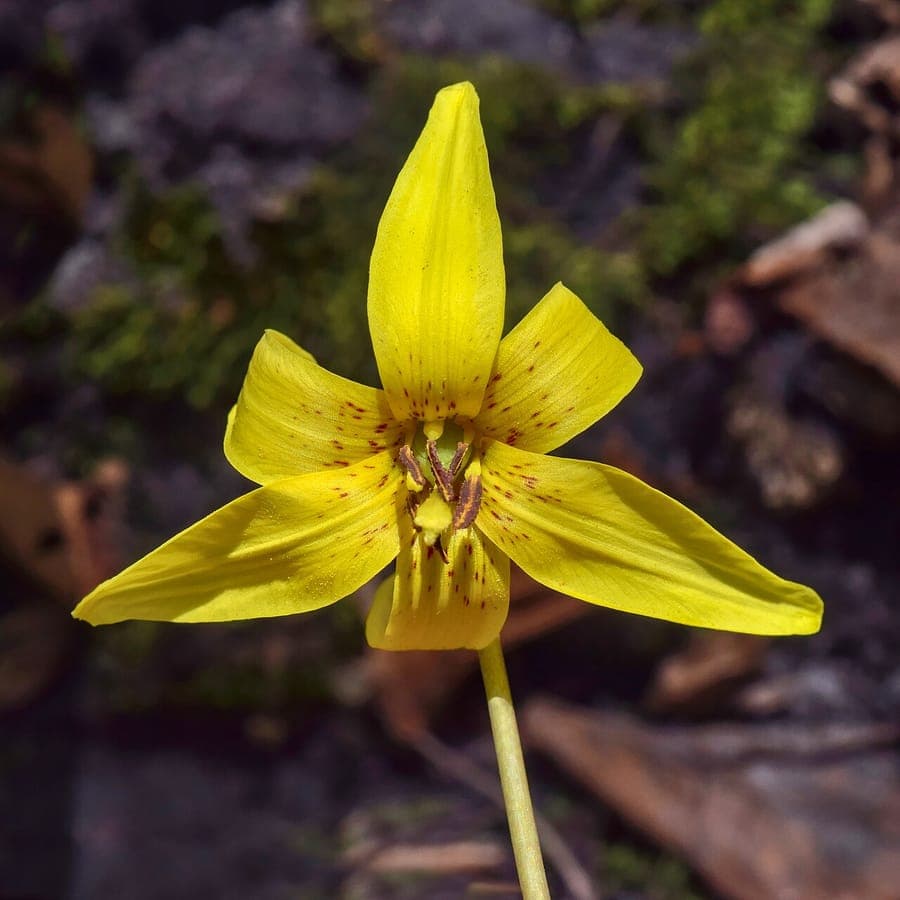
The Cosmonaut / CC BY-SA 2.5 ca, via Wikimedia Commons
Erythronium americanum: complete guide
Erythronium americanum
¿Quieres ver Erythronium americanum: complete guide en tu jardín?
1 minuto, sin tarjeta de crédito
Overview
Erythronium americanum, known as Trout-Lily, American Trout Lily, Dogtooth Violet, Yellow Adder's-Tongue, and Ostamerikanischer Hundszahn, is an elegant spring bloomer from North America. This woodland plant naturally inhabits shaded forests from Canada to North Carolina.
Belonging to the Liliaceae family (lily family), Erythronium americanum distinguishes itself through its unique, mottled foliage and yellow, tulip-like flowers. The plant derives its common name from its tooth-shaped bulbs.
Appearance & Bloom
American Trout-Lily grows only 15-25 cm tall and forms clusters of two marbled green leaves with red-brown mottling. From April through May, elegant, yellow flowers appear nodding downward like little dancers.
Each bloom features six curved petals and stands out through graceful form. The plant spreads slowly via underground bulbs and forms beautiful carpets after many years.
Ideal Location
Give Erythronium americanum a spot in dappled to full shade, preferably beneath deciduous trees. This woodland plant thrives in shaded forest edges, beneath shrubs, and in shadowy garden corners.
The plant appreciates woodland settings and flourishes where light is limited. Combine with other woodland standouts like ferns, Helleborus, and Trillium for natural woodland atmosphere.
Soil Requirements
Erythronium americanum demands loose, humus-rich woodland soil with good drainage. A blend of peat moss, leaf mold, and sand (in ratio 2:2:1) works ideally. The plant prefers acidic to neutral terrain (pH 5.5-7.0).
Add generous compost during planting to improve soil texture. The plant grows better in rich, nutrient-rich soils than in lean earth.
Diseño gratis
¿Quieres ver Erythronium americanum: complete guide en tu jardín? Crea un diseño gratis ahora.
Watering
Erythronium americanum requires regularly moist soil during growth and bloom periods (March-June). Water regularly, especially if it becomes dry. In summer, when the plant goes dormant, watering may be greatly reduced.
In fall and winter, the plant prefers lightly moist soil over dry conditions. Consistent moisture uptake without waterlogging is preferred.
Pruning
Erythronium americanum requires no pruning. Allow flowers and leaves to fully emerge and die back naturally. This helps the plant store energy in bulbs for next season.
Remove only completely dead foliage carefully. Leave seed heads intact for natural seed dispersal.
Maintenance Calendar
May-August: Leaves die back, plant rests. August-October: Bulbs develop underground. October-March: Cold period needed for bloom. April-May: Bloom and leaf development. June-July: Plant disappears above ground.
Winter Hardiness
Erythronium americanum is extremely cold-hardy to -20°C and thrives in cold winter climates. The plant actually benefits from cold winters because the cold period is required for bloom induction.
In mild climates the plant may survive without difficulty, but less bloom may be experienced. A layer of mulch in winter protects irregularities in very severe frosts.
Companion Plants
Pair Erythronium americanum with other woodland standouts like Helleborus, Anemone, Trillium, Epimedium, and Astilbe. Add low-growing ferns for texture and greenery. These combinations form natural, woodland plant schemes.
Integrate sedges like Carex and Luzula for variation. These compositions create versatile, low-maintenance woodland gardens.
Closing
Erythronium americanum brings authentic spring magic into your shaded garden - yellow flowers above marbled foliage. Seek bulbs at nurseries or online retailers. gardenworld.app helps you design beautiful woodland scenes. gardenworld.app offers personalized plant advice.
¿Quieres ver Erythronium americanum: complete guide en tu jardín? Crea un diseño gratis ahora.
Sube una foto, elige un estilo y obtén un diseño fotorrealista con lista de plantas en menos de un minuto.
Más de 10.000 jardines diseñados
Sin tarjeta de crédito


Plantas similares
Reverchon's gagea: complete guide
Gagea reverchonii
Full guide to Gagea reverchonii, Reverchon's gagea: rare Pyrenean bulb with bright yellow spring flowers, soil needs and companion planting.
Leafy gagea: complete guide
Gagea foliosa
Gagea foliosa is a rare Mediterranean bulb with bright yellow star-shaped flowers blooming February to March in well-drained rocky settings.
Tubular gagea: complete guide
Gagea fragifera
Gagea fragifera is a mountain bulb with golden-yellow star flowers blooming May to July on subalpine slopes from Europe to the Himalaya.