
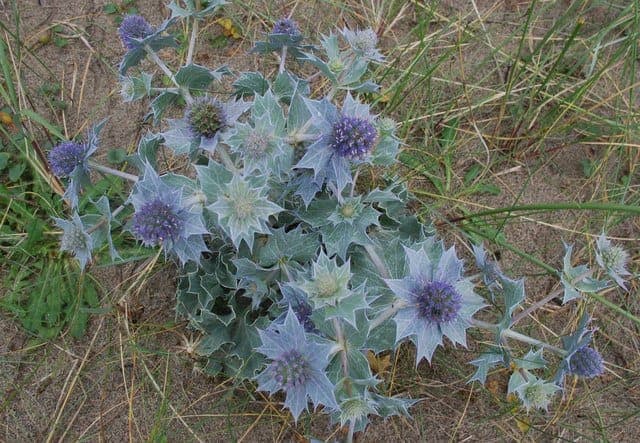
Alan Fryer / CC BY-SA 2.0, via Wikimedia Commons
Sea Eryngo: complete guide
Eryngium maritimum
¿Quieres ver Sea Eryngo: complete guide en tu jardín?
1 minuto, sin tarjeta de crédito
Overview
Sea eryngo (Eryngium maritimum) is a fascinating specialized coastal plant from the carrot family (Apiaceae). This distinctive species grows along all European coastlines and is renowned for its remarkable blue-green foliage and silvery-white flowers in sharp spiky knobs. With sand-binding roots and succulent foliage, sea eryngo makes a perfect choice for sandy gardens and coastal developments on gardenworld.app.
This is a plant that plays with marine-ecological tension: robustness with elegance.
Appearance and Bloom
Sea eryngo is characterized by:
- Leaves: Blue-green, fleshy, wavy, by far the most striking feature
- Stems: Blue-green tinted, short, woody
- Flowers: June through August, silvery-white spiky knobs (8-12 mm)
- Growth: 20-40 cm tall, 30 cm wide, dense compact form
- Persistence: Foliage remains winter-attractive
Color development is subtle: blue-green in summer, then silvery with red tints in autumn. Flowers provide seed food and nectar simultaneously.
Ideal Location
Sea eryngo grows best in:
- Full sun, hot locations (minimum 7 hours sun)
- Coastal areas with sea breeze (plant tolerates salt spray excellently)
- Sandy or gravelly, perfectly drained soils
- Elevated positions on rooftops or raised borders
- Ideal for gardenworld.app designs in coastal style
Soil
- Type: Sandy, very well-draining soil
- Moisture: Very dry; true sand-lover
- pH: Neutral to slightly alkaline (7.0-7.5)
- Salt: Tolerates coastal salt spray excellently
- Preparation: Pure sand or sandy mix; no clay
Watering
- First season: Very limited; support only during establishment
- Established: Completely dry; no supplemental water needed
- Summer: Zero moisture management; plant dies from excess water
- Winter: Keep dry
- Warning: Overwatering is the #1 cause of death
Diseño gratis
¿Quieres ver Sea Eryngo: complete guide en tu jardín? Crea un diseño gratis ahora.
Pruning and Maintenance
- No pruning required; plant grows compact naturally
- Seed heads until October; prune to prevent self-seeding
- Remove aged foliage in March
- Extremely minimal maintenance, especially drought-tolerant form
- Winter: Foliage remains decorative, don't prune
Maintenance Calendar
| Month | Activity |
|---|---|
| Jan-Feb | None; plant dormant |
| Mar-Apr | Remove old foliage |
| May-Jun | Begin growth care, prepare for bloom |
| Jul-Aug | Bloom; no maintenance |
| Sep-Oct | Prune seed heads to prevent self-seeding |
| Nov-Dec | Winter rest; foliage remains |
Winter Hardiness
- USDA zone: 5b-9a (down to -26°C, extremely hardy)
- Preparation: None required; fully winter-hardy
- Salt wind tolerance: Excellent; higher than most plants
- Frost damage: Minimal; foliage remains intact
- Sea breeze advice: Perfect in coastal breeze climate
Companion Plants
Sea eryngo combines beautifully with:
- Sea kale (Crambe maritima)
- Sea sandwort (Honkenya peploides)
- Centaury (Centaurium erythraea)
- Sea milkwort (Glaux maritima)
- Buttonweed (Cotula coronopifolia)
Avoid moisture-lovers and leaf-mold plants entirely.
Final Thoughts
Sea eryngo is the specialist of coastal developments. Its blue-green foliage and minimal maintenance make it indispensable for gardenworld.app gardens in beach areas. Plant in clusters of 3-5 for maximum sea-breeze graphics, and you'll see how this plant dances with coastal winds rather than suffering from them. Expect subtle flower color - sea eryngo works through its unique foliage color and seaside elegance.
¿Quieres ver Sea Eryngo: complete guide en tu jardín? Crea un diseño gratis ahora.
Sube una foto, elige un estilo y obtén un diseño fotorrealista con lista de plantas en menos de un minuto.
Más de 10.000 jardines diseñados
Sin tarjeta de crédito

