
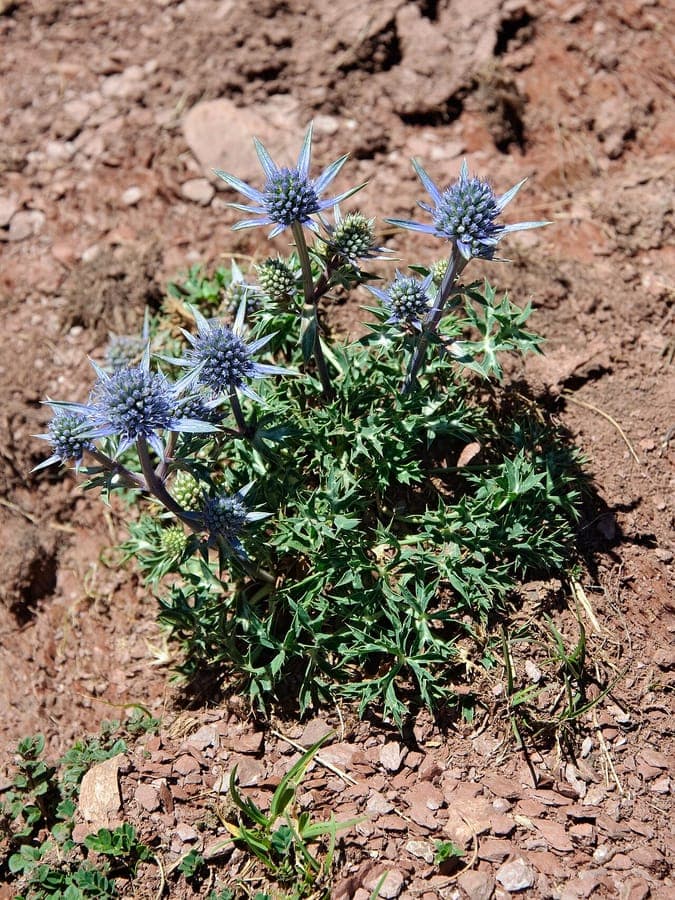
Myrabella / CC BY-SA 3.0, via Wikimedia Commons
Eryngium bourgatii: complete guide
Eryngium bourgatii
¿Quieres ver Eryngium bourgatii: complete guide en tu jardín?
1 minuto, sin tarjeta de crédito
Overview
Eryngium bourgatii, commonly known as the Pyrenean eryngo, is a remarkable perennial originating from the mountainous regions spanning the Pyrenees to Morocco. This plant belongs to the Apiaceae family (carrot family) and is celebrated for its striking metallic blue flower heads and distinctive silvery-blue foliage. It is an excellent choice for gardens requiring architectural character and texture, particularly for gardeners seeking resilient, low-maintenance plants.
The Pyrenean eryngo is not only visually striking but also exceptionally practical. It establishes effortlessly in sunny, dry corners of your garden and demands minimal care once established. This makes it an ideal solution for Mediterranean gardens, gravel gardens, or borders where you want something bold and long-lasting to capture attention.
Appearance and Bloom
The plant reaches heights of 30-60 cm and forms compact, densely-foliaged rosette patterns. What truly sets it apart, however, are the flower heads - spherical, metallic blue inflorescences that bloom from July through August and persist for many months afterward. These flowers are not merely a visual treat but also irresistible to pollinators.
The leaves are deeply dissected, almost finely cut, with a characteristic grey-green tone and often a bluish waxy coating. In their growth stage, they appear almost succulent-like, beautiful both in form and texture.
Following bloom, interesting seed capsules develop and remain ornamentally valuable for many months. This means your plant remains interesting from summer deep into autumn and provides structural interest even in winter.
Ideal Location
The Pyrenean eryngo demands full sunlight - at least 6 to 8 hours of direct daily sun. In warmer regions, you may provide light afternoon shade, but less than this will compromise flowering. It prefers elevated, windy locations where the plant experiences good air circulation.
It performs excellently in borders, Mediterranean gardens, gravel gardens, and even containers on terraces. It works equally well as a solitary accent among low-growing plants or as structural interest against a wall.
Soil
The critical component of successful cultivation is soil with exceptional drainage. Poorly draining soil is absolutely detrimental - it inevitably leads to root rot. Ensure your soil is amended with sand, gravel, or other organic material for proper drainage.
The plant is undemanding regarding nutrients. On poor, stony terrain it actually thrives best. A pH between 7.5 and 8 (neutral to slightly alkaline soil) is ideal, though it tolerates slightly acidic conditions.
Avoid heavy compost or leaf mold additions - this encourages excessive growth and weakens the plant. A thin layer of gravel or stone chippings keeps the soil around the plant's crown cool and dry.
Diseño gratis
¿Quieres ver Eryngium bourgatii: complete guide en tu jardín? Crea un diseño gratis ahora.
Watering
Once established, Eryngium bourgatii is extremely drought-tolerant and requires virtually no supplemental watering - unless you experience an exceptionally dry period. In fact, overwatering poses a greater risk than underwatering.
During the first season immediately after planting, you may water carefully until the root system is fully established. Subsequently, rainwater usually suffices. Err on the side of underwatering; this plant is genuinely a drought specialist adapted to mountain environments.
In container cultivation, you'll need to water more frequently, but always ensure perfect drainage - use grit-rich potting soil with drainage holes.
Pruning
Pruning here is straightforward. In autumn or early winter, remove spent, brown flower stems if desired. Many gardeners, however, leave them standing throughout winter for their structural value.
Remove damaged foliage and clear away dead matter. Otherwise, these plants rarely require pruning - they maintain neat form naturally.
Maintenance Calendar
April-May: Check drainage in the soil and add sand or gravel if needed. June-July: Ensure full sun exposure. Enjoy the first blooms. August-September: Flowers reach peak beauty. No maintenance required. October-November: Leave dead flower heads standing for winter interest. December-March: Plant rests. Minimal watering, no pruning.
Winter Hardiness
Eryngium bourgatii is extremely hardy, tolerating temperatures down to at least -15-20°C. This means it overwintersoutdoors without difficulty throughout the Netherlands and Belgium. The plant retains its foliage and provides structural interest even in winter.
In very wet, heavy clay soil, winter damage from rot is possible - ensure good drainage. Otherwise, worry not: this is a resilient, tenacious plant.
Companion Plants
The Pyrenean eryngo thrives alongside other drought-tolerant, Mediterranean plants:
- Lavender and sage
- Other eryngiums (such as E. alpinum)
- Sea lavender (Limonium) and static
- Stonecrops (Sedum)
- Stipa and other ornamental grasses
- Santolina and other silver-foliaged plants
These combinations create harmonious, well-supported gravel or Mediterranean gardens with extended flowering periods and minimal maintenance.
Closing Thoughts
For many gardeners, Eryngium bourgatii is a revelation. Here is a plant that is beautiful, hardy, demands minimal attention, and is genuinely useful for insects. Whether you desire a Mediterranean garden, a gravel garden, or simply a location full of character, this eryngo deserves a place.
Available at Intratuin and Gamma. Discover more garden inspiration at gardenworld.app and make your front yard unique and low-maintenance. Read more guides at gardenworld.app for additional ideas on hardy groundcover solutions.
¿Quieres ver Eryngium bourgatii: complete guide en tu jardín? Crea un diseño gratis ahora.
Sube una foto, elige un estilo y obtén un diseño fotorrealista con lista de plantas en menos de un minuto.
Sin tarjeta de crédito


Plantas similares
Whorled carrot: complete guide
Daucus involucratus
Daucus involucratus is a Mediterranean umbellifer with white flower heads framed by lacy bracts. Growing this gravel garden gem.
Daucus muricatus: complete guide
Daucus muricatus
Daucus muricatus, the spiny wild carrot, grows wild on Mediterranean coasts. Discover sowing, June-July bloom, and wildflower meadow use.
Daucus pumilus: complete guide
Daucus pumilus
Daucus pumilus is a dwarf wild carrot relative with white lacy umbels, thriving on dunes and coastal rock in poor, fast-draining soil.